
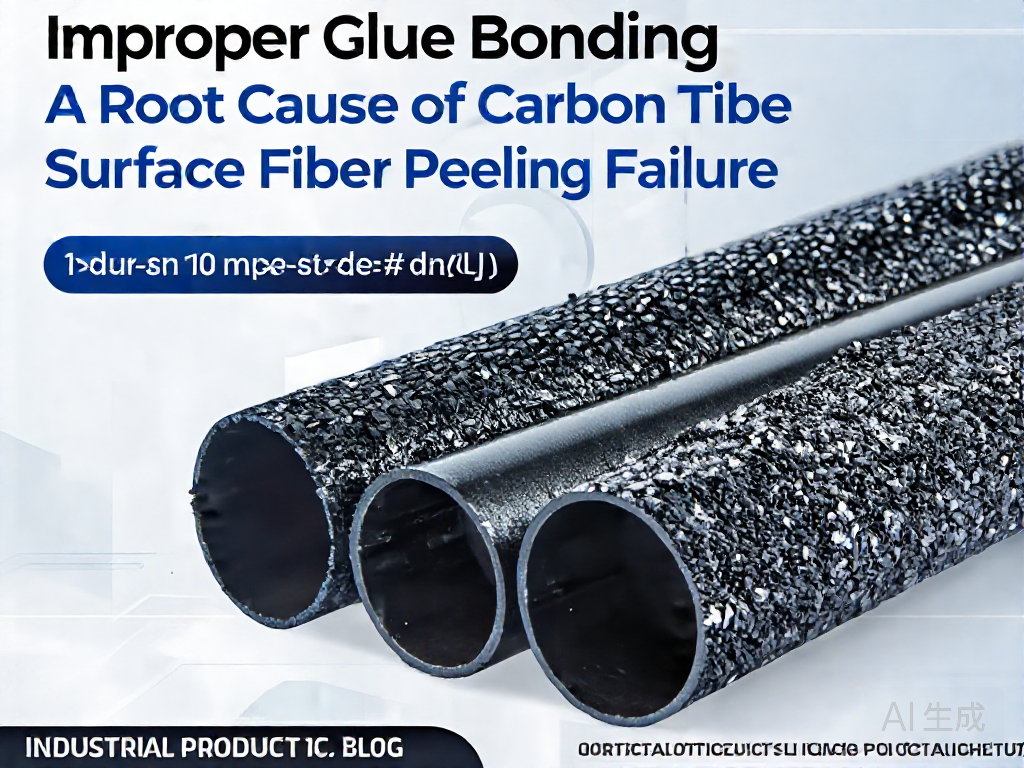
# Improper Glue Bonding: A Root Cause of Carbon Tube Surface Fiber Peeling Failure
Carbon fiber reinforced polymer (CFRP) tubes are widely used in aerospace, automotive, and sports equipment due to their high strength-to-weight ratio. However, surface fiber peeling failure can significantly compromise their performance and aesthetics. One of the primary causes of this failure is improper glue bonding during manufacturing or assembly. This article examines how improper adhesive bonding leads to fiber peeling, the mechanisms involved, and preventive measures to ensure reliable carbon tube performance.
## Understanding Carbon Tube Surface Fiber Peeling
Fiber peeling refers to the detachment of carbon fibers from the resin matrix or the separation of layers within the composite. It often manifests as fraying, delamination, or flaking on the tube surface. While mechanical damage is a common cause, improper adhesive bonding during joining or coating processes is a frequently overlooked root cause.
### The Role of Adhesive Bonding in Carbon Tubes
Adhesive bonding is used to join carbon tubes to metallic fittings, attach components, or apply protective coatings. The adhesive must form a strong, durable bond with the carbon fiber surface. When bonding is improper, stress concentrations develop, leading to localized failure that can propagate as fiber peeling.
## Mechanisms of Improper Glue Bonding Leading to Fiber Peeling
Several bonding-related factors can initiate fiber peeling:
### 1. Inadequate Surface Preparation
Carbon fiber surfaces are often contaminated with mold release agents, oils, or dust. Without proper cleaning and surface treatment (e.g., abrasion, plasma treatment), the adhesive cannot achieve adequate adhesion. The bond fails at the interface, and peeling stresses cause fibers to detach.
### 2. Incorrect Adhesive Selection
The adhesive must be compatible with the carbon fiber and the mating material. Using an adhesive with mismatched modulus or thermal expansion coefficient can lead to stress concentrations at the bond line. Over time, these stresses cause microcracks that propagate into the composite, resulting in fiber peeling.
### 3. Improper Adhesive Application
Inconsistent adhesive thickness, air entrapment, or incomplete coverage can create weak points. These defects act as stress raisers, and under load, the bond fails locally, pulling fibers away from the matrix.
### 4. Inadequate Curing
Insufficient curing temperature, time, or pressure can result in under-cured adhesive with poor mechanical properties. The bond may not develop full strength, leading to premature failure and fiber peeling.
### 5. Environmental Factors
Moisture, temperature fluctuations, and chemical exposure can degrade the adhesive bond over time. If the bond weakens, peeling stresses can cause fiber detachment.
## Case Study: Peeling Failure in a Carbon Tube Assembly
In a recent industrial case, carbon tubes bonded to aluminum inserts exhibited surface fiber peeling after field use. Investigation revealed that the bonding process lacked proper surface abrasion and cleaning, and the adhesive was applied in a humid environment. The result was poor adhesion, leading to interfacial failure and subsequent fiber peeling. This highlights the criticality of controlled bonding processes.
## Preventive Measures for Reliable Adhesive Bonding
To prevent fiber peeling caused by improper glue bonding, manufacturers should implement the following measures:
### 1. Strict Surface Preparation Protocols
– Clean and degrease surfaces with appropriate solvents.
– Use mechanical abrasion or plasma treatment to enhance adhesion.
– Ensure surfaces are dry and free of contaminants before bonding.
### 2. Adhesive Selection and Validation
– Choose adhesives specifically designed for carbon fiber composites.
– Validate adhesive performance through lap shear and peel tests.
– Consider environmental resistance and thermal expansion compatibility.
### 3. Controlled Application and Curing
– Use automated dispensing for consistent adhesive thickness.
– Avoid air entrapment by applying uniform pressure.
– Follow recommended curing schedules with precise temperature and time control.
### 4. Quality Inspection and Testing
– Implement non-destructive testing (e.g., ultrasonic inspection) to detect voids or weak bonds.
– Perform destructive tests on coupons to verify bond strength.
– Conduct regular audits of the bonding process.
### 5. Environmental Controls
– Maintain controlled humidity and temperature during bonding.
– Protect bonded joints from moisture and chemicals in service.
## Conclusion
Improper glue bonding is a significant but preventable cause of carbon tube surface fiber peeling failure. By understanding the mechanisms and implementing rigorous bonding protocols, manufacturers can enhance the reliability and longevity of carbon fiber tubes. Attention to surface preparation, adhesive selection, application, curing, and inspection is essential to mitigate this failure mode and ensure product quality.
By addressing these factors, industries can reduce costly failures and maintain the performance advantages of carbon fiber composites.