
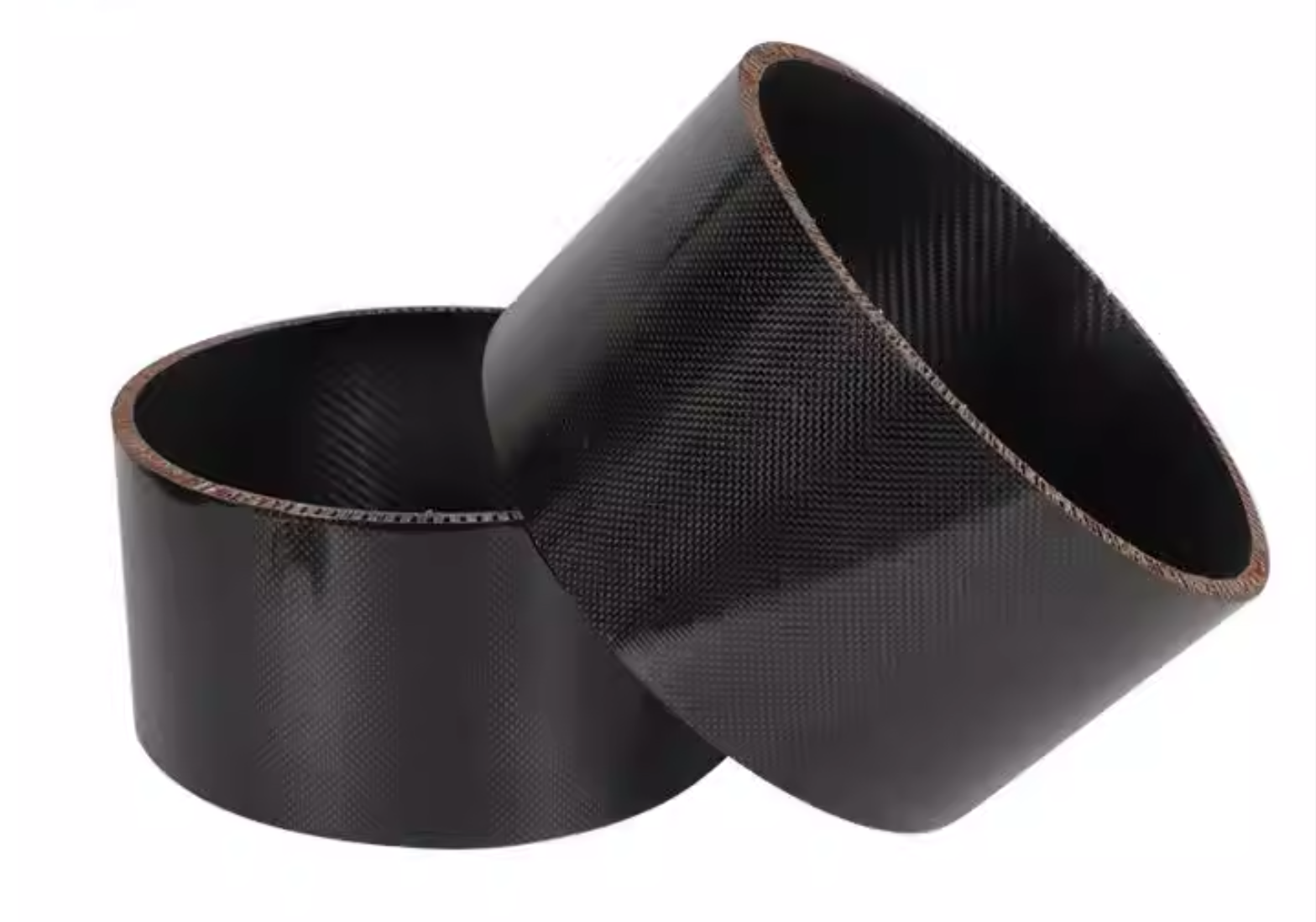
Carbon fiber hollow tubes are widely used in aerospace, automotive, robotics, and medical devices due to their high strength-to-weight ratio and stiffness. However, their inner wall surface often exhibits high friction coefficients, which can hinder the movement of cables, fluids, or mechanical components passing through. Low friction inner wall modification technology addresses this limitation by reducing surface roughness and altering surface chemistry. This article explores the key methods, benefits, and industrial applications of this technology.
**Why Low Friction Inner Walls Matter**
In many applications, carbon fiber tubes serve as conduits for pneumatic lines, electrical wiring, or drive shafts. A high friction inner surface can cause wear on moving parts, increase energy consumption, and lead to premature failure. For example, in robotic arms, cables sliding through the tube experience resistance, reducing precision and speed. In medical catheters, friction can cause tissue damage or hinder the smooth delivery of instruments. Therefore, achieving a low friction inner wall is critical for performance, durability, and safety.
**Modification Techniques**
Several technologies are employed to reduce friction on the inner walls of carbon fiber hollow tubes:
1. **Polishing and Abrasive Flow Machining (AFM)** – This mechanical method uses abrasive particles suspended in a viscous fluid that is forced through the tube. The abrasive action smooths out microscopic peaks and valleys, reducing surface roughness (Ra) from several micrometers to below 0.2 µm. AFM is particularly effective for long, slender tubes where conventional polishing is impossible.
2. **Chemical Vapor Deposition (CVD) of Diamond-Like Carbon (DLC)** – DLC coatings are applied to the inner surface via CVD at low temperatures. DLC offers a friction coefficient as low as 0.05–0.1, along with high hardness and wear resistance. The coating conforms to complex geometries, ensuring uniform coverage inside the tube.
3. **PTFE (Polytetrafluoroethylene) Lining** – A thin layer of PTFE can be applied as a dispersion or film. PTFE has one of the lowest static friction coefficients (0.04) and excellent chemical resistance. However, adhesion to carbon fiber can be challenging; surface pre-treatment with plasma or chemical etching is often required.
4. **Electroless Nickel with Embedded PTFE (Ni-PTFE)** – This composite coating combines the hardness of nickel with the lubricity of PTFE. It is deposited via electroless plating, providing a uniform, corrosion-resistant layer with a friction coefficient around 0.1–0.15. This method is cost-effective for large batches.
5. **Plasma-Enhanced Chemical Vapor Deposition (PECVD) of Silicone or Fluoropolymers** – PECVD allows for the deposition of ultra-thin (100–500 nm) low-friction films. These films reduce friction without significantly altering the tube’s inner diameter, which is crucial for tight-tolerance applications.
**Process Considerations**
– **Surface Preparation:** The inner wall must be clean and free of release agents or debris. Plasma cleaning or solvent washing is typically performed before coating.
– **Uniformity:** For long tubes, ensuring even coverage is challenging. Techniques like pulsed flow or rotating magnetic fields are used to enhance deposition uniformity.
– **Adhesion:** Carbon fiber surfaces are relatively inert. Plasma activation or silane coupling agents improve the bonding of coatings.
– **Thickness Control:** Overly thick coatings can reduce the inner diameter, affecting flow rates or cable clearance. Precise process control is essential.
**Performance Benefits**
– **Reduced Friction Coefficient:** From 0.3–0.5 (unmodified) down to 0.05–0.1, depending on the method.
– **Improved Wear Resistance:** DLC and Ni-PTFE coatings extend the lifespan of both the tube and the components passing through.
– **Enhanced Flow Efficiency:** Lower friction reduces pressure drop in pneumatic or hydraulic systems.
– **Corrosion Protection:** Many coatings also provide a barrier against moisture and chemicals, which is beneficial in harsh environments.
**Industrial Applications**
– **Aerospace:** Fuel lines and control cables in aircraft benefit from reduced friction and weight savings.
– **Robotics:** Tendon-driven robots use carbon fiber tubes with low-friction inner walls to enable smooth, precise movement of cables.
– **Medical Devices:** Endoscopic instruments and catheters require low friction to minimize patient trauma and improve maneuverability.
– **Automotive:** Drive shafts and brake lines with low-friction inner surfaces reduce energy losses and improve response times.
– **Textile Machinery:** Thread guides and pneumatic transport tubes operate more efficiently with reduced friction.
**Future Trends**
Research is focusing on self-lubricating composites that integrate solid lubricants (e.g., MoS2 or graphite) into the carbon fiber matrix during manufacturing. This eliminates the need for post-processing coatings. Additionally, laser surface texturing is being explored to create micro-patterns that trap lubricants, further reducing friction. These innovations promise even lower friction coefficients and longer service life.
**Conclusion**
Low friction inner wall modification technology is essential for maximizing the performance of carbon fiber hollow tubes in demanding applications. By selecting the appropriate method—whether mechanical polishing, DLC coating, or PTFE lining—manufacturers can achieve significant improvements in efficiency, durability, and reliability. As technology advances, we can expect more integrated and durable solutions that will expand the use of carbon fiber tubes across industries.