
# Semi-Gloss Intermediate Finish Carbon Tube: Balancing Texture and Scratch Resistance
## Introduction
In the world of high-performance composites, carbon fiber tubes have become indispensable across aerospace, automotive, sports equipment, and industrial machinery. While much attention is given to mechanical properties like strength and stiffness, the surface finish plays a critical role in both aesthetics and durability. Among the various finish options, the semi-gloss intermediate finish has emerged as a preferred choice for many engineers and designers. This article explores how semi-gloss intermediate finishes on carbon tubes achieve an optimal balance between visual texture and scratch resistance, and why this balance matters in real-world applications.
## Understanding Carbon Tube Finishes
Carbon fiber tubes are typically available in three main finish categories: matte, semi-gloss (also called satin), and high-gloss. Each finish is achieved through different surface treatment processes, including sanding, coating, and polishing.
– **Matte finish:** Offers a non-reflective, understated look but tends to show fingerprints and can be more susceptible to surface marks.
– **High-gloss finish:** Provides a mirror-like, reflective surface that highlights the carbon weave but is prone to showing scratches and requires frequent cleaning.
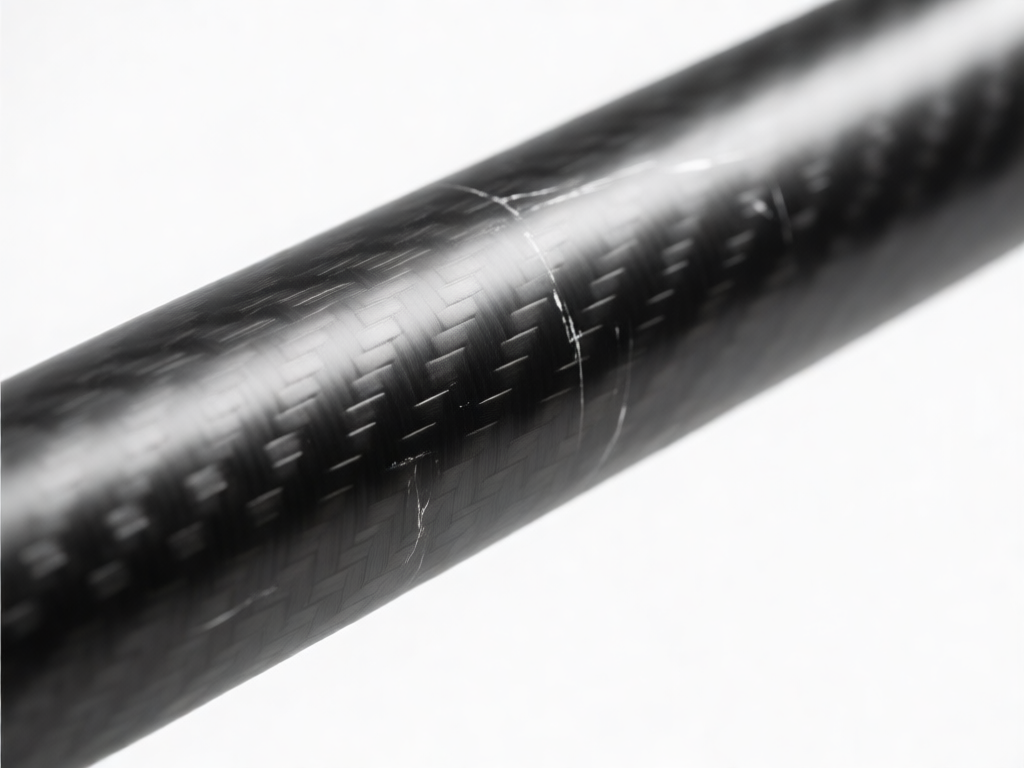
– **Semi-gloss intermediate finish:** Strikes a middle ground, offering a subtle sheen that enhances the depth of the carbon weave while providing practical durability.
The semi-gloss finish is often referred to as an “intermediate” finish because it sits between the extremes of matte and high-gloss. It is typically achieved by applying a clear coat with specific additives or by mechanically abrading a high-gloss surface to a uniform satin sheen.
## The Science of Texture and Scratch Resistance
The surface texture of a carbon tube is determined by the topcoat’s microstructure. In a semi-gloss finish, the texture is carefully controlled to scatter light in a way that produces a soft, satin appearance without completely diffusing reflections.
### How Texture Affects Scratch Visibility
Scratches become visible when they disrupt the uniformity of light reflection. On a high-gloss surface, even a microscopic scratch creates a noticeable line because it contrasts sharply with the surrounding smooth surface. On a matte surface, the inherent roughness can mask fine scratches, but deeper scratches may still stand out. A semi-gloss finish, with its intermediate level of texture, offers a compromise: it hides minor scratches better than high-gloss while maintaining a more refined look than matte.
### Enhancing Scratch Resistance Through Chemistry
Beyond texture, the chemical composition of the finish plays a vital role in scratch resistance. Modern semi-gloss finishes often incorporate nano-particles or ceramic additives that increase surface hardness without sacrificing flexibility. These additives create a cross-linked network that resists abrasion and impact, making the tube more durable in harsh environments.
## Manufacturing Process for Semi-Gloss Intermediate Finish
Achieving a consistent semi-gloss finish requires precise control throughout the manufacturing process. Here are the key steps:
1. **Surface Preparation:** The carbon tube is first sanded to remove imperfections and create a uniform base. This step is crucial for adhesion and final appearance.
2. **Primer Application:** A primer may be applied to fill pores and enhance bonding of the topcoat.
3. **Topcoat Application:** A clear coat formulated for semi-gloss is sprayed or dipped onto the tube. The thickness and curing conditions are carefully monitored.
4. **Controlled Curing:** The coating is cured under specific temperature and humidity to achieve the desired cross-linking and hardness.
5. **Surface Texturing:** In some processes, a mechanical or chemical texturing step is employed to fine-tune the gloss level.
6. **Quality Control:** Each tube is inspected for gloss uniformity, texture consistency, and scratch resistance using standardized tests.
## Balancing Texture and Scratch Resistance: Key Considerations
Designers and manufacturers must consider several factors to achieve the ideal balance:
– **Application Environment:** For outdoor or high-wear applications, scratch resistance may be prioritized, leading to a slightly higher gloss level. For aesthetic applications, texture may be more important.
– **Carbon Weave Visibility:** A semi-gloss finish enhances the three-dimensional appearance of the carbon weave, making it more pronounced than in matte but less stark than in high-gloss.
– **Maintenance Requirements:** Semi-gloss surfaces are easier to clean than matte and show fewer marks than high-gloss, reducing long-term maintenance costs.
– **Cost:** The additional processing steps for a semi-gloss finish can increase cost, but the durability benefits often justify the investment.
## Testing and Standards
To ensure that a semi-gloss intermediate finish meets performance requirements, several tests are commonly performed:
– **Gloss Meter Measurement:** Quantifies the gloss level in gloss units (GU), typically ranging from 20 to 60 GU for semi-gloss.
– **Pencil Hardness Test:** Assesses the coating’s resistance to scratching.
– **Taber Abrasion Test:** Measures wear resistance under abrasive conditions.
– **Adhesion Test:** Ensures the coating bonds well to the carbon substrate.
– **Visual Inspection:** Checks for uniformity and defects.
These tests help manufacturers guarantee that the finish will perform as expected in its intended application.
## Applications and Benefits
The semi-gloss intermediate finish is particularly valued in:
– **Aerospace:** Where both aesthetics and durability are critical for interior and exterior components.
– **Automotive:** For decorative and functional parts like drive shafts and trim.
– **Sports Equipment:** Bicycle frames, golf shafts, and fishing rods benefit from the combination of looks and toughness.
– **Industrial Machinery:** Rollers and robotic arms require a finish that can withstand frequent handling and abrasion.
The benefits are clear: enhanced visual appeal, improved scratch resistance, reduced maintenance, and extended service life.
## Conclusion
The semi-gloss intermediate finish on carbon fiber tubes represents a sophisticated solution that balances texture and scratch resistance. By carefully controlling the surface microstructure and chemistry, manufacturers can deliver tubes that not only look professional but also withstand the rigors of real-world use. As carbon fiber continues to penetrate new markets, the demand for such optimized finishes will only grow, driving further innovation in coating technologies.