
## Introduction
Fiber-reinforced composite materials, such as carbon fiber and glass fiber, are widely used in aerospace, automotive, and sporting goods due to their high strength-to-weight ratio. However, their anisotropic nature makes them susceptible to edge damage, particularly fiber splitting during assembly. One critical factor in preventing such damage is the chamfering of end surfaces. This article explores the standards for end surface chamfering to avoid fiber splitting, ensuring reliable and efficient assembly processes.
## Understanding Fiber Splitting in Composites
Fiber splitting occurs when the reinforcing fibers separate from the matrix or break longitudinally, often initiated by stress concentrations at sharp edges. During assembly, mating parts may induce axial or radial forces that can propagate cracks along the fiber direction. This not only compromises structural integrity but also leads to costly rework and potential safety hazards.
### Causes of Fiber Splitting
– **Sharp Edges:** Unchamfered edges create stress risers that concentrate forces, leading to crack initiation.
– **Improper Handling:** Rough handling during assembly can cause micro-damage that escalates into splitting.
– **Inadequate Clearance:** Insufficient clearance between mating parts can cause interference, forcing fibers to split.
– **Thermal Expansion Mismatch:** Differences in thermal expansion between composite and metal parts can induce stresses during temperature fluctuations.
## The Role of Chamfering in Preventing Fiber Splitting
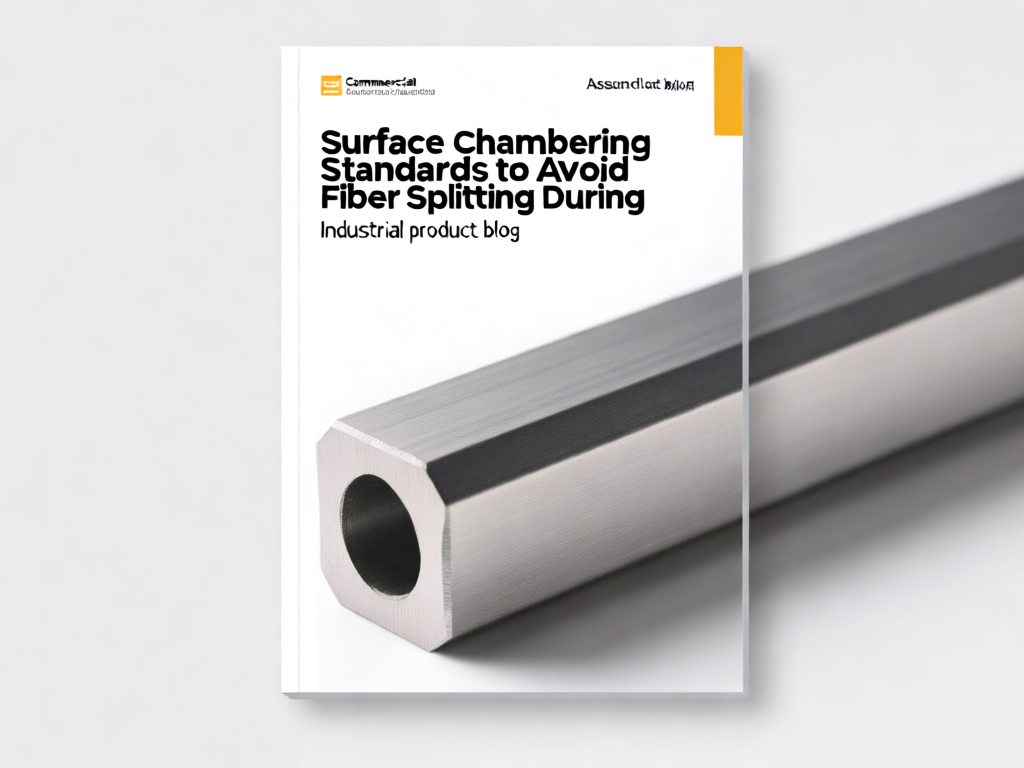
Chamfering involves cutting a beveled edge on the end surface of a composite part. This simple geometric modification distributes assembly stresses over a larger area, reducing stress concentrations and minimizing the risk of fiber splitting. Additionally, chamfers facilitate easier insertion during assembly, reducing the likelihood of mechanical damage.
### Benefits of Chamfering
– **Stress Redistribution:** Chamfers eliminate sharp corners, spreading loads more evenly.
– **Improved Assembly:** The tapered edge guides parts into place, reducing forced fitting.
– **Damage Mitigation:** Chamfers protect fibers from abrasion and impact during handling.
– **Enhanced Fatigue Life:** Reduced stress concentrations lead to longer service life.
## Chamfering Standards and Specifications
To effectively prevent fiber splitting, chamfering must adhere to specific standards. These standards vary depending on the application, material, and assembly requirements. Key parameters include chamfer angle, depth, and surface finish.
### Chamfer Angle
The chamfer angle is typically measured relative to the end surface. Common angles range from 30° to 60°, with 45° being the most prevalent. The optimal angle depends on the stress orientation and assembly forces. For axial loading, a 30° chamfer may suffice, while radial loading might require a steeper angle like 60°.
### Chamfer Depth
Chamfer depth, or the length of the beveled edge, should be sufficient to cover the anticipated stress zone but not so deep as to weaken the part. A general guideline is to set the depth equal to or slightly greater than the fiber diameter. For typical carbon fiber composites, this translates to 0.1–0.5 mm.
### Surface Finish
A smooth chamfer surface is crucial to avoid introducing new stress risers. Rough machining marks can act as crack initiation sites. Therefore, chamfers should be machined or ground to a surface roughness (Ra) of 1.6 µm or better. Polishing may be required for high-performance applications.
### Edge Quality
Chamfered edges must be free of delamination, fiber pull-out, and micro-cracks. Non-destructive inspection techniques such as visual inspection, dye penetrant, or ultrasonic testing should be employed to ensure edge integrity.
## Industry Standards and Guidelines
Several industry standards provide guidance on chamfering composites to prevent fiber splitting. Notable ones include:
– **ASTM D3039:** Standard test method for tensile properties of polymer matrix composite materials, which includes specimen preparation with chamfered ends.
– **ISO 14125:** Fibre-reinforced plastic composites — Determination of flexural properties, specifying chamfered edges for test specimens.
– **SAE AIR4844:** Composites and metal bonds — Chamfering guidelines for aerospace applications.
– **Internal Company Specifications:** Many manufacturers have proprietary standards tailored to their specific processes and materials.
## Best Practices for Chamfering to Avoid Fiber Splitting
Implementing best practices ensures that chamfering effectively prevents fiber splitting. Consider the following recommendations:
### Design Phase
– **Finite Element Analysis (FEA):** Simulate assembly stresses to determine optimal chamfer geometry.
– **Material Characterization:** Understand the fiber orientation and matrix properties to tailor chamfer parameters.
– **Tolerance Stack-Up:** Account for manufacturing tolerances to ensure chamfers align properly during assembly.
### Machining Phase
– **Tool Selection:** Use diamond-coated or polycrystalline diamond (PCD) tools to achieve clean cuts without delamination.
– **Cutting Parameters:** Optimize speed, feed, and depth of cut to minimize heat and mechanical damage.
– **Cooling:** Apply adequate coolant to prevent thermal damage to the matrix.
### Assembly Phase
– **Cleanliness:** Ensure chamfered surfaces are free of debris and contaminants.
– **Lubrication:** Apply appropriate lubricants to reduce friction during insertion.
– **Controlled Force:** Use assembly fixtures that apply uniform force to avoid point loading.
## Case Study: Aerospace Assembly
In aerospace, composite parts are often assembled with metallic fasteners. A leading aircraft manufacturer implemented a 45° chamfer with a depth of 0.3 mm on all composite end surfaces. This reduced fiber splitting incidents by 80% and improved assembly efficiency by 15%. The chamfers were machined using PCD tooling and inspected with ultrasonic testing to ensure quality.
## Conclusion
End surface chamfering is a critical yet often overlooked aspect of composite assembly. By adhering to established standards and best practices, manufacturers can significantly reduce the risk of fiber splitting, enhancing product reliability and reducing costs. As composite applications continue to grow, the importance of proper chamfering will only increase. Investing in precise chamfering processes and quality control is essential for any industry utilizing fiber-reinforced materials.