
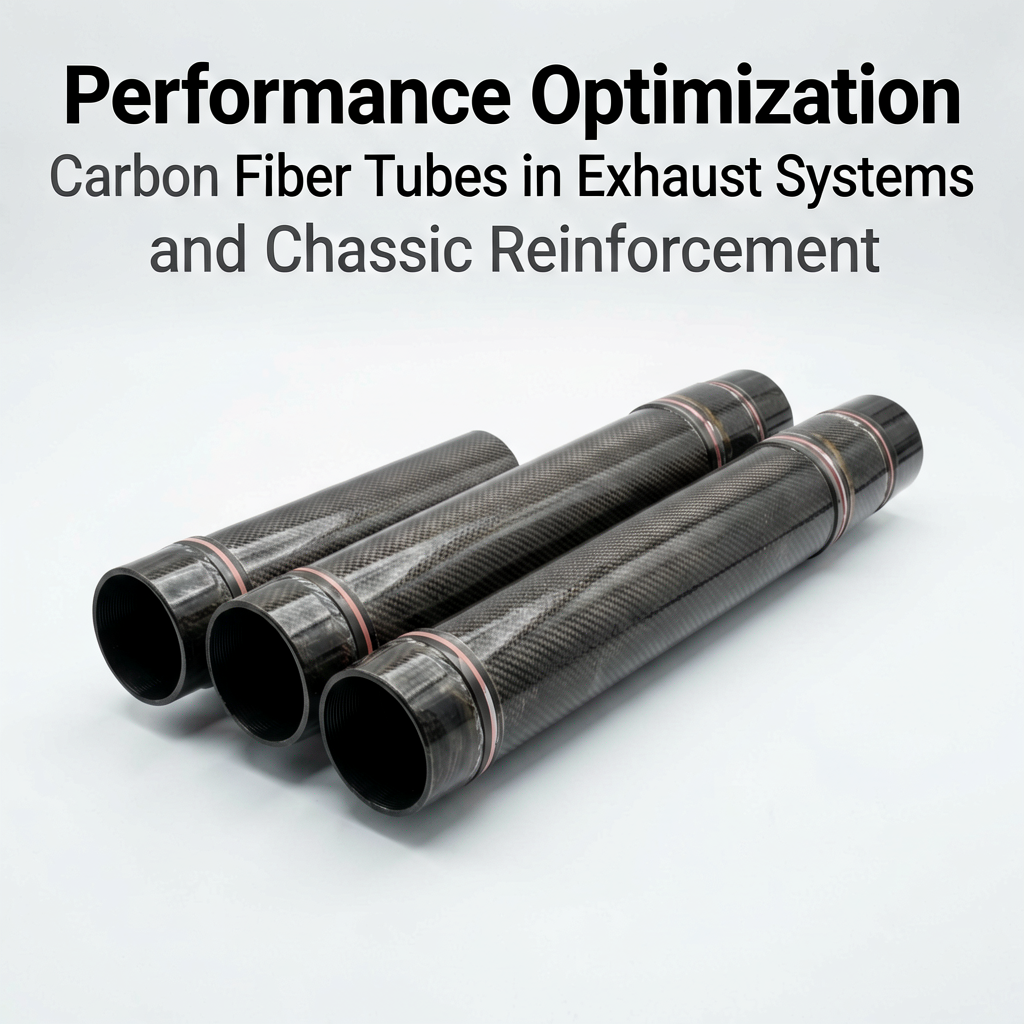
In advanced engineering sectors such as aerospace, robotics, and high-performance automotive design, the demand for structural components that are simultaneously stiff and lightweight is relentless. Hollow carbon fiber tubes have emerged as a quintessential solution, offering a unique combination of high specific stiffness and low mass. The key to their performance lies not merely in the carbon fiber material itself, but in the intricate engineering of the hollow wall structure. This article examines the mechanisms by which hollow carbon fiber tubes achieve this delicate balance, focusing on the physics of rigidity, the role of wall architecture, and the manufacturing parameters that govern performance.
### The Physics of Rigidity in Hollow Sections
The fundamental principle behind the rigidity of a hollow tube lies in its geometry. When a tube is subjected to bending or torsional loads, the material at the outer surface experiences the highest stress, while the material near the neutral axis (the center) experiences minimal stress. By removing material from the center—creating a hollow core—engineers eliminate low-stress material without significantly compromising the tube’s resistance to bending or twisting. This is quantified by the area moment of inertia, which increases dramatically with the outer diameter. For a given mass per unit length, a hollow tube can have a substantially larger outer diameter than a solid rod, thereby achieving far greater stiffness. The ratio of the outer diameter to the inner diameter (or wall thickness) is the critical design variable. A thinner wall increases the diameter-to-thickness ratio, which boosts rigidity per unit mass, but it also introduces risks of local buckling and wall instability.
### The Role of the Hollow Wall Structure
The term “ultra-light hollow wall structure” refers to the deliberate design of the tube’s cross-section to minimize density while maintaining structural integrity. This is achieved through several key strategies:
1. **Thin-Wall Laminates:** The wall itself is composed of multiple plies of carbon fiber prepreg, each oriented at specific angles (e.g., 0°, ±45°, 90°) to tailor the tube’s mechanical properties. For pure bending rigidity, fibers are aligned along the longitudinal axis (0°). For torsional rigidity, ±45° plies are essential. The number of plies and their sequence determine the wall thickness and, consequently, the tube’s weight. Advanced design optimizes the layup to place the stiffest fibers exactly where the stress is highest—at the outer and inner surfaces—while using lighter or fewer plies in the middle.
2. **Sandwich Core Technology:** To achieve extreme lightness without sacrificing resistance to local buckling, some hollow tubes incorporate a lightweight core material, such as foam or a honeycomb structure, between the inner and outer carbon fiber skins. This creates a true sandwich wall. The skins carry the bending and in-plane loads, while the core resists shear and prevents the thin skins from crumpling inward or outward. This approach allows for very thin carbon skins, drastically reducing weight while maintaining high global rigidity.
3. **Filament Winding and Braiding:** For continuous, seamless hollow tubes, filament winding or braiding is often used. These processes allow precise control over fiber tension and orientation, producing a dense, void-free wall. Braided tubes offer excellent torsional stiffness and impact resistance, while filament-wound tubes can be optimized for axial strength. The hollow interior is formed by a mandrel, which is removed after curing, leaving a clean, uniform inner surface.
### Balancing Rigidity and Weight: The Engineering Trade-offs
The balance between rigidity and ultra-light weight is not a single point but a spectrum of design choices. Increasing wall thickness adds stiffness but also mass. Conversely, reducing wall thickness lowers weight but may lead to failure by local buckling under compressive or bending loads. The critical buckling stress of a thin cylindrical shell is proportional to the wall thickness cubed and inversely proportional to the radius squared. Therefore, as the wall becomes thinner, the tube becomes more susceptible to ovalization and collapse. To mitigate this, engineers employ several tactics:
– **Optimized Ply Orientation:** By incorporating a higher percentage of ±45° plies, the tube’s shear modulus increases, which improves its resistance to buckling and torsional deformation without adding excessive longitudinal stiffness.
– **Tapered Walls:** In applications where loads vary along the length, tubes can be manufactured with a tapered wall—thicker at the ends where connections or high stress concentrations occur, and thinner in the middle. This reduces overall weight while maintaining rigidity where it matters most.
– **Hybrid Materials:** Adding a small amount of aramid or glass fiber in specific layers can increase impact resistance and toughness, allowing the overall wall to be thinner without compromising durability.
### Manufacturing Precision and Quality Control
The realization of an ultra-light hollow wall structure depends heavily on manufacturing precision. Voids, fiber waviness, or inconsistent wall thickness can drastically reduce both rigidity and strength. Advanced techniques such as automated fiber placement (AFP) and resin transfer molding (RTM) ensure high fiber volume fractions (typically 60–65%) and minimal porosity. Post-curing processes, such as autoclave curing under high pressure and temperature, consolidate the layers and eliminate micro-voids, enhancing the mechanical properties of the wall. Non-destructive testing, including ultrasonic scanning and X-ray computed tomography, is employed to verify wall uniformity and detect any internal defects.
### Applications and Future Directions
Hollow carbon fiber tubes with ultra-light walls are extensively used in drone frames, satellite booms, bicycle frames, and robotic arms, where every gram counts. In aerospace, they replace heavier metallic tubes in control linkages and structural struts, contributing to fuel efficiency and payload capacity. The ongoing development of thinner, yet more stable, wall structures is driven by advances in nano-reinforced resins and the use of high-modulus carbon fibers. Additionally, additive manufacturing of continuous fiber composites is beginning to allow for lattice-like internal wall structures, which could push the boundaries of weight reduction even further.
### Conclusion
Hollow carbon fiber tubes achieve their remarkable balance of rigidity and ultra-light weight through a combination of geometric efficiency and sophisticated wall engineering. By strategically placing high-stiffness fibers at the outer surfaces and employing thin-wall or sandwich core designs, engineers can maximize the moment of inertia while minimizing mass. The challenge lies in preventing buckling and maintaining structural integrity, which is addressed through precise ply orientation, hybrid materials, and rigorous manufacturing control. As material science and manufacturing technologies evolve, these tubes will continue to enable lighter, stronger, and more efficient structures across high-performance industries.