
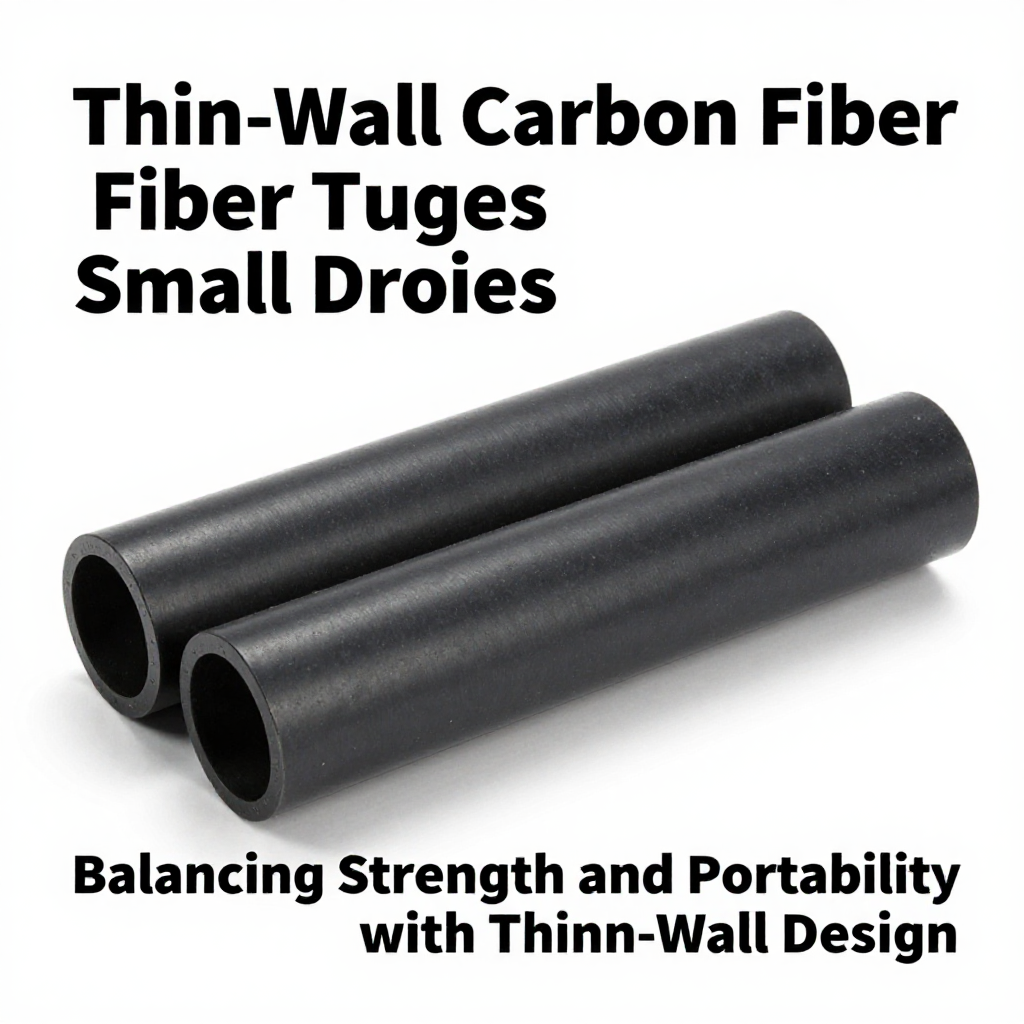
## Introduction
The rapid evolution of small unmanned aerial vehicles (UAVs), commonly known as drones, has placed unprecedented demands on materials engineering. From consumer photography drones to agile FPV racing quads and compact inspection platforms, every gram counts. Among the critical structural components, the arms and booms that support motors and propellers must be exceptionally strong yet remarkably light. This is where thin-wall carbon fiber tubes have emerged as a game-changing solution. By leveraging the anisotropic properties of carbon fiber composites and optimizing wall thickness, manufacturers can achieve an ideal balance between structural integrity and portability. This article explores the engineering principles, manufacturing considerations, and practical benefits of using thin-wall carbon fiber tubes in small drone applications.
## The Structural Role of Tubes in Small Drones
In a typical small drone, the central frame houses the flight controller, battery, and payload, while arms extend outward to support the motors and propellers. These arms are subjected to complex loading conditions, including bending moments from thrust, torsional forces during yaw maneuvers, and vibrations from high-speed rotation. The tube geometry is inherently efficient for resisting bending and torsion, but the material and wall thickness determine the ultimate performance. Thin-wall carbon fiber tubes offer a superior strength-to-weight ratio compared to solid rods or thicker-walled alternatives, making them ideal for minimizing inertia and maximizing flight endurance.
## Why Thin-Wall Design Matters for Portability
Portability is a key selling point for small drones, especially those designed for travel, outdoor reconnaissance, or rapid deployment. A drone that folds into a compact case or backpack requires components that are not only lightweight but also slim. Thin-wall tubes reduce the outer diameter for a given inner diameter, or allow a larger inner diameter for routing wires and cables without increasing weight. This slenderness contributes to a sleek, aerodynamic profile, reducing drag and improving overall efficiency. Moreover, the reduced mass at the extremities (the arms) lowers the moment of inertia, enabling quicker angular accelerations and more agile flight characteristics—a critical factor for FPV racing and acrobatic maneuvers.
## Engineering Strength in Thin-Wall Carbon Fiber Tubes
The strength of a carbon fiber tube is not solely determined by its wall thickness; the fiber orientation, resin system, and manufacturing process play equally vital roles. Thin-wall tubes are typically produced using unidirectional (UD) or woven prepregs, with fibers aligned along the tube’s axis to maximize bending stiffness. However, to resist torsional and hoop stresses, additional layers with ±45° fiber orientation are incorporated. The challenge lies in achieving a thin wall—often less than 1 mm—while maintaining a high fiber volume fraction and low void content. Advanced filament winding and pultrusion techniques allow for precise control over wall thickness, ensuring consistent mechanical properties along the tube’s length.
### Optimizing Fiber Orientation for Multi-Axial Loads
In small drone arms, loads are rarely unidirectional. During aggressive maneuvers, the arm experiences a combination of axial compression, bending, and torsion. A well-designed thin-wall tube uses a laminate stack that balances 0° fibers for axial stiffness, ±45° fibers for shear and torsion resistance, and sometimes 90° fibers to improve local buckling resistance. Finite element analysis (FEA) is often employed to optimize the ply sequence, ensuring that the tube can withstand ultimate loads without catastrophic failure. The result is a tube that is not only thin but also highly resilient to fatigue and impact.
## Manufacturing Processes for Thin-Wall Tubes
Several manufacturing methods are used to produce thin-wall carbon fiber tubes, each with its own advantages and limitations.
### Filament Winding
Filament winding involves wrapping continuous carbon fiber tows around a rotating mandrel. This process allows for precise control of fiber tension and orientation, making it ideal for producing thin-wall tubes with high strength and consistency. The mandrel is removed after curing, leaving a smooth inner surface. Filament winding is cost-effective for medium to large production runs and can achieve wall thicknesses as low as 0.5 mm.
### Pultrusion
Pultrusion is a continuous process where carbon fiber tows are pulled through a resin bath and then through a heated die. This method produces tubes with constant cross-sections and excellent surface finish. However, pultruded tubes typically have unidirectional fibers, which may not offer sufficient torsional strength unless combined with braided or woven sleeves. For thin-wall applications, pultrusion is often used in conjunction with braiding to enhance multi-axial properties.
### Roll Wrapping
Roll wrapping involves wrapping prepreg sheets around a mandrel and curing under pressure. This process is highly versatile, allowing for custom layups and wall thicknesses. It is commonly used for low-volume, high-performance tubes where specific mechanical properties are required. The main drawback is the manual labor involved, which increases cost.
## Balancing Strength and Weight: Key Considerations
When designing a thin-wall carbon fiber tube for a small drone, engineers must consider several factors to achieve the optimal balance.
### Wall Thickness vs. Stiffness
Reducing wall thickness directly reduces weight, but it also decreases the second moment of area, which governs bending stiffness. A tube that is too thin may flex excessively under load, leading to poor flight stability or even structural failure. The key is to select a wall thickness that provides adequate stiffness while keeping weight within acceptable limits. For small drones, typical wall thicknesses range from 0.5 mm to 1.5 mm, depending on the drone’s size and intended use.
### Impact Resistance and Damage Tolerance
Thin walls are more susceptible to impact damage, such as from hard landings or collisions. Carbon fiber composites are brittle, and a localized impact can cause delamination or fiber breakage, compromising structural integrity. To mitigate this, manufacturers may incorporate toughened resin systems or add a thin outer layer of aramid or glass fiber. Additionally, the tube’s design should include a safety factor to account for unexpected loads.
### Environmental Factors
Carbon fiber tubes are resistant to corrosion and moisture, but prolonged exposure to UV radiation can degrade the resin. For outdoor drones, a protective UV-resistant coating is recommended. Also, temperature fluctuations can affect the matrix properties, so the operating temperature range should be considered during material selection.
## Case Studies: Thin-Wall Tubes in Action
Several drone manufacturers have successfully integrated thin-wall carbon fiber tubes into their designs.
### FPV Racing Drones
FPV racing drones demand extreme agility and minimal weight. Thin-wall tubes with a diameter of 10-12 mm and a wall thickness of 0.7 mm are commonly used for arms. These tubes provide the necessary stiffness for high-speed turns while keeping the overall weight low, allowing for rapid acceleration and deceleration.
### Foldable Consumer Drones
Foldable drones, such as those used for travel photography, benefit from thin-wall tubes that can be hinged or slid into the main body. The slim profile enables compact folding mechanisms without adding bulk. For example, a 16 mm outer diameter tube with a 1.0 mm wall thickness can support a mid-size drone while maintaining a sleek, portable form factor.
## Future Trends in Thin-Wall Carbon Fiber Tubes
As drone technology advances, so does the demand for even lighter and stronger materials. Emerging trends include the use of high-modulus carbon fibers, which offer greater stiffness at the same weight, and the development of hybrid composites that combine carbon fiber with other materials to enhance toughness. Additive manufacturing (3D printing) is also being explored for creating complex tube geometries with optimized internal structures, although the mechanical properties of printed composites still lag behind traditional prepreg systems.
## Conclusion
Thin-wall carbon fiber tubes have become an indispensable component in the design of small drones, offering an exceptional balance of strength and portability. By carefully engineering the wall thickness, fiber orientation, and manufacturing process, drone manufacturers can achieve lightweight structures that do not compromise on performance or durability. As the industry continues to push the boundaries of flight efficiency and portability, thin-wall carbon fiber tubes will remain at the forefront of innovation, enabling the next generation of compact, high-performance UAVs.