
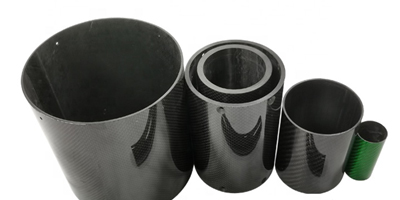
The Physics of Performance: Why Strength and Stiffness Defy the Weight Penalty
At its most fundamental level, the value proposition of a carbon fiber tube rests on two material properties: specific strength and specific stiffness. Specific strength is the amount of force a material can withstand per unit of density, while specific stiffness is its resistance to deformation per unit of density. Steel is incredibly strong, but it is heavy. Aluminum is lighter, but it lacks the ultimate fatigue resistance of steel. Carbon fiber composites, however, rearrange the periodic table to their advantage.
A unidirectional carbon fiber tube—where all fibers run parallel to the tube’s axis—can exhibit a tensile strength exceeding 600,000 PSI. Compare this to high-grade titanium at roughly 130,000 PSI. Now, factor in density. Carbon fiber composites hover around 1.6 g/cm³, whereas titanium is 4.5 g/cm³ and steel is 7.8 g/cm³. This yields a strength-to-weight ratio that is up to five times greater than steel. In practical terms, a carbon fiber tube can achieve the same load-bearing capacity as a steel tube while being only one-fifth the mass. This is not a marginal improvement; it is a paradigm shift in engineering tolerances.
The Structural Engineering Advantage: Managing Bending and Torsion
Real-world equipment—whether a drone arm, a bicycle seatpost, or a prosthetics pylon—rarely faces pure axial tension. The primary failure modes are bending and torsion. Here, the geometry of a hollow tube is ideal, but the material mechanics are critical. A metal tube bends by yielding; it deforms plastically at the stress point. A carbon fiber tube, however, distributes the load across its laminate structure.
The “core skeleton” advantage lies in laminate design. By orienting fibers at 0° (axial), +45°, and -45° along the mandrel, engineers create a tube that resists bending in one plane while being torsionally stiff in another. This anisotropy allows for bespoke mechanical behavior. A cycling fork needs high longitudinal stiffness to transmit steering forces, but must be compliant vertically to absorb road vibration. Carbon fiber allows this by placing high-modulus fibers along the steering axis and lower-modulus fibers radially. No single metal alloy can offer this directional tuning. Consequently, the carbon fiber tube is not just a lighter replacement for metal; it is a smarter structure that reduces unwanted vibration and dampens resonant frequencies better than any isotropic material.
The Hidden Cost of Weight: Inertia and Dynamic Performance
The benefits of weight reduction extend beyond simple static load. Consider rotational or reciprocating masses. An aluminum propeller shaft on a drone must overcome its own inertia to spin up. A carbon fiber tube reduces that moment of inertia, allowing faster spool times and more efficient energy use. In aerospace, every 1 kg removed from a non-structural component translates to significant fuel savings over a craft’s lifetime. But the “core skeleton” concept is about more than passive mass. The lower weight of a carbon fiber tube changes the frequency response of the entire equipment.
By reducing the mass of the structural frame, engineers can shift the center of gravity lower and reduce the overall dynamic load transmitted to actuators or joints. This leads to quicker response times in robotic arms and less motor strain in electric vehicles. The tube’s internal damping coefficient—the ability to absorb vibrational energy—is inherently higher than steel or aluminum due to the viscoelastic nature of the epoxy matrix. This means that the “skeleton” does not transfer destructive resonance spikes into sensitive components like batteries or circuit boards. Instead, it filters them, preserving the integrity of the equipment’s internal systems.
Manufacturing Precision: From Filament Winding to Pultrusion
The production process is the final factor cementing carbon fiber’s role as the core skeleton. Unlike welding or casting metal, carbon fiber tubes can be manufactured with extreme dimensional tolerance using techniques like filament winding or roll wrapping. This allows for wall thicknesses that are uniform to within microns, ensuring that the axial and hoop strength are consistent across the entire length.
More critically, the absence of weld seams—the classic failure point in metal frames—means the tube has no weak grain boundaries. In metal frames, the heat-affected zone near a weld degrades the material properties. A carbon fiber tube, whether pultruded for constant cross-sections or bladder-molded for complex tapers, is a monolithic piece. This structural continuity is the literal definition of a “skeleton”—a single, continuous load path that distributes stress cleanly from joint to joint, eliminating stress risers. The result is a component that fails predictably (through fiber fracture) rather than catastrophically (through cracking), offering a safer lifecycle for high-performance equipment.
In conclusion, the carbon fiber tube has earned its place as the core skeleton not because it is simply light, but because it is physically optimized. It offers a superior strength-to-weight ratio, anisotropic stiffness control, superior vibration damping, and monolithic manufacturing integrity. These dual breakthroughs—strength and weight—are not separate achievements but are intertwined in the very chemistry of the material, providing the ultimate structural foundation for modern, high-performance lightweight design.