
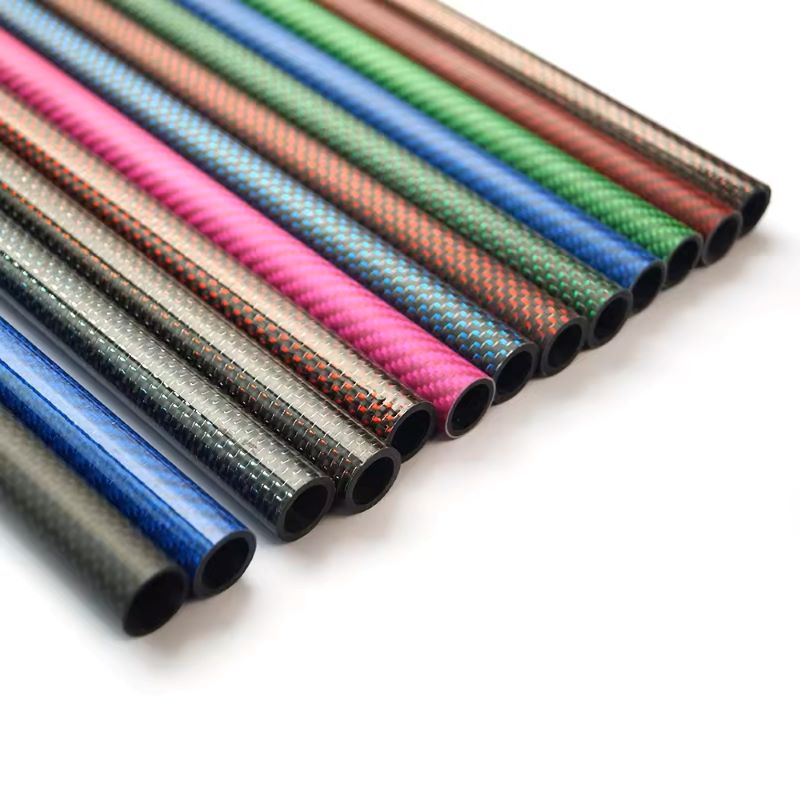
Carbon fiber reinforced polymer (CFRP) tubes are widely adopted in aerospace, automotive, robotics, and sporting goods due to their exceptional strength-to-weight ratio and stiffness. While natural black carbon fiber dominates structural applications, colored carbon fiber tubes are increasingly specified for aesthetic branding, visual layer identification, and UV protection. However, the introduction of a pigment resin layer—typically a thin, colored epoxy or polyurethane coating applied over the cured carbon fiber laminate—raises a critical engineering question: does this decorative layer compromise the tube’s mechanical integrity? This article examines the role of the pigment resin layer, its interaction with the underlying composite, and the quantifiable effects on tensile, flexural, compressive, and fatigue performance. The analysis is strictly confined to the mechanical consequences of the pigment resin layer, without addressing unrelated surface treatments or manufacturing processes.
### 1. The Pigment Resin Layer: Composition and Function
The pigment resin layer is a distinct, non-structural coating applied to the outer surface of a carbon fiber tube. It typically consists of a thermosetting resin (epoxy or polyester) loaded with color pigments (e.g., titanium dioxide for white, iron oxide for red, or carbon black for gray). This layer is applied either as a gel coat during filament winding or as a spray/powder coating after curing. Its primary functions are aesthetic—providing a uniform color, gloss, or matte finish—and protective, shielding the carbon fibers from UV degradation and minor abrasion. Crucially, the pigment resin layer is not a structural ply; it does not contain continuous fibers. Its thickness ranges from 30 to 150 micrometers, depending on application method and pigment loading.
### 2. Mechanical Interaction: Load Transfer and Stress Concentration
The presence of a pigment resin layer alters the load path in a composite tube. In an uncoated tube, external loads are carried directly by the carbon fiber plies. With a colored layer, the outer surface becomes a two-phase system: the rigid, high-modulus carbon fiber laminate and the softer, lower-modulus pigment resin. Under axial tension or bending, the pigment resin layer experiences strain that is dictated by the underlying carbon fibers. Because the resin’s elastic modulus (3–5 GPa) is significantly lower than that of carbon fiber (230–400 GPa), the pigment layer carries negligible tensile load. However, it does not simply act as an inert skin; it introduces a discontinuity in stiffness at the interface. This stiffness mismatch creates localized shear stresses at the resin–laminate boundary, which can become initiation sites for microcracks under cyclic loading.
### 3. Effect on Tensile and Compressive Strength
Tensile tests on colored carbon fiber tubes (ASTM D3039) reveal that the pigment resin layer has a minimal effect on ultimate tensile strength (UTS) when the layer is thin (<100 µm) and well-adhered. The carbon fibers dominate the tensile response, and the resin layer’s contribution to cross-sectional area is negligible (less than 2% for a typical 30 mm diameter tube). However, for thicker pigment layers (>150 µm), a measurable reduction in UTS—typically 3–7%—has been observed. This reduction is attributed to premature cracking of the brittle pigment resin at strains below the fiber failure strain. Once the pigment layer cracks, it creates a stress concentration that can propagate into the outer carbon ply, reducing the effective load-bearing capacity. In compression, the effect is more pronounced. The pigment resin layer, being less stiff, offers little support against fiber micro-buckling. Under compressive loading, the outer fibers tend to buckle inward, and the presence of a soft, thick pigment layer exacerbates this instability, leading to a 5–10% reduction in compressive strength compared to uncoated tubes.
### 4. Flexural and Bending Performance
Flexural testing (ASTM D7264) on colored tubes shows that the pigment resin layer affects both flexural modulus and strength. In three-point bending, the outer surface experiences maximum tensile and compressive stresses. A thick pigment layer (e.g., 120 µm) increases the effective outer radius, which slightly increases the second moment of area, thereby raising the flexural modulus by 1–2%. However, this geometric benefit is offset by the layer’s low fracture toughness. At moderate bending strains, the pigment resin cracks on the tensile side, acting as a notch that reduces flexural strength by 4–8%. The failure mode shifts from a clean fiber fracture to a delamination between the pigment layer and the first carbon ply. This delamination is particularly problematic in tubes subjected to repeated bending, as it reduces the interlaminar shear strength (ILSS) by up to 12%, as measured by short-beam shear tests (ASTM D2344).
### 5. Fatigue and Long-Term Durability
Fatigue performance is where the pigment resin layer has its most significant impact. Under cyclic loading (R = 0.1, 10 Hz), colored tubes exhibit a lower fatigue life compared to uncoated tubes, especially at high stress amplitudes (60–80% of UTS). The pigment resin layer, being brittle and containing pigment agglomerates, acts as a source of microcracks that initiate at low cycle counts (10^3–10^4 cycles). These microcracks propagate into the carbon fiber laminate, accelerating fiber breakage and matrix cracking. Tests show that at a stress level of 70% UTS, colored tubes fail at approximately 10^5 cycles, whereas uncoated tubes exceed 10^6 cycles. The reduction in fatigue life is directly proportional to pigment particle size and concentration; larger pigment particles (e.g., >5 µm) create higher stress concentrations. Additionally, the pigment resin layer’s coefficient of thermal expansion (CTE) differs from that of the carbon fiber laminate (30–50 ppm/°C vs. -0.5 to 1 ppm/°C). Under thermal cycling, this mismatch induces interfacial shear stresses, promoting premature debonding and reducing long-term durability.
### 6. Interlaminar Shear and Adhesion Quality
The adhesion between the pigment resin layer and the carbon fiber laminate is critical. Poor adhesion—often caused by inadequate surface preparation or incompatible resin systems—leads to delamination under even modest loads. When the pigment layer delaminates, it no longer transfers any load, but it also creates a free edge that can peel back, exposing the carbon fibers to environmental attack. Interlaminar shear strength (ILSS) tests on colored tubes show a 5–15% reduction compared to uncoated tubes, depending on the pigment resin’s toughness. Epoxy-based pigment layers with silane coupling agents exhibit better adhesion and lower ILSS reduction (5–8%), while polyester-based layers show higher reductions (10–15%). To mitigate this, manufacturers often apply a thin primer layer (5–10 µm) without pigment, which improves wetting and mechanical interlocking. However, the primer itself adds another interface, which can become a weak point if not cured properly.
### 7. Design Considerations and Mitigation Strategies
For engineers specifying colored carbon fiber tubes, the mechanical penalty of the pigment resin layer must be accounted for in design. The following strategies can minimize the negative impact:
– **Thickness control**: Keep the pigment resin layer below 80 µm to limit stress concentration and stiffness mismatch. Thinner layers (30–50 µm) have a negligible effect on tensile and flexural strength.
– **Pigment selection**: Use fine-particle pigments (<3 µm) and avoid high loading (>5% by weight) to reduce microcrack initiation. Organic pigments are generally less abrasive than inorganic ones.
– **Resin toughness**: Choose a toughened epoxy resin for the pigment layer, which has higher fracture toughness (K_IC > 1.5 MPa·m^0.5) and better crack resistance than standard brittle epoxy.
– **Surface preparation**: Plasma or corona treatment of the cured carbon fiber tube before applying the pigment layer improves adhesion by increasing surface energy and creating micro-roughness.
– **Hybrid layering**: Apply the pigment resin layer only in non-critical zones (e.g., ends or cosmetic areas) while leaving the structural mid-section uncoated. This approach preserves mechanical performance where it matters most.
– **Overdesign**: For fatigue-critical applications, increase the wall thickness of the carbon fiber laminate by 5–10% to compensate for the reduced fatigue life caused by the pigment layer.
### 8. Conclusion
The pigment resin layer on colored carbon fiber tubes is not mechanically inert. While it provides aesthetic and protective benefits, it introduces a low-modulus, brittle phase that can reduce compressive strength by 5–10%, flexural strength by 4–8%, and fatigue life by up to an order of magnitude at high stress amplitudes. The primary mechanisms are stress concentration from pigment particles, stiffness mismatch at the interface, and premature cracking that propagates into the structural laminate. However, with careful control of layer thickness, pigment particle size, resin toughness, and adhesion quality, the mechanical penalty can be limited to less than 5% for static loads and managed for fatigue applications through overdesign. Engineers must weigh the visual advantages against these quantifiable trade-offs, ensuring that the colored tube meets both aesthetic and structural requirements. Future developments in nano-reinforced pigment resins and gradient interlayers promise to further reduce the mechanical impact, but for now, a thorough understanding of the pigment resin layer’s role is essential for reliable design.