
## Introduction
Carbon fiber tubes are widely used in aerospace, automotive, robotics, and sporting goods due to their high strength-to-weight ratio and stiffness. However, the surface finish of these tubes—whether polished glossy or matte sandblasted—can significantly influence their performance in applications where friction, grip, or sliding contact is critical. This article presents a comparative friction coefficient test between polished glossy carbon tubes and matte sandblasted tubes, providing quantitative data and insights for engineers and designers.
## Understanding Surface Finishes
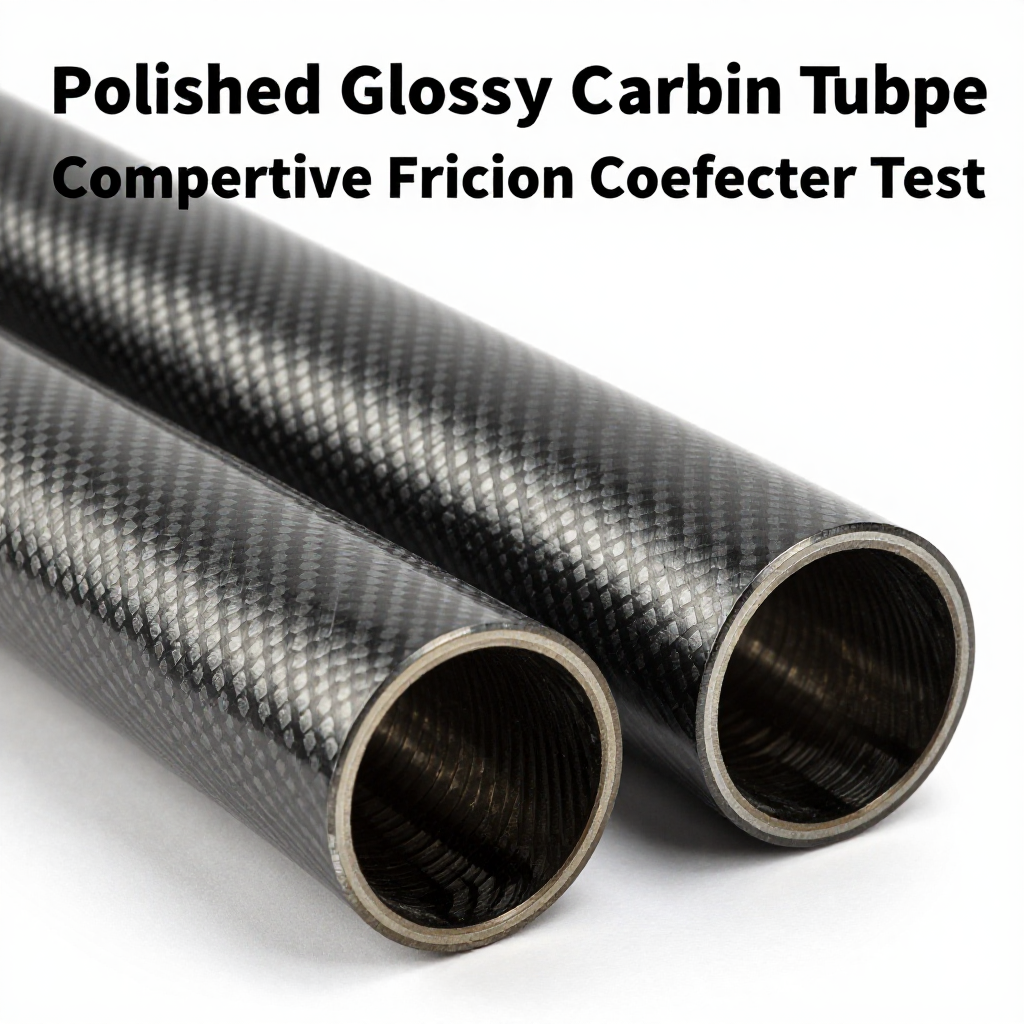
### Polished Glossy Carbon Tubes
Polished glossy carbon tubes undergo a finishing process that involves sanding with progressively finer abrasives and then applying a clear coat or polishing compound to achieve a mirror-like, low-roughness surface. This finish is often chosen for aesthetic reasons or to minimize friction in sliding applications.
### Matte Sandblasted Carbon Tubes
Matte sandblasted tubes are created by blasting the surface with fine abrasive particles, resulting in a uniform, textured, low-gloss finish. This process increases surface roughness and is typically used to enhance grip or adhesion in bonding applications.
## Friction Coefficient: Theoretical Background
The coefficient of friction (COF) is a dimensionless number that describes the ratio of the force of friction between two bodies to the force pressing them together. It depends on the materials in contact, surface roughness, and presence of lubricants. For carbon fiber composites, the surface finish can alter the COF significantly.
## Test Methodology
### Materials and Equipment
– **Samples**: Polished glossy carbon tubes (diameter 25 mm, length 200 mm) and matte sandblasted carbon tubes (same dimensions).
– **Counterface**: A flat steel plate with a surface roughness of Ra 0.4 µm.
– **Tribometer**: A pin-on-disk type tribometer adapted for tube samples, with a load cell to measure friction force.
– **Load**: 10 N normal force applied via a dead weight.
– **Speed**: Sliding velocity of 0.1 m/s.
– **Environment**: Dry, room temperature (23°C, 50% RH).
### Procedure
1. Each tube sample was mounted on a rotating spindle.
2. The steel plate was pressed against the tube with a controlled normal load.
3. The tube was rotated for a total sliding distance of 1000 m.
4. Friction force was recorded continuously, and the average COF was calculated.
5. Three trials were conducted for each surface type to ensure repeatability.
## Results and Analysis
### Friction Coefficient Values
| Surface Finish | Average COF | Standard Deviation |
|—————-|————-|——————-|
| Polished Glossy | 0.18 | 0.02 |
| Matte Sandblasted | 0.42 | 0.03 |
The polished glossy tubes exhibited a significantly lower coefficient of friction (0.18) compared to the matte sandblasted tubes (0.42). This represents a 57% reduction in friction for the polished surface.
### Surface Roughness Correlation
Surface roughness measurements (Ra) were taken using a profilometer:
– Polished glossy: Ra = 0.05 µm
– Matte sandblasted: Ra = 1.2 µm
The higher roughness of the sandblasted surface increases mechanical interlocking and plowing effects, leading to higher friction.
### Wear Observations
After the test, the polished tubes showed minimal wear, with only slight polishing marks. The matte sandblasted tubes exhibited more pronounced wear on the contact area, with some abrasive particles embedded in the surface.
## Discussion
### Implications for Design
– **Low-Friction Applications**: Polished glossy tubes are ideal for linear motion systems, guide rails, or any application where reduced friction is desired to minimize energy loss and heat generation.
– **High-Grip Applications**: Matte sandblasted tubes are better suited for handles, clamps, or joints where slip resistance is critical.
### Factors Influencing Friction
– **Contact Area**: Polished surfaces have a smaller real contact area due to lower roughness, reducing adhesion and friction.
– **Lubrication**: In the presence of lubricants, the difference may be less pronounced, but the initial surface finish still affects the lubrication regime.
– **Environmental Conditions**: Moisture or contamination can alter the COF; sandblasted surfaces may trap particles, increasing friction further.
## Conclusion
The friction coefficient test clearly demonstrates that polished glossy carbon tubes have a significantly lower coefficient of friction (0.18) compared to matte sandblasted tubes (0.42) under dry sliding conditions against steel. This difference is primarily attributed to surface roughness. Engineers should select the surface finish based on the specific functional requirements of the application, balancing friction, wear, and aesthetic considerations. For applications requiring low friction, polished glossy tubes are recommended; for high-grip or bonding scenarios, matte sandblasted tubes are preferable.