
## Introduction
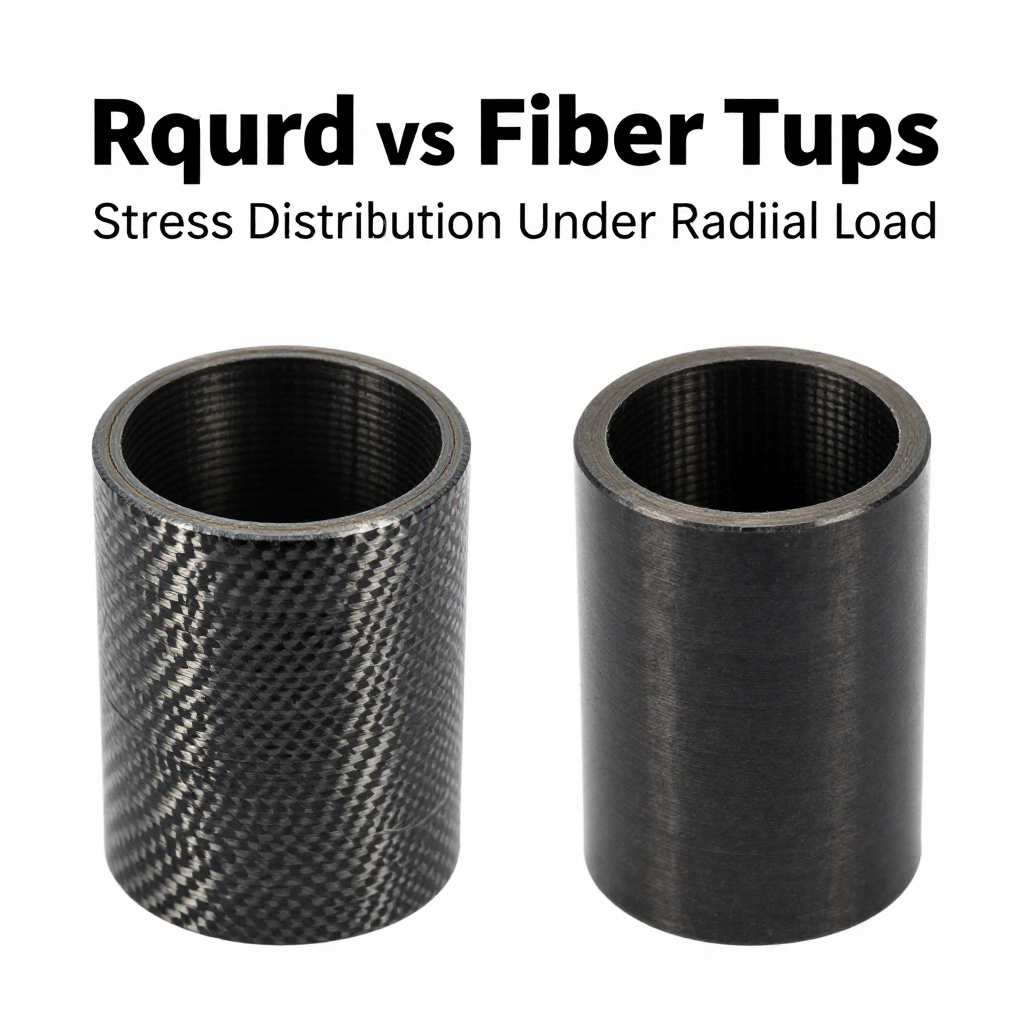
Carbon fiber tubes are widely used in industries ranging from aerospace to robotics due to their high strength-to-weight ratio and stiffness. When selecting a carbon tube for a structural application, engineers often face a critical choice: round or square cross-section. Under identical radial loads (forces applied perpendicular to the tube’s axis), the geometry of the tube significantly influences stress distribution, load-bearing capacity, and failure modes. This article provides a technical comparison of round and square carbon tubes, focusing on stress distribution, bending behavior, and practical implications for design engineers.
## Fundamentals of Radial Loading on Tubes
Radial load refers to a force applied perpendicular to the longitudinal axis of the tube, such as a point load at the center of a simply supported beam. This loading induces bending moments, which create tensile and compressive stresses across the cross-section. The magnitude and distribution of these stresses depend on the second moment of area (I) of the cross-section, the distance from the neutral axis (y), and the applied moment (M), as described by the flexure formula: σ = M*y/I.
For a given material and load, a higher second moment of area results in lower maximum stress. Therefore, the cross-sectional shape plays a pivotal role in structural performance.
## Stress Distribution in Round Carbon Tubes
Round carbon tubes (circular hollow sections) have a symmetric cross-section, which means the neutral axis passes through the centroid, and the distance from the neutral axis to the outer fiber is equal in all directions. The second moment of area for a circular tube is I = π/4 * (R_o^4 – R_i^4), where R_o and R_i are outer and inner radii.
Under a radial point load, the maximum bending stress occurs at the top and bottom fibers (tension and compression, respectively). The stress distribution across the diameter is linear, with zero stress at the neutral axis. Because the material is distributed evenly around the centroid, the stress is uniform along the circumference at any given distance from the neutral axis. This symmetry ensures that no torsional or warping stresses are induced, and the tube resists bending equally in all directions.
However, for a given outer diameter, a round tube has a relatively lower second moment of area compared to a square tube of the same outer width, because the material is concentrated closer to the centroid. This means that under the same radial load, a round tube will experience higher maximum stress than a square tube of equivalent outer dimensions, assuming identical wall thickness.
## Stress Distribution in Square Carbon Tubes
Square carbon tubes (rectangular hollow sections with equal sides) have a cross-section with sharp corners and flat sides. The second moment of area for a square tube is I = (a^4 – b^4)/12, where a is the outer side length and b is the inner side length. This value is significantly larger than that of a round tube with the same outer width and wall thickness, because the material is located farther from the neutral axis, especially at the corners.
Under a radial load, the maximum bending stress occurs at the top and bottom surfaces, but the stress distribution is not uniform across the width. At the corners, the stress concentration is higher due to the abrupt change in geometry. The flat sides experience lower stress, but the corners act as stress raisers, which can lead to premature failure, especially in carbon fiber composites that are sensitive to stress concentrations.
Additionally, square tubes have different bending stiffness in different orientations. When loaded along the flat side, the second moment of area is higher than when loaded along the diagonal. This anisotropy can be advantageous if the load direction is known, but it can also lead to unexpected behavior if the load is applied at an angle.
## Comparative Analysis Under Identical Radial Load
To compare the two geometries, consider carbon tubes with the same outer width (diameter for round, side length for square) and same wall thickness. Under a central point load on a simply supported beam, the maximum bending stress is inversely proportional to the section modulus (S = I/c), where c is the distance from the neutral axis to the outermost fiber.
For a round tube, c = R_o, and for a square tube, c = a/2. Given that the square tube has a higher I and a similar c (since a/2 ≈ R_o for same outer width), the square tube will have a higher section modulus and thus lower maximum stress. For example, a 25 mm outer diameter round tube with 2 mm wall thickness has I ≈ 1.15e4 mm^4, while a 25 mm square tube with 2 mm wall has I ≈ 2.04e4 mm^4, almost double. Consequently, the square tube will experience roughly half the maximum bending stress under the same load.
However, the stress distribution in the square tube is not uniform. At the corners, local stresses can be significantly higher than the nominal bending stress due to stress concentration factors. In carbon fiber composites, which are brittle and have low toughness, these stress concentrations can initiate cracks, leading to catastrophic failure. Round tubes, with their smooth continuous surface, distribute stress more evenly and are less prone to stress concentration.
## Impact of Stress Concentrations on Carbon Fiber Composites
Carbon fiber reinforced polymers (CFRP) are anisotropic and have high strength in the fiber direction but are weak in transverse directions. Stress concentrations at sharp corners can cause delamination or fiber breakage. Round tubes, with their continuous curvature, allow fibers to be oriented more uniformly, reducing the risk of localized overstress. Square tubes, on the other hand, require fiber layup to accommodate corners, which can lead to fiber waviness and voids, further reducing strength.
In practical applications, such as drone arms or structural frames, square carbon tubes are often preferred for their higher bending stiffness and ease of mounting flat surfaces. However, engineers must account for stress concentrations by adding fillets or using thicker walls at corners, which increases weight and cost.
## Practical Considerations for Design Engineers
When choosing between round and square carbon tubes, consider the following:
– **Load direction**: If the load is primarily in one direction, a square tube can be oriented to maximize stiffness. If loads are multidirectional, a round tube provides uniform performance.
– **Stress concentrations**: Avoid sharp corners in high-cycle fatigue applications. Round tubes are safer.
– **Weight efficiency**: For the same outer dimensions and wall thickness, square tubes are stiffer and lighter for a given bending stress, but they may require additional reinforcement at corners.
– **Manufacturing**: Round tubes are easier to produce with continuous fiber winding, resulting in better fiber alignment. Square tubes often require pultrusion or molding, which can introduce defects.
## Conclusion
Under identical radial loads, square carbon tubes exhibit lower maximum bending stress than round tubes of the same outer width and wall thickness, due to a higher second moment of area. However, the presence of sharp corners in square tubes introduces stress concentrations that can compromise the structural integrity of carbon fiber composites. Round tubes, while experiencing higher nominal stress, offer more uniform stress distribution and better resistance to stress raisers. The optimal choice depends on the specific application, load conditions, and manufacturing constraints. Engineers should perform finite element analysis (FEA) to evaluate stress distribution and failure modes for their particular design, ensuring safety and performance.