
## Introduction
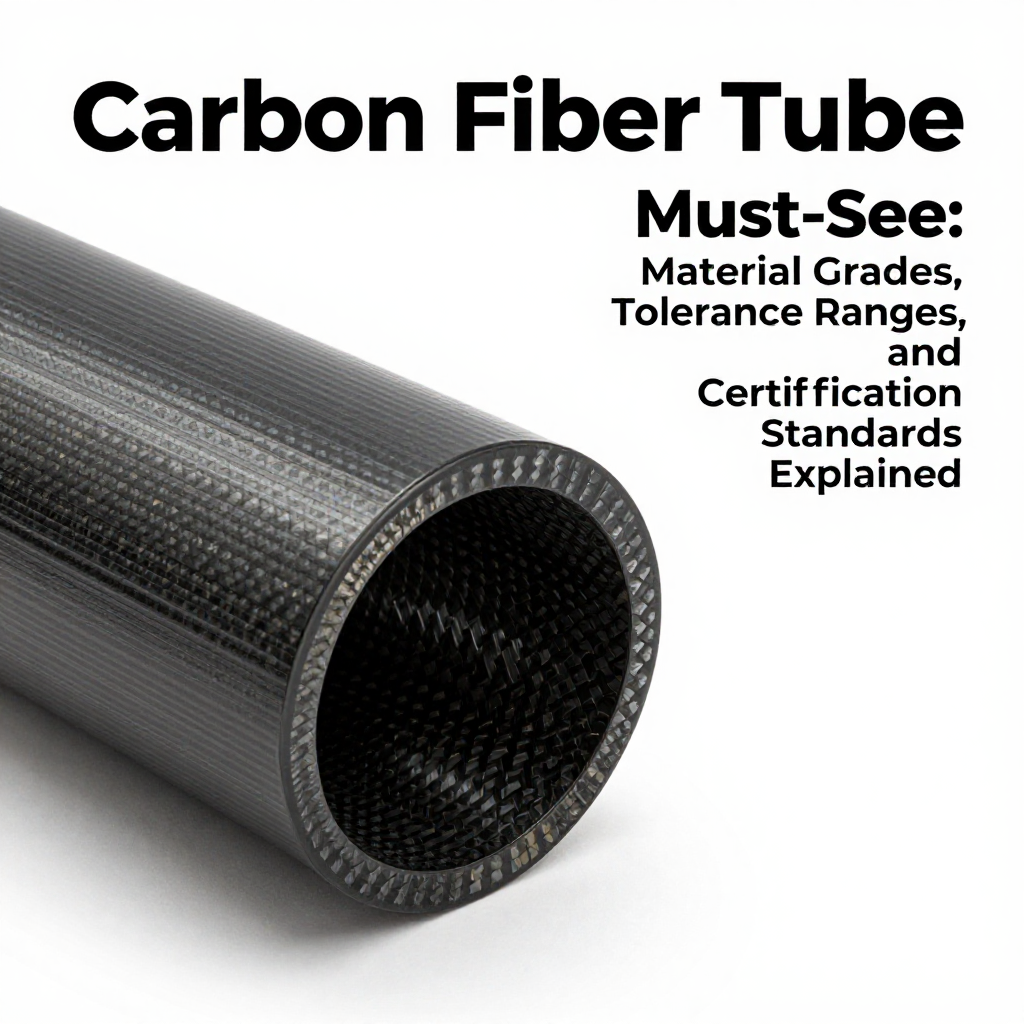
Carbon fiber tubes are critical components in industries ranging from aerospace and robotics to sporting goods and medical devices. Their high strength-to-weight ratio, stiffness, and corrosion resistance make them ideal for demanding applications. However, procuring carbon fiber tubes is not as simple as ordering a standard metal pipe. The performance and safety of your final product depend heavily on the material grade, dimensional tolerances, and certification standards of the tubes you purchase. This article provides a comprehensive guide to these three essential aspects, ensuring you make informed procurement decisions.
## Material Grades: Understanding the Differences
Carbon fiber tubes are manufactured using different grades of carbon fiber, each offering distinct mechanical properties and cost profiles. The grade determines the fiber’s tensile modulus, strength, and thermal characteristics.
### Standard Modulus (SM) Carbon Fiber
Standard modulus fibers (e.g., T300, T700) are the most common and cost-effective. They offer a tensile modulus of 230-240 GPa and a tensile strength of 3.5-4.9 GPa. These fibers are suitable for general-purpose applications where high stiffness is not the primary requirement, such as drone arms, lightweight frames, and industrial automation components.
### Intermediate Modulus (IM) Carbon Fiber
Intermediate modulus fibers (e.g., T800, IM7) provide a balance between strength and stiffness. With a modulus of 290-300 GPa and strength of 5.5-6.3 GPa, they are used in high-performance automotive parts, aerospace secondary structures, and sports equipment like bicycle frames and tennis rackets.
### High Modulus (HM) and Ultra-High Modulus (UHM) Carbon Fiber
High modulus fibers (e.g., M40, M46) and ultra-high modulus fibers (e.g., M55, M60) offer exceptional stiffness (modulus > 350 GPa) but lower tensile strength compared to IM fibers. They are brittle and expensive, making them ideal for space applications, precision instruments, and specialized tooling where dimensional stability is critical.
### Pitch-Based Carbon Fiber
Pitch-based fibers (e.g., K13D) have extremely high thermal conductivity and modulus, but they are costly and used in niche applications like heat sinks and advanced aerospace components.
**Procurement Tip:** Always specify the fiber grade (e.g., T700, T800) and the resin system (epoxy, vinyl ester, etc.) in your technical drawings. Do not rely on generic terms like “carbon fiber tube” without defining the grade.
## Tolerance Ranges: What to Specify and Why
Carbon fiber tubes are manufactured through pultrusion, filament winding, or roll wrapping. Each process yields different dimensional tolerances. Understanding these tolerances is crucial for assembly fit and performance.
### Outer Diameter (OD) Tolerance
For general-purpose tubes, an OD tolerance of ±0.05 mm is common. For precision applications (e.g., shafts in robotics), tighter tolerances of ±0.02 mm are achievable with ground or machined tubes. Always specify the required OD tolerance based on your bearing or mating component.
### Inner Diameter (ID) Tolerance
ID tolerance is more challenging to control, especially in pultruded tubes. Standard ID tolerance is ±0.1 mm, but for tubes that require a tight fit over a mandrel, specify ±0.05 mm or request a reamed/bored ID.
### Wall Thickness Tolerance
Wall thickness variation can affect the tube’s stiffness and balance. Standard tolerance is ±0.1 mm, but high-performance applications may require ±0.05 mm. For rotating shafts, a tighter wall thickness tolerance reduces vibration.
### Straightness
Straightness is a critical tolerance for long tubes. Typical straightness is 0.5 mm per meter, but for precision applications, specify 0.1 mm per meter. Straightness is often measured as a deviation from a straight line over the tube’s length.
### Length Tolerance
Length tolerance is usually ±1 mm for standard tubes, but if you need exact lengths for assembly, specify ±0.5 mm or request CNC cutting.
**Procurement Tip:** Always provide a detailed drawing with tolerance callouts. If you are unsure about achievable tolerances, consult with the manufacturer early in the design phase to avoid costly rework.
## Certification Standards: Ensuring Quality and Traceability
Certifications are essential to verify that the carbon fiber tubes meet specified material and performance requirements. Depending on your industry, certain certifications may be mandatory.
### ISO 9001:2015
This is a quality management system certification. While it does not guarantee product-specific quality, it ensures that the manufacturer has consistent processes and quality control procedures in place.
### AS9100D
For aerospace and defense applications, AS9100D is the industry standard. It includes all ISO 9001 requirements plus additional aerospace-specific criteria, such as traceability, configuration management, and risk management.
### Material Test Reports (MTR)
A Material Test Report (also known as a certificate of conformance) provides documented evidence that the tubes meet the specified material grade, mechanical properties, and dimensions. It should include:
– Fiber type and resin system
– Tensile strength and modulus (from test coupons)
– Density and fiber volume fraction
– Dimensional measurements
– Batch and lot numbers for traceability
### ASTM D3039 / D3410
These are standard test methods for tensile properties of polymer matrix composite materials. If your application requires specific mechanical properties, ask for test reports conducted per these standards.
### UL Certification
For electrical applications, UL certification may be required to ensure the tube’s flame resistance and electrical insulation properties.
### RoHS and REACH Compliance
If your product is sold in the European Union, ensure that the carbon fiber tubes comply with RoHS (Restriction of Hazardous Substances) and REACH (Registration, Evaluation, Authorisation and Restriction of Chemicals) regulations.
**Procurement Tip:** Always request a copy of the manufacturer’s certifications and MTRs before placing a bulk order. Verify that the certifications are current and cover the specific batch of tubes you are receiving.
## How to Choose the Right Combination
Selecting the correct material grade, tolerance, and certification is a balancing act between performance, cost, and lead time.
1. **Define your application requirements:** Determine the load, stiffness, environmental conditions, and assembly tolerances.
2. **Select the material grade:** Use the mechanical property data to choose the fiber grade that meets your strength and stiffness needs without over-engineering.
3. **Specify tolerances:** Only tighten tolerances where necessary, as tighter tolerances increase manufacturing cost and lead time.
4. **Determine required certifications:** Based on your industry (aerospace, medical, etc.) and regulatory requirements, list the certifications you need.
5. **Communicate with suppliers:** Share your specifications with multiple suppliers and ask for their recommendations. A reputable supplier will help you optimize the design for manufacturability.
## Common Pitfalls in Carbon Fiber Tube Procurement
– **Ignoring the resin system:** The resin affects temperature resistance, chemical resistance, and impact strength. Specify the resin type (e.g., epoxy, vinyl ester) and its glass transition temperature (Tg).
– **Over-specifying tolerances:** This can lead to unnecessary costs. For example, a ±0.02 mm tolerance may be required for a bearing seat, but a ±0.1 mm tolerance is fine for a simple spacer.
– **Assuming all carbon fiber tubes are the same:** Different manufacturing processes (pultrusion vs. roll wrapping) yield different fiber orientations and mechanical properties. Pultruded tubes have unidirectional fibers, while roll-wrapped tubes have a more balanced layup.
– **Not verifying the fiber volume fraction:** A higher fiber volume fraction (typically 60-65%) indicates better mechanical properties. Ask for this data in the MTR.
## Conclusion
Procuring carbon fiber tubes requires a clear understanding of material grades, tolerance ranges, and certification standards. By specifying the correct fiber grade, defining realistic tolerances, and demanding proper certifications, you can ensure that your tubes perform reliably in your application. Always work closely with your supplier to validate your specifications and obtain the necessary documentation. With the right approach, carbon fiber tubes will deliver exceptional performance and durability, making them a worthwhile investment for your product.
Remember: The cheapest tube is not always the most cost-effective. Quality, traceability, and consistency are paramount in critical applications. Use this guide as a checklist when evaluating suppliers and placing orders.