
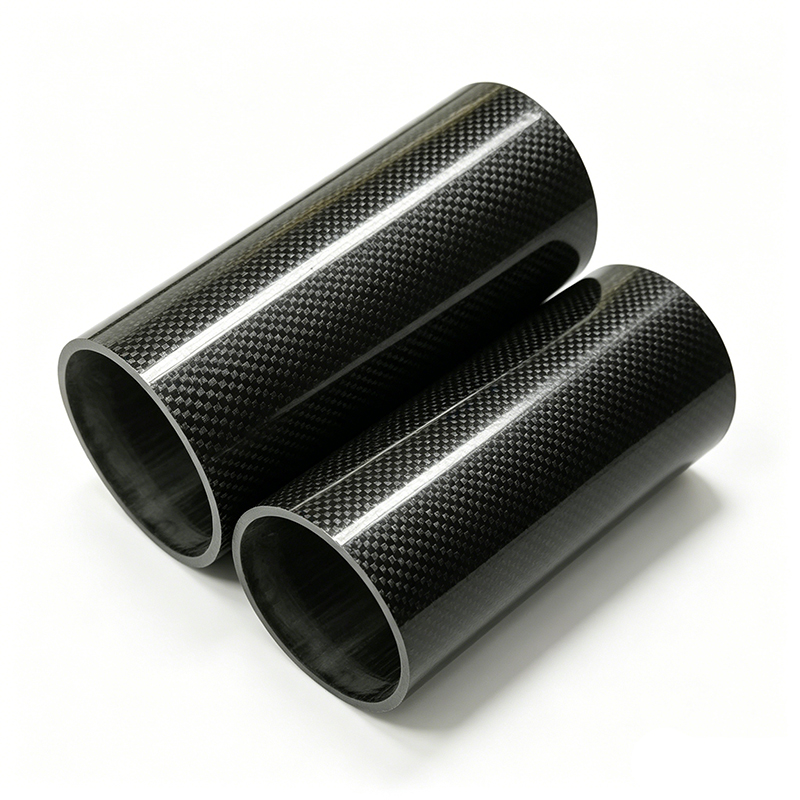
The Physics of Quiet Confidence
In precision engineering, the most critical performance attributes are often the ones you never see. While carbon fiber’s high strength-to-weight ratio is widely celebrated, its true value in demanding applications lies in a suite of less obvious, yet transformative properties. These “invisible advantages”—specifically high specific modulus, vibration damping, and dimensional stability—are what separate a merely functional component from one that delivers exceptional operational stability. This post examines how these characteristics manifest in carbon fiber tubes and why they matter for systems where consistency is paramount.
High Specific Modulus: The Stiffness-to-Weight Revolution
The first invisible advantage is high specific modulus—the ratio of stiffness (elastic modulus) to density. A standard carbon fiber tube, with a modulus of 230 GPa and a density of 1.6 g/cm³, offers a specific modulus roughly 2.5 times that of steel and nearly 4 times that of aluminum. When you specify a “high-modulus” (HM) fiber (modulus exceeding 395 GPa), that advantage multiplies to over 4 times steel.
What this means operationally: For a given load, a high-modulus carbon fiber tube will deflect significantly less than a metal tube of the same weight. But the more profound implication is that engineers can design a thinner-walled tube that retains the same stiffness as a thicker metal one, while reducing mass by up to 70%. This reduction in moving mass directly lowers inertia, which is critical for robotic arms, gantries, and high-speed printing systems. Lower inertia means less torque required for acceleration, less overshoot at stop points, and faster cycle times—all achieved without sacrificing the rigidity needed to maintain positional accuracy under fluctuating loads.
The Damping Ratio: Silence as a Specification
Vibration is the enemy of stability. In metal structures, vibrational energy propagates with minimal attenuation, leading to resonant chatter that degrades surface finish, measurement accuracy, and bearing life. Carbon fiber, by contrast, possesses a naturally high damping ratio—the ability to convert mechanical vibration into heat through internal friction at the fiber-matrix interface.
A typical carbon fiber tube exhibits a damping ratio 5 to 10 times higher than steel or aluminum. This is not a passive benefit; it is an engineered property. The viscoelastic epoxy matrix, combined with the anisotropic nature of the carbon fibers, creates a microstructural network that disrupts and dissipates energy across a broad frequency range. In a CNC spindle, this means a less “ringing” frame. In an aerospace drone arm, it means the camera platform remains stable in gusty conditions. The operational result is a dramatic reduction in settling time after any disturbance, allowing for faster servo tuning and tighter closed-loop control.
Thermal Dimensional Stability: The Low CTE Advantage
All materials expand and contract with temperature. The coefficient of thermal expansion (CTE) of metals is a constant headache for precision systems. Steel expands at ~12 ppm/°C; aluminum at ~23 ppm/°C. Over a 20°C temperature swing, a 500 mm aluminum tube grows by 0.23 mm—catastrophic for a precision linear stage.
Carbon fiber offers a unique counter-intuitive benefit: its CTE can be engineered to be near zero, or even slightly negative, along the fiber axis. A unidirectional carbon fiber tube with high-modulus fibers has a longitudinal CTE of approximately -0.5 to +0.5 ppm/°C. In a properly designed laminate, this can be optimized to cancel out the positive CTE of the resin system, yielding a dimensionally stable structure over a wide operating range.
Operational impact: In photolithography equipment, coordinate measuring machines (CMMs), or long-reach inspection arms, this stability ensures that measurements taken at 8 AM are identical to those taken at 4 PM, regardless of ambient heating or cooling cycles. The equipment does not drift; it holds its calibrated geometry, eliminating the need for frequent thermal compensation routines.
The Composite Effect: Synergy Over Sum
These advantages do not act in isolation. High specific modulus reduces deflection, which in turn reduces the amplitude of any vibration. High damping quickly kills what vibration does occur. Low CTE prevents thermally-induced geometric changes that could excite new resonances. Together, they create a system that is predictably stable—a condition where the machine’s behavior is consistent across time, temperature, and load.
This synergy is why high-modulus carbon fiber tubes are the material of choice for the horizontal beam of a high-speed pick-and-place machine, the main column of a precision measuring instrument, and the telescope tube of an astronomical observatory. In each case, the operator does not see the fiber orientation or the laminate stacking sequence. They only see that the machine produces repeatable, high-quality results—hour after hour, year after year. That is the real, invisible value of carbon fiber: not strength on paper, but stability in practice.
Conclusion: Specifying for the Invisible
When selecting carbon fiber tubes, it is easy to get lost in tensile strength numbers. But for operational stability, the specification sheet must focus on modulus (GPa), damping ratio, and CTE. Insist on these metrics from your supplier. A tube with mediocre modulus but flashy aesthetics will not provide the vibration attenuation or thermal immunity that your equipment demands. The next time you are evaluating a component, ask not “how strong is it?” but rather “how stable will it make my system?” The answer lies in the invisible advantages—and that is where high-modulus carbon fiber truly excels.