## Introduction
In the realm of professional photography, the tripod is an indispensable tool, providing the stability required for sharp images in diverse environments. As photographers increasingly venture into remote locations, the demand for portable yet robust support systems has intensified. Central to this evolution is the material choice for the tripod’s legs and support columns. While aluminum and steel have historically dominated, carbon fiber round tubes have emerged as the premier material for high-end portable photography tripods. This article delves into the engineering properties, manufacturing processes, and structural benefits of carbon fiber round tubes specifically within the context of tripod support frameworks, highlighting why they have become the industry standard for professionals who prioritize both performance and portability.
## The Engineering Imperative: Why Carbon Fiber for Tripods?
The primary function of a tripod is to provide a rigid, vibration-dampening platform for the camera. This requires a material that offers an exceptional stiffness-to-weight ratio, high tensile strength, and the ability to absorb micro-vibrations. Carbon fiber composites excel in all these areas. Unlike metals, which can transmit vibrations, carbon fiber’s internal structure naturally dampens high-frequency oscillations, a critical feature for long-exposure photography and video work. Furthermore, the low density of carbon fiber (approximately 1.6 g/cm³) compared to aluminum (2.7 g/cm³) or steel (7.9 g/cm³) allows for a significant reduction in overall tripod weight without compromising load-bearing capacity. This weight reduction is not merely a convenience; it is a strategic advantage for landscape, wildlife, and travel photographers who must carry their equipment over long distances.
## Material Properties and Structural Performance
### Stiffness and Load Capacity
The stiffness of a carbon fiber round tube is determined by the modulus of the carbon fibers used. High-modulus (HM) and intermediate-modulus (IM) fibers are commonly specified for tripod legs to achieve the necessary rigidity. A typical tripod leg must support a camera and lens combination that can weigh anywhere from 5 to 15 kilograms. The tube’s wall thickness and diameter are engineered to resist buckling and bending under these loads. For instance, a 28mm diameter tube with a 1.5mm wall thickness can offer a flexural rigidity that far exceeds that of a comparable aluminum tube of the same weight. This allows manufacturers to use thinner walls, further reducing weight while maintaining structural integrity.
### Vibration Damping
One of the most significant advantages of carbon fiber is its inherent damping characteristic. When a tripod is subjected to wind or shutter shock, the resulting vibrations can cause image blur. Carbon fiber’s viscoelastic nature absorbs these oscillations, dissipating energy as heat rather than transmitting it to the camera. This property is quantified by the material’s damping ratio, which is significantly higher for carbon fiber composites than for metals. For photographers working in windy conditions or using telephoto lenses, this translates directly into sharper images.
### Thermal Stability
Carbon fiber has a very low coefficient of thermal expansion (CTE), meaning it does not expand or contract significantly with temperature changes. This is particularly important for photographers who work in extreme environments, from freezing mountain tops to scorching deserts. Aluminum, in contrast, expands and contracts more noticeably, which can lead to a slight shift in the camera’s position during long exposures. The dimensional stability of carbon fiber ensures that the tripod’s geometry remains constant, preserving the composition and focus of the image.
## Manufacturing Processes for Carbon Fiber Tripod Tubes
The production of high-quality carbon fiber round tubes for tripods involves several sophisticated processes. The choice of process affects the tube’s mechanical properties, surface finish, and cost.
### Filament Winding
Filament winding is a common method for producing cylindrical composite structures. In this process, continuous carbon fiber tows are impregnated with resin and wound onto a rotating mandrel at precise angles. The winding angle can be optimized to provide strength in both the longitudinal and hoop directions, which is essential for a tripod leg that experiences both axial compression and bending. After winding, the component is cured in an oven or autoclave, and the mandrel is removed, leaving a hollow tube. Filament winding offers excellent control over fiber orientation and is highly repeatable, making it ideal for mass production of tripod legs.
### Pultrusion
Pultrusion is a continuous manufacturing process where carbon fiber tows are pulled through a resin bath and then through a heated die that shapes and cures the profile. This method is highly efficient for producing constant cross-section tubes with excellent longitudinal strength. However, pultruded tubes have fibers primarily oriented along the length, which provides high stiffness but lower hoop strength. For tripod legs, which may experience radial clamping forces from leg locks, a combination of pultrusion and braiding or a filament-wound outer layer is often used to enhance circumferential properties.
### Roll Wrapping
Roll wrapping involves wrapping pre-impregnated carbon fiber sheets (prepreg) around a mandrel. The prepreg is rolled onto the mandrel at specific angles, and the assembly is then cured under heat and pressure, often in an autoclave. This method allows for precise control over wall thickness and fiber orientation, resulting in a high-quality, void-free tube. Roll-wrapped tubes are typically more expensive but offer superior surface finish and mechanical properties, making them a choice for premium tripod models.
## Design Considerations for Tripod Support Frameworks
### Tapered Leg Design
Many high-end tripods feature legs that taper from a larger diameter at the top to a smaller diameter at the bottom. This design reduces weight while maintaining strength where it is most needed. Carbon fiber’s ability to be molded into complex shapes makes it ideal for such tapered tubes. The taper can be achieved through filament winding with a variable-diameter mandrel or by using a combination of different tube sections that are bonded together. The result is a leg that is thick and rigid near the apex, where the bending moment is highest, and thinner and lighter towards the foot.
### Joint and Locking Mechanisms
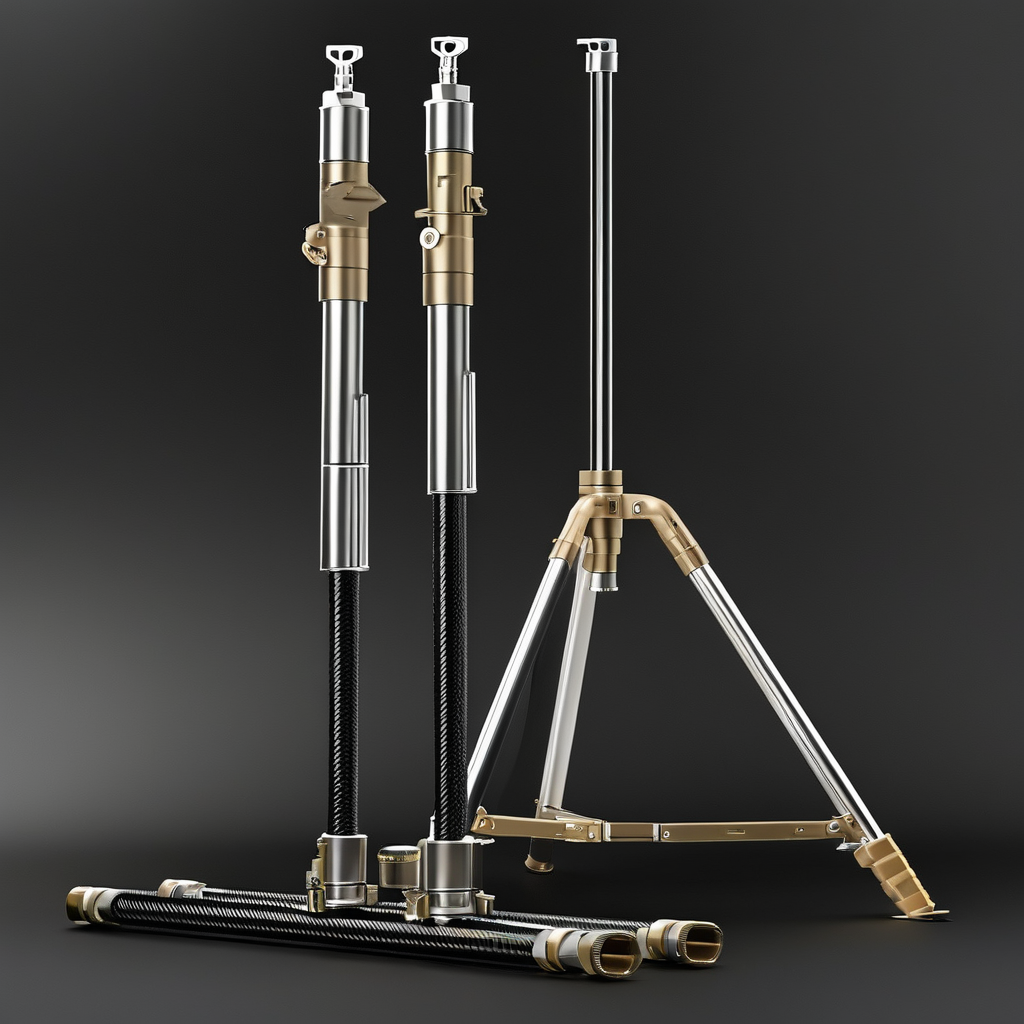
The connection between the leg sections and the locking mechanisms are critical points in a tripod’s design. Carbon fiber tubes are often fitted with aluminum or titanium inserts at the ends to provide a durable surface for the twist-lock or lever-lock mechanisms. These inserts are bonded to the carbon fiber using high-strength adhesives, ensuring a reliable load path. The design of these joints must account for the anisotropic nature of carbon fiber, which is strong in tension and compression along the fiber direction but weaker in shear. Proper bonding and mechanical interlocking are essential to prevent failure at these interfaces.
### Integration with Center Column and Apex
The apex of the tripod, where the three legs meet, is another critical component. In some designs, the apex is a cast aluminum or magnesium piece that is bolted to the carbon fiber legs. In more advanced designs, the apex itself may be a carbon fiber composite structure, further reducing weight. The center column, which allows for additional height adjustment, is often also made of carbon fiber. The column must be strong enough to support the camera without flexing, and its diameter is typically larger than that of the legs to provide adequate stiffness.
## Comparative Analysis: Carbon Fiber vs. Aluminum vs. Basalt Fiber
While carbon fiber is the premium choice, it is not the only material used in tripod construction. Aluminum is a common budget-friendly alternative, offering good strength and stiffness at a lower cost. However, aluminum tripods are heavier and conduct vibrations more readily. Basalt fiber is another composite material that has gained some traction in the market. It offers similar damping properties to carbon fiber but at a lower cost. However, basalt fiber has a lower modulus, meaning it is less stiff, requiring thicker walls to achieve the same rigidity, which negates some of the weight savings. Carbon fiber remains the superior choice for photographers who demand the absolute best in performance and portability.
## Quality Control and Testing
Manufacturers of carbon fiber tripod tubes must adhere to strict quality control standards to ensure safety and reliability. Non-destructive testing methods, such as ultrasonic inspection, are used to detect voids or delaminations in the composite structure. Mechanical testing, including compression, bending, and fatigue tests, is performed on sample tubes to verify that they meet the specified load ratings. Additionally, environmental testing simulates extreme temperatures and humidity to ensure that the tubes do not degrade over time. These rigorous testing protocols are essential to guarantee that a tripod will not fail in the field, potentially damaging expensive camera equipment.
## Conclusion
Carbon fiber round tubes have revolutionized the design of portable photography tripods, offering an unparalleled combination of lightweight construction, high stiffness, and superior vibration damping. The engineering and manufacturing processes involved in producing these tubes are complex, requiring careful consideration of fiber orientation, resin systems, and structural design. As a result, carbon fiber tripods represent the pinnacle of support framework technology, enabling photographers to capture images that were previously impossible due to weight or stability constraints. For professionals and serious enthusiasts, the investment in a carbon fiber tripod is a direct investment in the quality and reliability of their work, ensuring that the support system never becomes a limiting factor in their creative vision.