
## Introduction
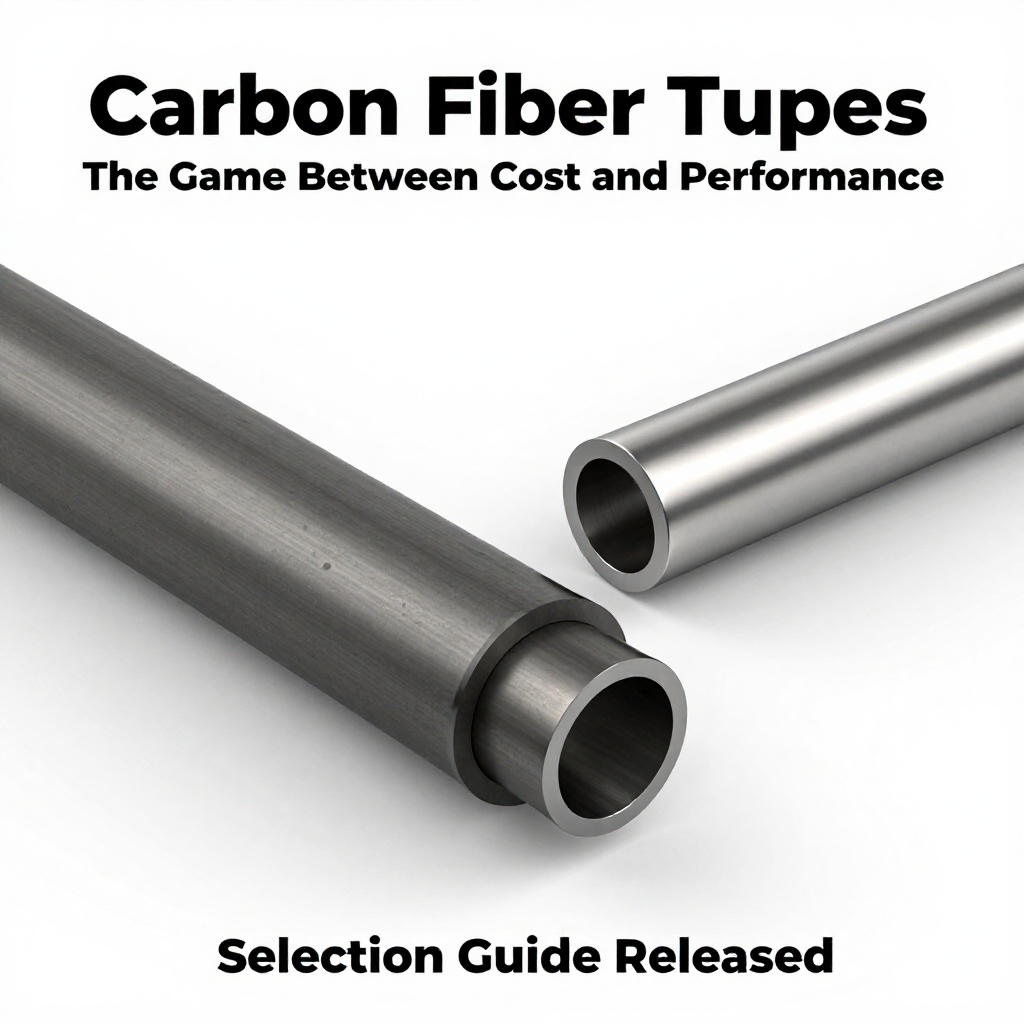
In the world of advanced engineering materials, the choice between carbon fiber tubes and titanium alloy tubes is a critical decision that can significantly impact product performance, manufacturing costs, and overall project success. Both materials offer exceptional strength-to-weight ratios, but they differ dramatically in mechanical properties, thermal behavior, corrosion resistance, and—most importantly—cost. This comprehensive selection guide aims to demystify the trade-offs between these two high-performance materials, providing engineers, designers, and procurement specialists with the data-driven insights needed to make an informed choice.
## Understanding the Materials
### Carbon Fiber Tubes: The Lightweight Champion
Carbon fiber reinforced polymer (CFRP) tubes are manufactured by aligning high-strength carbon fibers in a resin matrix, typically epoxy. The unidirectional or multi-directional fiber orientation allows engineers to tailor stiffness and strength precisely to the application’s load requirements. With a density of approximately 1.6 g/cm³, carbon fiber tubes are about 40% lighter than titanium alloy tubes (density ~4.4 g/cm³). This weight advantage is a primary driver for their adoption in aerospace, automotive, and sporting goods industries.
### Titanium Alloy Tubes: The Metal Workhorse
Titanium alloys, particularly Ti-6Al-4V (Grade 5), are renowned for their excellent combination of high tensile strength (around 900-1000 MPa), good ductility, and outstanding corrosion resistance. Unlike carbon fiber, titanium is isotropic, meaning its mechanical properties are consistent in all directions. This makes titanium tubes more predictable under complex loading scenarios and easier to join using conventional welding techniques.
## Performance Comparison: Beyond the Numbers
### Mechanical Strength and Stiffness
When comparing tensile strength, titanium alloy tubes typically exhibit a yield strength of 800-900 MPa, while high-modulus carbon fiber tubes can reach tensile strengths of 2000-3000 MPa along the fiber direction. However, carbon fiber’s strength is highly anisotropic—perpendicular to the fibers, the strength is only about 50-80 MPa. This means that carbon fiber tubes are excellent for axial loads but require careful design for bending, torsion, or impact loads. Titanium, on the other hand, offers uniform strength in all directions, making it more forgiving in multi-axial stress states.
In terms of stiffness, carbon fiber’s modulus of elasticity can range from 230 GPa (standard modulus) to 400 GPa (ultra-high modulus), while titanium’s modulus is around 110-120 GPa. For applications requiring maximum stiffness with minimal weight, carbon fiber is the clear winner.
### Fatigue and Impact Resistance
Titanium alloys have superior fatigue resistance, especially under cyclic loading, due to their ductility and ability to absorb energy through plastic deformation. Carbon fiber composites, while having good fatigue properties in the fiber direction, are more susceptible to impact damage. A low-velocity impact can cause delamination, which is often invisible to the naked eye but can drastically reduce load-bearing capacity. Titanium tubes, in contrast, will show visible dents or cracks before failure, providing a warning sign for maintenance.
### Thermal and Electrical Properties
Titanium has a thermal expansion coefficient of about 8.6 µm/m·°C, which is relatively low for a metal, but carbon fiber’s negative axial thermal expansion coefficient (around -0.5 to -1 µm/m·°C) makes it dimensionally stable under temperature changes. This property is advantageous in precision instruments and space structures. However, carbon fiber is electrically conductive, which can cause galvanic corrosion when in contact with metals like aluminum. Titanium is a poor conductor of electricity and heat, making it suitable for thermal insulation applications.
### Corrosion Resistance
Titanium is virtually immune to corrosion in seawater, acidic environments, and many chemical media, thanks to its stable oxide layer. Carbon fiber composites are generally corrosion-resistant, but the resin matrix can absorb moisture, leading to micro-cracking and degradation over time. Additionally, carbon fiber can act as a cathode in galvanic couples, accelerating corrosion of adjacent metal parts.
## Cost Analysis: The Deciding Factor
### Raw Material Costs
The raw material cost of carbon fiber is significantly higher than that of titanium alloy. High-grade carbon fiber (e.g., T700 or T800) costs between $20 and $40 per kilogram, while titanium alloy (Ti-6Al-4V) costs around $15-$25 per kilogram. However, the price gap narrows when considering the final component weight—since carbon fiber is lighter, the cost per part may be comparable for weight-critical applications.
### Manufacturing and Processing Costs
Titanium tubes are typically produced by extrusion, rolling, or machining from solid bars. These processes are well-established and relatively inexpensive for simple geometries. However, titanium is notoriously difficult to machine due to its low thermal conductivity and high chemical reactivity, leading to increased tool wear and longer cycle times. Welding titanium requires a controlled atmosphere to prevent contamination, adding to production costs.
Carbon fiber tubes are manufactured through processes like pultrusion, filament winding, or roll wrapping. These processes are labor-intensive and require autoclave curing, which is energy-intensive. The cost of molds and tooling is also high. However, for high-volume production, automated fiber placement and resin transfer molding can reduce costs. Overall, carbon fiber tube manufacturing is generally more expensive than titanium tube manufacturing for simple shapes, but the cost difference diminishes for complex, net-shaped parts.
### Lifecycle and Maintenance Costs
When evaluating total cost of ownership, carbon fiber tubes often require less maintenance due to their inherent corrosion resistance (provided the matrix is intact). However, they are more susceptible to impact damage, which may necessitate costly repairs or replacements. Titanium tubes, while more robust, may require periodic inspection and surface treatment to prevent galling or stress corrosion cracking in aggressive environments.
## Application-Specific Selection Guide
### Aerospace and Defense
In aerospace, weight reduction is paramount. Carbon fiber tubes are extensively used in aircraft control surfaces, landing gear struts, and satellite structures where every gram counts. Titanium is preferred for high-temperature areas (e.g., engine components) and where impact resistance is critical, such as helicopter rotor shafts.
### Automotive and Motorsports
For high-performance vehicles, carbon fiber drive shafts and suspension links offer significant weight savings and improved torsional stiffness. Titanium is used in exhaust systems and roll cages where high-temperature resistance and energy absorption are needed. For budget-conscious racing teams, titanium may be a more cost-effective choice due to lower material costs and easier repair.
### Medical and Prosthetics
Carbon fiber is the material of choice for prosthetic limbs and orthopedic implants due to its biocompatibility, radiolucency, and ability to be tailored for specific load-bearing requirements. Titanium is also biocompatible and is used in bone plates and screws where high fatigue strength is required. The choice depends on whether the application prioritizes weight (carbon fiber) or durability (titanium).
### Industrial and Marine
In marine environments, titanium’s corrosion resistance makes it ideal for underwater equipment, heat exchangers, and propeller shafts. Carbon fiber is used in masts, booms, and hulls of racing yachts, but requires careful isolation from metal fittings to prevent galvanic corrosion. For industrial applications like robotic arms and structural supports, the decision hinges on the operating environment and load conditions.
## Conclusion
The battle between carbon fiber tubes and titanium alloy tubes is not about which material is superior, but rather which is more suitable for a specific application. Carbon fiber offers unmatched weight savings and stiffness, making it ideal for performance-critical and weight-sensitive designs. Titanium provides reliability, impact resistance, and corrosion resistance, often at a lower manufacturing cost.
To make the right choice, engineers must consider not only the initial material and processing costs but also the lifecycle performance, maintenance requirements, and failure modes. By using this selection guide, you can navigate the cost-performance game with confidence, ensuring that your project achieves the optimal balance between budget and functionality.
For further assistance, consult with material specialists and conduct prototype testing to validate performance under real-world conditions. The future of engineering lies in smart material selection, and understanding the trade-offs between carbon fiber and titanium is a crucial step in that direction.