
## Introduction
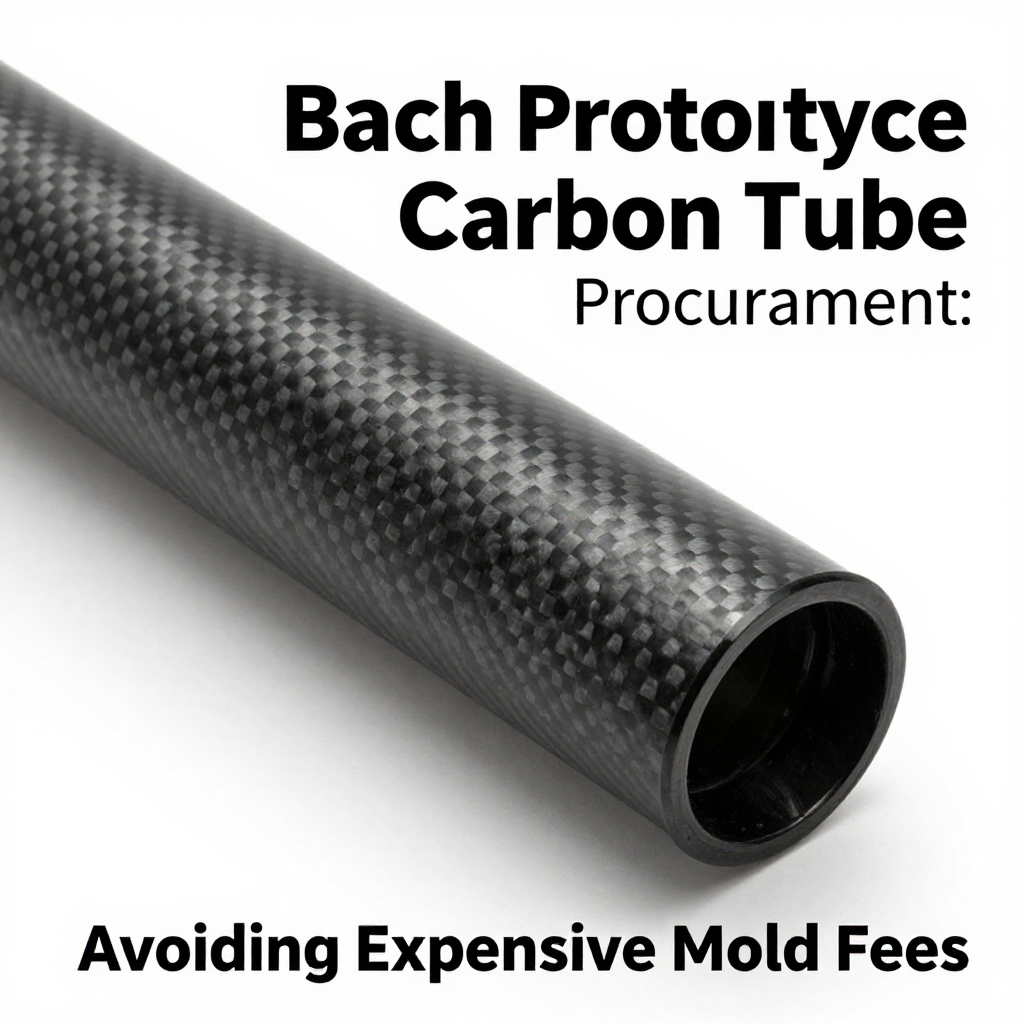
Carbon fiber tubes are prized for their exceptional strength-to-weight ratio, stiffness, and corrosion resistance, making them indispensable in aerospace, automotive, robotics, and sporting goods. However, for startups, R&D teams, and low-volume manufacturers, the traditional procurement route often hits a roadblock: high mold fees. Custom carbon tube tooling can cost thousands of dollars, which is prohibitive when you only need a few prototypes or a short production run. Fortunately, there are several proven strategies to source small batch prototype carbon tubes without breaking the bank. This article explores practical solutions, from mandrel-less techniques to modular tooling and strategic supplier partnerships.
## Understanding the Mold Fee Problem
Carbon fiber tubes are typically manufactured using a pultrusion, filament winding, or roll-wrapping process, each requiring a dedicated mold or mandrel. For custom diameters, wall thicknesses, or fiber orientations, a new mold is often necessary. The cost of a precision steel or aluminum mandrel can range from $500 to $5,000 or more, depending on complexity. For a prototype run of just 10 to 50 tubes, this tooling cost becomes a significant per-unit expense. Moreover, lead times for custom tooling can stretch to several weeks, delaying critical development cycles.
## Solution 1: Use Mandrel-Less Manufacturing Processes
One of the most effective ways to avoid mold fees is to choose a manufacturing process that does not require a dedicated mandrel. Two such methods are:
– **Filament Winding with Collapsible Mandrels**: While traditional filament winding uses a rigid mandrel, some suppliers offer collapsible or segmented mandrels that can be adjusted to different diameters. This allows you to produce tubes of varying sizes without investing in a new mandrel for each dimension. The mandrel is reused, and only the winding program changes.
– **Roll Wrapping with Expandable Bladders**: In this process, a flexible bladder is inflated inside the carbon fiber layup to apply pressure during curing. The bladder can be reused for a range of diameters, and the outer mold is often a simple aluminum or steel tube that can be machined at a lower cost. Some suppliers even use a single outer mold for multiple inner diameters by varying the bladder size.
These methods significantly reduce tooling costs, making them ideal for prototype quantities.
## Solution 2: Leverage Standardized Mandrel Sizes
Many carbon tube manufacturers maintain a library of standard mandrel sizes (e.g., 10mm, 20mm, 30mm, 50mm, etc.). By designing your prototype around these standard dimensions, you can avoid custom tooling altogether. Even if your required diameter is slightly off, you can often adjust the wall thickness or fiber layup to meet your performance needs while staying within a standard mandrel size. This approach is particularly effective for early-stage testing where exact dimensions are not critical.
## Solution 3: Partner with a Supplier Offering Low-Cost Prototype Tooling
Some specialized carbon fiber fabricators have developed low-cost tooling options specifically for prototypes. These include:
– **3D-Printed Mandrels**: For low-temperature curing prepregs, 3D-printed polymer mandrels can be used. They are inexpensive and can be produced in days. However, they are limited to lower curing temperatures (typically below 150°C) and may not be suitable for all resin systems.
– **Machined Aluminum Mandrels**: Instead of hardened steel, some suppliers use soft aluminum mandrels that are easier and cheaper to machine. While they may not last for high-volume production, they are perfectly adequate for prototype runs of 10-100 parts.
– **Modular Tooling Systems**: A few companies offer modular mandrel systems where you can combine standard segments to achieve different lengths and diameters. This reduces the need for a completely custom tool.
When sourcing, explicitly ask suppliers if they have prototype-grade tooling options that can be amortized over a small run.
## Solution 4: Opt for Pultrusion with Custom Dies (But Be Smart)
Pultrusion is a continuous process that uses a die to shape the profile. While custom dies are expensive, some pultruders offer “near-net” shapes that can be machined to your final dimensions. For example, you can order a standard round tube and then machine it to a custom outer diameter or add features like slots or holes. This avoids the cost of a custom die and is cost-effective for small quantities, especially if you have in-house machining capabilities.
## Solution 5: Consider Hybrid Approaches
Sometimes, you can combine different manufacturing methods to reduce tooling costs. For instance:
– Use a **filament-wound tube** with a standard mandrel and then **machine the ends** to create custom fittings or threads.
– Use a **roll-wrapped tube** with a standard outer diameter and then **sand or grind** the inner diameter to achieve a tight tolerance.
These hybrid approaches allow you to leverage standard tooling while still achieving a custom final product.
## Solution 6: Collaborate with Research Institutions or Open-Source Communities
Universities and research labs often have carbon fiber processing equipment and may be willing to produce small batches for a fee. They may also have access to grant funding that can offset tooling costs. Additionally, some open-source hardware projects share designs for low-cost mandrels and winding machines, enabling you to produce your own tubes in-house for prototyping. While this requires an upfront investment in equipment, it can be cost-effective if you anticipate multiple prototype iterations.
## How to Evaluate Suppliers for Prototype-Friendly Pricing
When contacting potential suppliers, ask the following questions:
– Do you have standard mandrel sizes that match my requirements?
– What is your minimum order quantity (MOQ) for prototype runs?
– Can you use a collapsible or expandable mandrel for my tube dimensions?
– Do you offer prototype-grade tooling at a reduced cost?
– What is the lead time for a prototype without custom tooling?
– Are there any additional machining or finishing services that can help me avoid custom tooling?
Suppliers that specialize in low-volume or custom carbon fiber parts are more likely to offer flexible tooling solutions.
## Case Study: A Robotics Startup’s Success
A robotics startup needed 30 carbon fiber tubes with a unique 28mm outer diameter and a 2mm wall thickness for a new drone arm. Traditional tooling would have cost $3,000 and taken 4 weeks. By partnering with a supplier that used a collapsible mandrel system, they were able to produce the tubes using a standard 30mm mandrel and then machine the outer diameter down to 28mm. The total cost was $1,200, and the parts were delivered in 10 days. This approach saved the startup both time and money, allowing them to iterate on their design quickly.
## Conclusion
Small batch prototype carbon tube procurement does not have to be prohibitively expensive. By exploring mandrel-less processes, standard mandrel sizes, prototype-grade tooling, and hybrid manufacturing approaches, you can significantly reduce or eliminate mold fees. The key is to communicate your needs clearly with suppliers and be open to alternative manufacturing methods. With these strategies, you can accelerate your development cycle and bring your carbon fiber products to market faster and more cost-effectively.
Remember, the goal of prototyping is to test and refine your design. By minimizing tooling costs, you can afford to iterate more often, ultimately leading to a better final product. So, don’t let mold fees hold you back—explore these solutions and start building your carbon fiber prototypes today.