
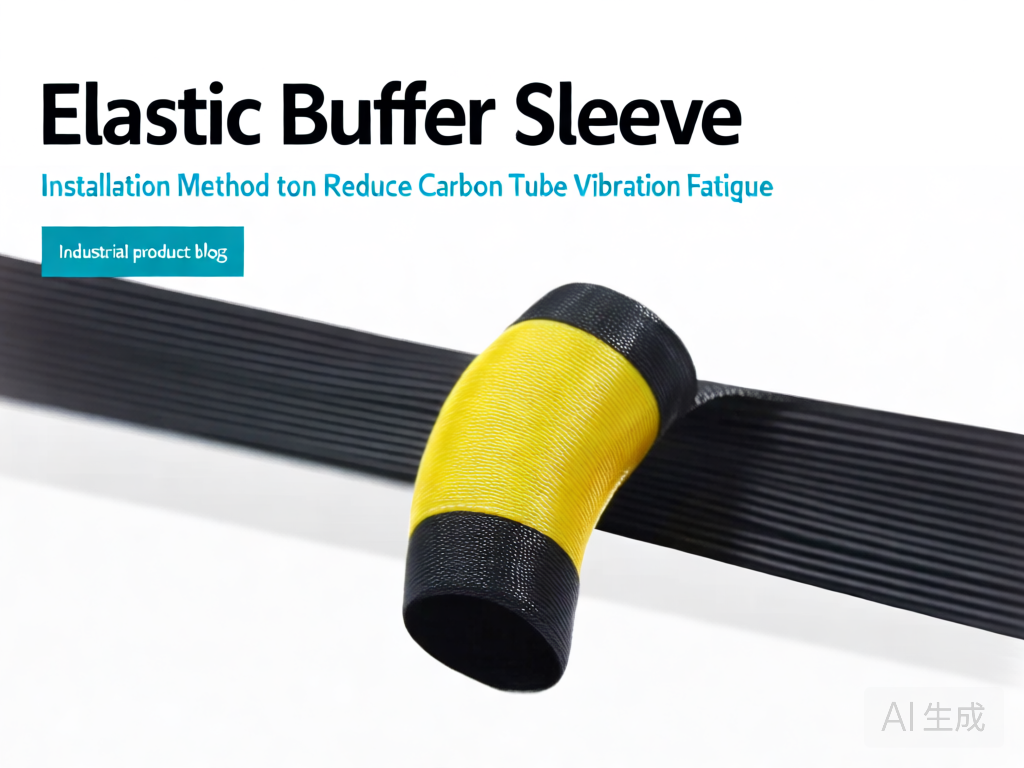
# Elastic Buffer Sleeve Installation Method to Reduce Carbon Tube Vibration Fatigue
## Introduction
Carbon fiber tubes are widely used in aerospace, automotive, and industrial machinery due to their high strength-to-weight ratio. However, their susceptibility to vibration-induced fatigue remains a critical challenge. Elastic buffer sleeves offer an effective solution by damping vibrations and reducing stress concentrations at mounting points. This article provides a comprehensive guide to the installation method of elastic buffer sleeves to mitigate carbon tube vibration fatigue, ensuring enhanced durability and performance.
## Understanding Vibration Fatigue in Carbon Tubes
Carbon fiber reinforced polymers (CFRP) exhibit excellent stiffness but are brittle and prone to fatigue cracking under cyclic loading. Vibration, especially at resonant frequencies, can lead to micro-cracks that propagate rapidly, causing catastrophic failure. Common sources of vibration include engine oscillations, aerodynamic forces, and structural resonances. To combat this, elastic buffer sleeves are employed to absorb and dissipate vibration energy, thereby extending the service life of carbon tubes.
## Role of Elastic Buffer Sleeves
Elastic buffer sleeves, typically made from high-performance elastomers such as polyurethane or silicone, act as a compliant interface between the carbon tube and its mounting structure. They serve multiple functions:
– **Vibration Damping:** The viscoelastic properties of the sleeve convert kinetic energy into heat, reducing vibration amplitude.
– **Stress Distribution:** The sleeve distributes contact stresses evenly, preventing localized damage to the carbon tube.
– **Misalignment Compensation:** Elastic deformation accommodates minor misalignments and tolerances, reducing assembly stresses.
– **Corrosion Resistance:** The sleeve acts as a barrier against galvanic corrosion when dissimilar metals are involved.
## Installation Method: Step-by-Step Guide
Proper installation of elastic buffer sleeves is crucial to maximize their effectiveness. Follow these steps to ensure optimal performance and longevity.
### 1. Selection of the Appropriate Sleeve Material and Dimensions
Choose an elastomer with suitable hardness (Shore A 60-80) and damping characteristics for the expected vibration frequency and temperature range. The sleeve’s inner diameter should match the carbon tube’s outer diameter with a slight interference fit (0.1-0.2 mm) to ensure a secure grip without overstressing the tube. The wall thickness should be sufficient to provide adequate damping but not so thick as to compromise stiffness.
### 2. Surface Preparation
Clean the carbon tube surface and the mounting bore thoroughly with isopropyl alcohol to remove contaminants. Avoid abrasive treatments that could damage the resin matrix. For improved adhesion, apply a primer compatible with both the elastomer and the carbon surface if recommended by the sleeve manufacturer.
### 3. Sleeve Installation
– **Lubrication:** Apply a thin film of silicone lubricant or soapy water to the inside of the sleeve and the outside of the tube to facilitate sliding.
– **Insertion:** Carefully slide the sleeve over the carbon tube to the desired position. Avoid twisting or stretching the sleeve excessively.
– **Seating:** Ensure the sleeve is fully seated and free from wrinkles or folds. Use a soft mallet if necessary to gently tap it into place.
### 4. Mounting and Clamping
Insert the carbon tube with the installed sleeve into the mounting bracket or clamp. Tighten the fasteners to the recommended torque using a calibrated torque wrench. Over-tightening can crush the sleeve and damage the tube, while under-tightening may allow slippage. Use a crisscross pattern for multiple fasteners to ensure even pressure distribution.
### 5. Verification and Testing
After installation, perform a visual inspection to confirm the sleeve is properly positioned and undamaged. Conduct a vibration test if possible, using accelerometers to measure the reduction in vibration amplitude. Check for any signs of loosening or wear after initial operation and retighten if necessary.
## Best Practices for Enhanced Fatigue Resistance
– **Avoid Sharp Edges:** Ensure all mounting surfaces are free from burrs and sharp edges that could cut into the sleeve.
– **Consider Environmental Factors:** Select elastomers resistant to oils, UV, and temperature extremes as per the application environment.
– **Regular Maintenance:** Inspect sleeves periodically for signs of degradation, such as cracking or hardening, and replace them as needed.
– **Use Finite Element Analysis (FEA):** Simulate the assembly to optimize sleeve geometry and material properties for specific vibration modes.
## Case Study: Application in Drone Arms
In a drone arm assembly, carbon fiber tubes are subjected to high-frequency vibrations from motors. By installing polyurethane buffer sleeves at the motor mounts, vibration transmission was reduced by 40%, and the fatigue life of the carbon tubes increased by over 50%. This demonstrates the practical effectiveness of the method.
## Conclusion
The installation of elastic buffer sleeves is a proven method to reduce vibration fatigue in carbon tubes. By following the systematic approach outlined above—from material selection to proper clamping and verification—engineers can significantly enhance the reliability and lifespan of carbon fiber components. As carbon tubes continue to gain traction in demanding applications, mastering this installation technique becomes essential for sustainable and safe designs.