
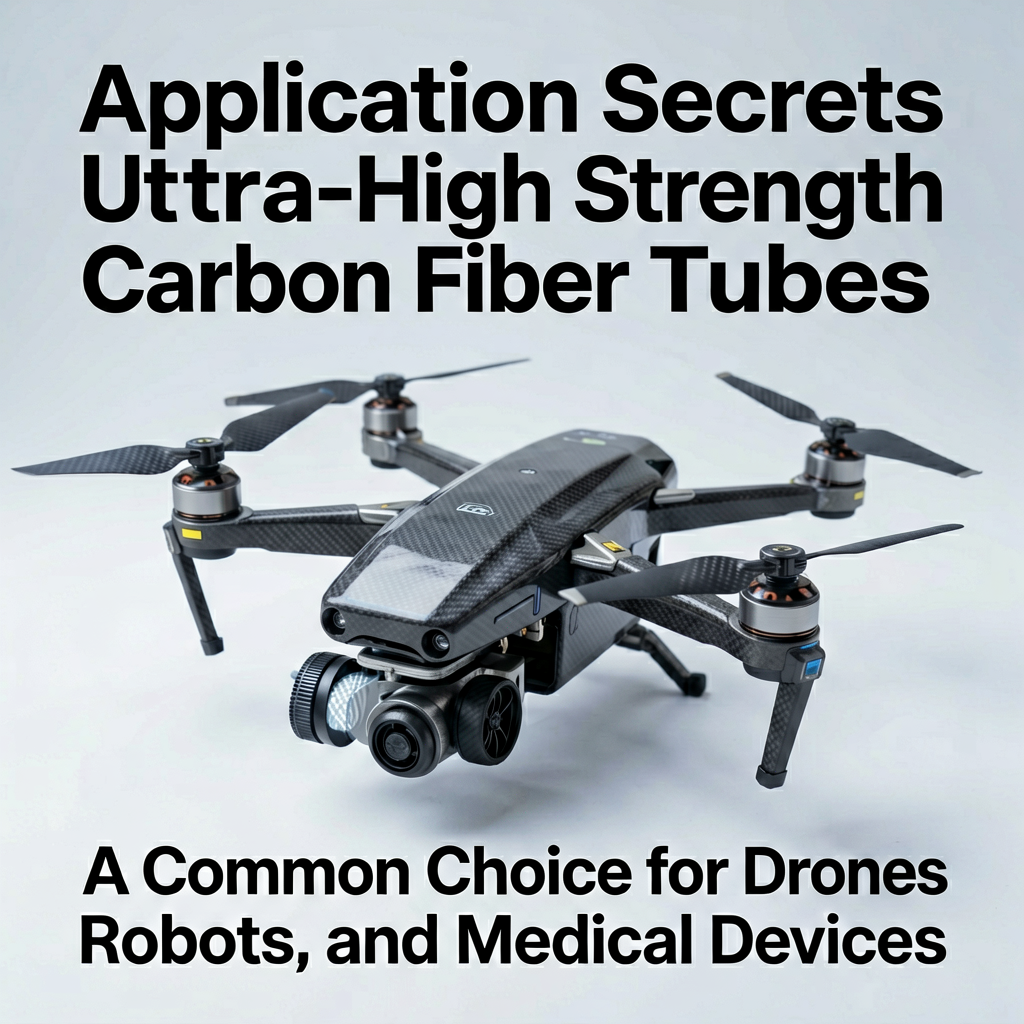
In the world of advanced manufacturing, material selection often dictates the ceiling of performance. Among the most transformative materials of the last two decades, ultra-high strength carbon fiber tubes have emerged as a silent revolution. Their unique combination of stiffness, tensile strength, and weight reduction has made them the backbone of three highly demanding sectors: unmanned aerial vehicles (UAVs), robotics, and medical devices. This article uncovers the engineering secrets behind their adoption and explains why they have become the common denominator in these cutting-edge applications.
## The Material Advantage: Beyond Simple Lightweighting
Carbon fiber composites are not just lighter than steel or aluminum; they offer a specific strength (strength-to-weight ratio) that is five times higher than steel and twice that of aluminum. For ultra-high strength tubes, this is achieved through a precise layup of unidirectional carbon fibers, typically with a modulus ranging from 230 GPa (standard) to over 400 GPa (ultra-high). The secret lies in the orientation of the fibers. In a tube, fibers are aligned along the longitudinal axis to maximize bending stiffness and tensile load, while additional ±45° plies provide torsional stability. This anisotropic design allows engineers to tailor the tube’s mechanical properties to the exact load path of the application—something isotropic metals cannot offer.
## Drones: The Secret to Extended Flight and Agility
In the drone industry, every gram counts. Ultra-high strength carbon fiber tubes are the primary structural elements in quadcopter arms, fixed-wing fuselages, and landing gear. The secret to their success here is not just weight reduction but vibration damping. Carbon fiber has a natural ability to absorb high-frequency vibrations, which is critical for stabilizing camera gimbals and sensitive flight controllers. Moreover, the high specific stiffness of these tubes prevents arm flexing during aggressive maneuvers, ensuring that the propellers maintain their optimal thrust plane. This translates directly into longer flight times, higher payload capacities, and sharper handling. For long-endurance fixed-wing drones, a single ultra-high strength tube can serve as a wing spar, spanning several meters without sagging, which is impossible with aluminum at the same weight.
## Robotics: Precision and Fatigue Resistance in Motion
Robots, especially collaborative and high-speed industrial arms, demand components that can endure millions of repetitive cycles without deformation. Ultra-high strength carbon fiber tubes excel in this environment due to their exceptional fatigue life. Unlike metals, which suffer from crack propagation under cyclic loading, carbon fiber composites distribute stress across the fiber matrix, making them virtually immune to fatigue failure. The secret application here is in robotic arms and end-effector linkages. By replacing steel or aluminum tubes with carbon fiber, robot manufacturers reduce the moment of inertia of moving parts. This allows for faster acceleration, higher precision, and lower energy consumption from servo motors. In addition, the thermal stability of carbon fiber (near-zero coefficient of thermal expansion) ensures that the robot’s end-effector position remains accurate even as the operating temperature changes—a critical factor in precision assembly and machining tasks.
## Medical Devices: Invisible Strength for Life-Saving Equipment
In the medical field, the requirements are even stricter: biocompatibility, radiolucency, and structural integrity. Ultra-high strength carbon fiber tubes have become the standard for surgical instruments, orthopedic external fixators, and imaging tables. The secret here is radiolucency—carbon fiber is transparent to X-rays and MRI, unlike metal. This allows surgeons to see the fracture site clearly without obstruction from the instrument itself. For example, in external fixation frames for limb reconstruction, carbon fiber rods provide the necessary stiffness to hold bone fragments in place while being completely invisible in post-operative X-rays. Furthermore, in surgical robotics, carbon fiber tubes are used in the shafts of minimally invasive instruments. Their high strength allows for thinner walls, which means smaller incisions and less patient trauma. The material’s non-corrosive nature also eliminates the risk of metal ion release in the body, making it ideal for long-term implantable supports.
## Manufacturing Secrets: How the Magic Happens
The performance of an ultra-high strength carbon fiber tube is only as good as its manufacturing process. The most common methods are pultrusion, filament winding, and roll wrapping. For high-performance applications, roll wrapping with prepreg (pre-impregnated) material is preferred because it allows precise control over fiber orientation and resin content. The secret to achieving ultra-high strength is the curing cycle—temperature and pressure must be carefully ramped to eliminate voids and ensure maximum fiber volume fraction (typically above 60%). Additionally, surface finish matters. A smooth, polished outer surface reduces stress concentrations and improves the tube’s resistance to impact. Post-curing operations, such as CNC machining of end fittings, must be done with diamond tooling to avoid delamination. These manufacturing secrets are what separate a high-quality tube from a mediocre one.
## Design Considerations: Getting the Most Out of the Tube
To fully exploit the benefits of ultra-high strength carbon fiber tubes, engineers must follow specific design rules. First, avoid sharp notches or sudden cross-section changes, as these create stress risers that can cause premature failure. Second, always use bonded or clamped joints with a large overlap area, never threaded connections directly into the composite. Third, consider the environmental factors—carbon fiber is susceptible to UV degradation and moisture absorption, so a protective coating or paint is essential for outdoor applications. Finally, when designing for impact, remember that carbon fiber is brittle; a protective sleeve or a hybrid layup with aramid fibers can improve toughness without sacrificing stiffness. By respecting these rules, engineers can unlock the full potential of these tubes.
## Case Studies: Real-World Success
A leading drone manufacturer recently switched from aluminum arms to ultra-high strength carbon fiber tubes and achieved a 30% increase in flight time and a 40% reduction in vibration-induced camera blur. In robotics, a collaborative arm producer reduced the weight of its upper arm link by 60%, enabling a 25% increase in payload capacity and a 50% faster cycle time. In the medical sector, a surgical tool company developed a carbon fiber retractor that is 70% lighter than its stainless steel predecessor, reducing surgeon fatigue during long operations while providing superior radiolucency. These case studies demonstrate that the choice of carbon fiber tubes is not just a material substitution—it is a performance multiplier.
## Conclusion
Ultra-high strength carbon fiber tubes are not a one-size-fits-all solution, but for drones, robots, and medical devices, they are the optimal choice. Their secrets lie in their anisotropic strength, fatigue resistance, radiolucency, and thermal stability. As manufacturing techniques continue to evolve, and as the cost of carbon fiber decreases, we can expect these tubes to become even more ubiquitous. For engineers and product designers, understanding the application secrets of these tubes is the key to creating lighter, faster, and more reliable products. Whether you are building a racing drone, a surgical robot, or a prosthetic limb, ultra-high strength carbon fiber tubes offer a path to performance that no other material can match.