
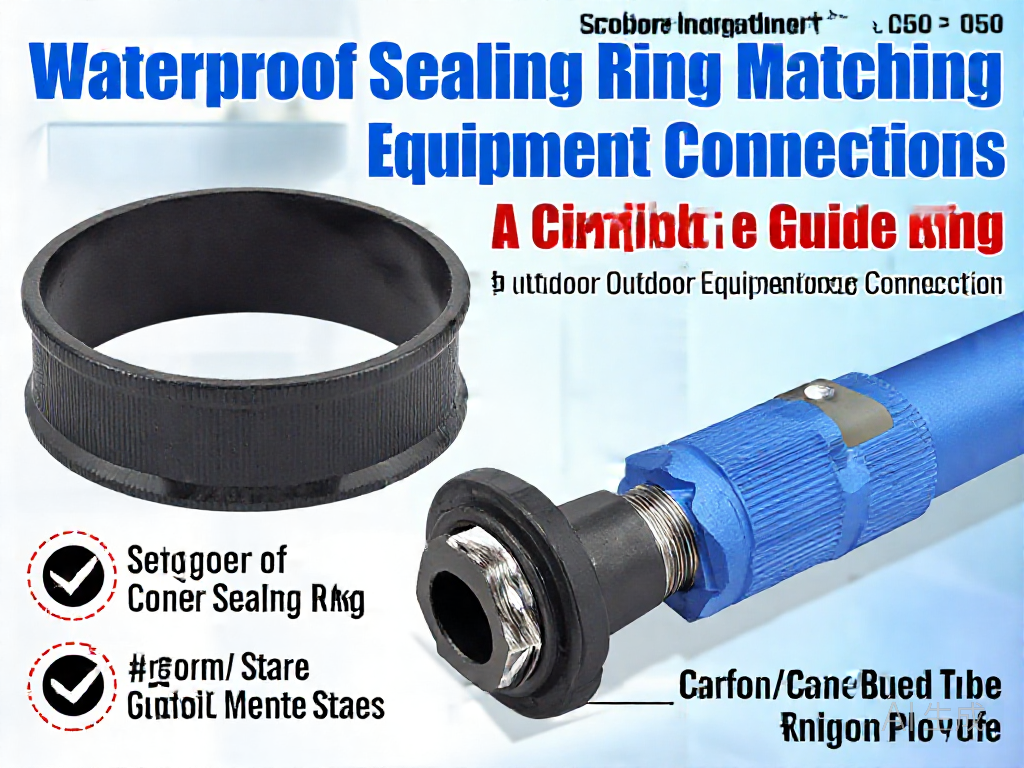
# Waterproof Sealing Ring Matching for Carbon Tube Outdoor Equipment Connections
Carbon fiber tubes are increasingly popular in outdoor equipment such as tent poles, hiking poles, tripods, and modular frames due to their high strength-to-weight ratio and corrosion resistance. However, the connections between carbon tubes are vulnerable to water ingress, which can lead to structural degradation, mold growth, and reduced performance. Proper matching of waterproof sealing rings is critical to ensure reliable, long-lasting outdoor equipment. This article provides a comprehensive guide to selecting and matching sealing rings for carbon tube connections, covering material compatibility, dimensional tolerances, environmental factors, and installation best practices.
## Understanding the Role of Sealing Rings in Carbon Tube Connections
Sealing rings, also known as O-rings or gaskets, create a barrier that prevents water, dust, and other contaminants from entering the joint between two carbon tubes. In outdoor equipment, these connections are often subjected to dynamic loads, temperature fluctuations, and exposure to UV radiation and moisture. A well-matched sealing ring must maintain its elasticity and sealing force under these conditions while avoiding damage to the carbon tube surface.
### Key Challenges with Carbon Fiber Surfaces
Carbon fiber reinforced polymer (CFRP) tubes have a smooth, hard surface that can be abrasive to softer sealing materials. Additionally, the resin matrix may be susceptible to chemical attack from certain lubricants or cleaning agents. Therefore, the sealing ring material must be compatible with both the carbon composite and the environmental stressors.
## Material Selection for Waterproof Sealing Rings
The choice of sealing ring material directly impacts sealing performance, durability, and compatibility with carbon tubes. Common materials include nitrile rubber (NBR), silicone rubber, fluorocarbon rubber (FKM), and thermoplastic elastomers (TPE). Each has distinct advantages and limitations.
### Nitrile Rubber (NBR)
NBR offers excellent resistance to oils and water, making it suitable for general outdoor applications. It has good mechanical properties and is cost-effective. However, NBR has limited resistance to UV and ozone, so it may degrade if exposed to sunlight over extended periods. For carbon tube connections that are frequently exposed, NBR may require additional protection.
### Silicone Rubber
Silicone rubber provides a wide temperature range (-60°C to 200°C) and excellent flexibility, which helps maintain sealing performance in cold conditions. It is also resistant to UV and ozone. However, silicone has lower tear strength and may be prone to damage during installation. It is ideal for applications where temperature extremes are expected.
### Fluorocarbon Rubber (FKM)
FKM, such as Viton®, offers superior chemical resistance and high-temperature stability. It is resistant to UV, ozone, and many chemicals, making it a premium choice for harsh environments. The downside is higher cost and limited low-temperature flexibility (typically down to -20°C). For high-end outdoor equipment, FKM can provide long-term reliability.
### Thermoplastic Elastomers (TPE)
TPE materials combine the flexibility of rubber with the processability of plastics. They can be formulated for specific hardness and resistance properties. TPEs are often used in overmolding applications, where the sealing ring is bonded directly to the carbon tube or connector. They offer good UV resistance and can be recycled, but may have lower compression set resistance compared to thermoset rubbers.
## Dimensional Matching and Tolerance Considerations
Proper sealing requires precise dimensional matching between the sealing ring, the carbon tube, and the connector. Key parameters include the inner diameter (ID), outer diameter (OD), cross-section (CS), and groove dimensions.
### Standard vs. Custom Sizes
While standard O-ring sizes are readily available, carbon tube connections often require custom dimensions to ensure optimal sealing. The sealing ring should be sized to provide a compression ratio (the amount of squeeze) typically between 15% and 30% for static seals, and 10% to 25% for dynamic seals. Over-compression can cause excessive stress and premature failure, while under-compression leads to leakage.
### Surface Finish and Groove Design
The surface finish of the carbon tube and the groove in the connector must be smooth to prevent damage to the sealing ring and ensure uniform contact. A surface roughness (Ra) of 0.8 µm or better is recommended. The groove should be designed with rounded edges and a width that allows for thermal expansion of the sealing ring.
## Environmental and Mechanical Factors
Outdoor equipment is exposed to a range of environmental conditions that affect sealing performance. These include temperature variations, UV radiation, moisture, and mechanical loads.
### Temperature Extremes
Sealing materials must remain flexible at low temperatures and resist degradation at high temperatures. For applications in alpine or desert environments, silicone or FKM may be necessary. The compression set of the material at expected temperatures should be considered to ensure long-term sealing.
### UV and Ozone Resistance
Carbon tubes are often used in exposed structures, so sealing rings must resist UV and ozone degradation. Materials like silicone, FKM, and UV-stabilized TPE are preferred. Adding carbon black to NBR can improve UV resistance, but may not be sufficient for prolonged exposure.
### Mechanical Loads and Vibration
Connections in outdoor equipment may experience repeated assembly/disassembly, vibration, and impact. The sealing ring must maintain its position and sealing force under these conditions. Groove design and material hardness play a role: harder materials (e.g., 70 Shore A) resist extrusion better, while softer materials (e.g., 50 Shore A) conform more easily to surface irregularities.
## Installation Best Practices
Proper installation is crucial to achieve a reliable seal. Follow these guidelines:
– **Cleanliness**: Ensure all surfaces are free of dust, oil, and debris before assembly.
– **Lubrication**: Apply a compatible lubricant (e.g., silicone grease for silicone rings) to reduce friction and prevent damage during installation. Avoid petroleum-based lubricants with silicone or EPDM rings.
– **Inspection**: Check sealing rings for defects such as cuts, tears, or deformation before installation.
– **Assembly**: Use gentle force to avoid twisting or pinching the ring. Ensure the ring sits evenly in the groove.
– **Testing**: Perform a water immersion test or pressure test to verify sealing integrity.
## Conclusion
Matching the right waterproof sealing ring for carbon tube connections in outdoor equipment is a multifaceted task that requires careful consideration of material properties, dimensional tolerances, environmental factors, and installation practices. By selecting appropriate materials such as silicone, FKM, or TPE, and ensuring precise dimensional matching, manufacturers can enhance the durability and performance of their products. Proper sealing not only protects the carbon tubes from water damage but also extends the overall lifespan of the equipment, ensuring user safety and satisfaction in demanding outdoor environments.