
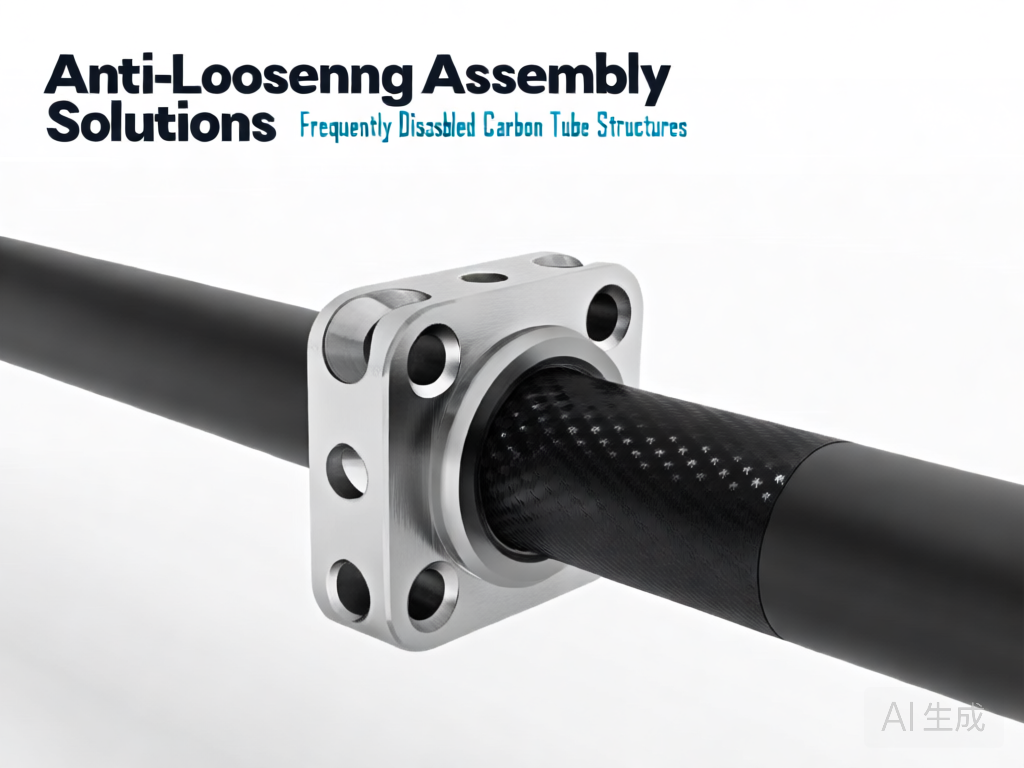
# Anti-Loosening Assembly Solutions for Frequently Disassembled Carbon Tube Structures
Carbon fiber tubes are widely used in applications where frequent disassembly and reassembly are required, such as modular robotics, racing bicycles, portable tripods, and aerospace ground support equipment. However, the smooth surface and low friction coefficient of carbon fiber composites make them prone to fastener loosening under vibration and repeated handling. This article explores effective anti-loosening assembly solutions specifically tailored for frequently disassembled carbon tube structures.
## Understanding the Loosening Mechanism in Carbon Tube Assemblies
Carbon fiber reinforced polymer (CFRP) tubes exhibit unique characteristics that contribute to fastener loosening:
– **Low friction coefficient:** The smooth resin-rich surface reduces friction between mating parts, allowing fasteners to back out more easily.
– **Anisotropic properties:** Carbon fibers have high strength along the fiber direction but are weak in the transverse direction, leading to potential crushing or delamination under bolt preload.
– **Thermal expansion mismatch:** Carbon composites have a low coefficient of thermal expansion, which can cause preload changes when assembled with metal components.
– **Vibration sensitivity:** The lightweight nature of carbon tubes makes them more susceptible to vibration-induced loosening.
Frequent disassembly exacerbates these issues by repeatedly disturbing the joint interface and wearing the contact surfaces.
## Key Design Considerations for Anti-Loosening
When designing assemblies for frequent disassembly, consider the following:
### 1. Joint Configuration
– **Clamped joints:** Use split clamps or collar clamps that distribute load over a larger area, reducing the risk of tube crushing.
– **Inserted fittings:** Bonded or mechanically locked inserts (e.g., aluminum or titanium) provide a durable threaded interface that can withstand repeated use.
– **Tapered interfaces:** Conical mating surfaces can create a friction lock when tightened, resisting loosening.
### 2. Fastener Selection
– **Thread-locking fasteners:** Pre-applied patches or liquid threadlockers (e.g., Loctite) can be used, but they may not be suitable for frequent disassembly as they require cleaning and reapplication.
– **Mechanical locking devices:** Nylon insert lock nuts, serrated flange nuts, or wedge-locking washers (e.g., Nord-Lock) provide reusable locking without chemical agents.
– **Quick-release mechanisms:** For applications requiring rapid disassembly, consider over-center latches or cam levers with secondary locking pins.
### 3. Surface Treatment
– **Friction-enhancing coatings:** Apply grit-blasted or carbide-coated shims at the joint interface to increase friction and resist loosening.
– **Anti-seize compounds:** Use sparingly on threads to prevent galling, but avoid excessive lubricity that promotes loosening.
## Proven Anti-Loosening Solutions
### Solution 1: Wedge-Locking Washers
Wedge-locking washers (e.g., Nord-Lock) consist of a pair of washers with radial teeth on one side and cams on the other. When tightened, the cams lock together, and the teeth bite into the mating surfaces, preventing loosening even under severe vibration. They are reusable and maintain preload over many cycles.
**Application tip:** Use with hardened washers to protect the carbon surface from damage.
### Solution 2: Threaded Inserts with Mechanical Locking
For carbon tubes, bonded threaded inserts (e.g., from Rampa or Bollhoff) provide a robust metal thread. To prevent the insert from rotating or pulling out, select inserts with knurled or ribbed exteriors and use a high-strength structural adhesive. Additionally, a cross-pin or set screw can be added for mechanical backup.
**Application tip:** Ensure proper surface preparation and adhesive cure to maximize insert performance.
### Solution 3: Split Clamp with Serrated Flanges
Split clamps with serrated or toothed flanges increase friction and resist rotational movement. When combined with high-strength bolts and wedge-locking washers, they offer a reliable solution for frequent disassembly. The clamp design should avoid point loads on the carbon tube by using a compliant liner (e.g., rubber or plastic) to distribute stress.
**Application tip:** Torque bolts to the recommended value using a calibrated torque wrench to ensure consistent preload.
### Solution 4: Quick-Release Pins with Detent Mechanisms
For applications requiring tool-free disassembly, quick-release pins with ball detents or spring-loaded locking mechanisms can be used. These pins provide secure locking but allow rapid removal. To prevent accidental release, choose pins with positive locking features such as a push-button or cotter pin.
**Application tip:** Regularly inspect detent balls and springs for wear, and replace as needed.
### Solution 5: Adhesive Bonding with Reversible Features
In some cases, semi-permanent bonding with structural adhesives can be used, but for frequent disassembly, this is not ideal. Instead, consider using a combination of adhesive and mechanical fasteners where the adhesive provides sealing and vibration damping, while fasteners handle the primary load.
## Best Practices for Frequent Disassembly
– **Torque control:** Always use a torque wrench and follow the manufacturer’s specifications. Over-torquing can damage carbon tubes, while under-torquing leads to loosening.
– **Inspection and maintenance:** Regularly inspect fasteners, washers, and inserts for wear or damage. Replace components as needed.
– **Training:** Ensure personnel are trained in proper assembly techniques to avoid common pitfalls.
– **Documentation:** Keep a log of assembly cycles and maintenance to track performance and predict replacement intervals.
## Conclusion
Anti-loosening assembly for frequently disassembled carbon tube structures requires a multifaceted approach that addresses the unique properties of carbon fiber composites. By selecting appropriate joint designs, fasteners, and locking mechanisms, and by adhering to best practices, engineers can achieve reliable, repeatable assemblies that withstand the rigors of frequent use. The solutions presented here offer a starting point for designing robust carbon tube assemblies that maintain integrity over many disassembly cycles.