
## Introduction
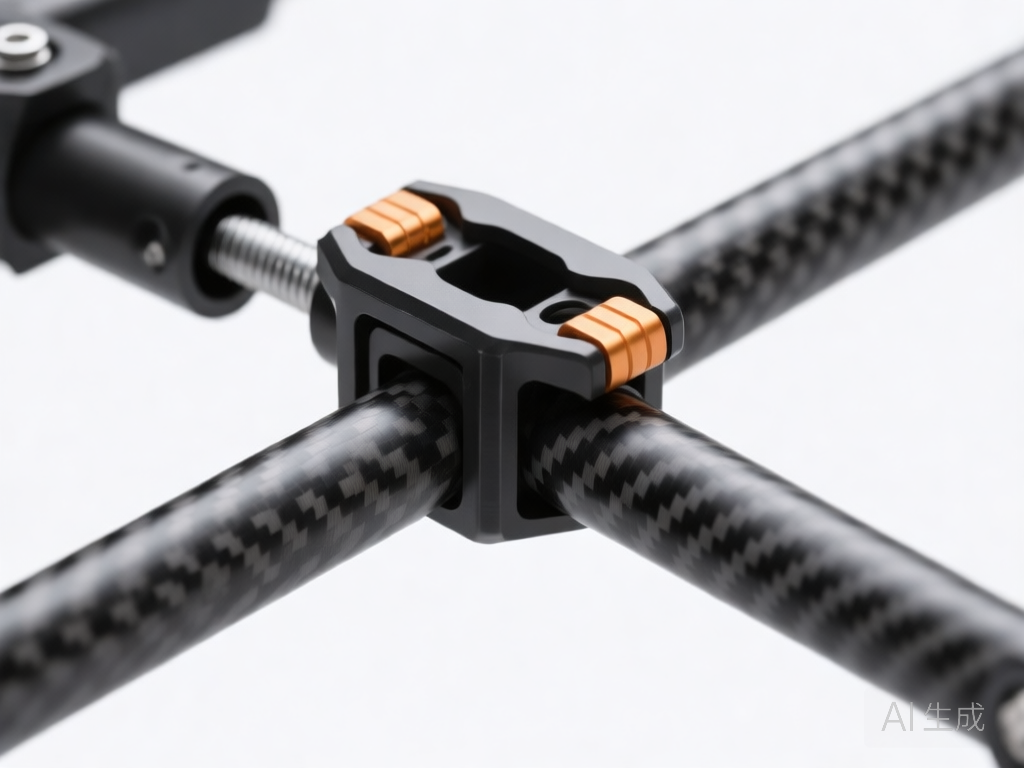
In the rapidly evolving world of drone technology, every gram counts and every second of assembly time matters. Carbon fiber tube frames have become the backbone of modern UAVs due to their exceptional strength-to-weight ratio. However, the connection points between these tubes often become the weakest link in the structural chain. Traditional glued or bolted joints are permanent, time-consuming to assemble, and prone to stress concentrations. This is where quick disassembly clamp connections revolutionize drone frame design. These innovative clamps allow for rapid field assembly and disassembly without compromising structural integrity, making them ideal for applications ranging from racing drones to industrial inspection UAVs. This article explores the design principles, material selection, and practical implementation of quick disassembly clamp connections specifically for carbon tube frames.
## Why Quick Disassembly Clamps Are Essential for Carbon Tube Frames
Carbon fiber reinforced polymer (CFRP) tubes offer unmatched stiffness and low weight, but they are brittle and notch-sensitive. Drilling holes for bolts creates stress risers that can lead to premature failure. Quick disassembly clamps solve this by distributing loads over a larger surface area without penetrating the tube. Moreover, the ability to break down a drone in seconds is critical for portability, rapid deployment, and field repairs. Whether you are a drone racing pilot needing to swap arms between heats or an industrial operator transporting equipment in a compact case, clamp connections provide the speed and reliability you need.
### Key Advantages Over Traditional Joints
– **Non-destructive**: No drilling or adhesive bonding required, preserving tube integrity.
– **Reusable**: Clamps can be assembled and disassembled thousands of times without loss of clamping force.
– **Modular**: Enables quick swapping of arms, booms, or landing gear for mission-specific configurations.
– **Vibration resistant**: Properly designed clamps maintain preload even under high-frequency vibrations typical of multirotor drones.
## Design Principles for Quick Disassembly Clamps
Designing an effective clamp for carbon tubes requires a careful balance of clamping force, weight, and ease of use. The clamp must grip the tube firmly without crushing it, and the disassembly mechanism must be intuitive, often requiring no tools. Below are the core design considerations.
### 1. Clamping Mechanism: Lever, Cam, or Threaded
The most common quick-release mechanisms include:
– **Over-center lever clamps**: Provide high clamping force with a simple flip of a lever. Ideal for quick assembly but require precise adjustment.
– **Cam-action clamps**: Use a rotating cam to apply pressure. Compact and fast, but may wear over time.
– **Threaded knobs with quick-pitch threads**: Offer fine adjustment and high force, but slower to operate.
– **Spring-loaded detent pins**: Allow for tool-free disassembly by pulling a pin, but may not provide sufficient clamping force alone.
For drone frames, over-center lever clamps are often preferred because they offer a visual indication of locked status and can be designed to be fail-safe.
### 2. Interface Geometry: Conforming to the Tube
Carbon tubes are typically round, square, or elliptical. The clamp’s inner surface must conform to the tube’s cross-section to maximize contact area and minimize stress concentrations. A common approach is to use a split clamp with a flexible hinge on one side and a locking mechanism on the other. The inner surface may be lined with a high-friction elastomer (e.g., silicone or polyurethane) to increase grip and damp vibrations. Alternatively, a machined aluminum clamp with a precise bore can provide a metal-to-composite interface, but care must be taken to avoid galvanic corrosion if carbon fiber contacts aluminum directly.
### 3. Material Selection: Strength, Weight, and Compatibility
The clamp material must be strong, lightweight, and compatible with carbon fiber. Common choices include:
– **6061-T6 aluminum**: Lightweight, machinable, and strong. Anodizing provides corrosion resistance and electrical insulation.
– **7075 aluminum**: Higher strength but more brittle and expensive. Suitable for high-stress applications.
– **Titanium**: Excellent strength-to-weight ratio and corrosion resistance, but costly and difficult to machine.
– **Engineering plastics (PEEK, PA12, Ultem)**: Offer electrical insulation and eliminate galvanic corrosion, but lower stiffness.
– **Carbon fiber reinforced polymer (CFRP)**: Can be used for the clamp body itself, but requires careful design to avoid delamination.
For most drone applications, anodized 6061 aluminum strikes the best balance between cost, weight, and performance.
### 4. Load Distribution and Stress Analysis
The clamp must transfer bending and torsional loads from one tube to another without causing local crushing or delamination. Finite element analysis (FEA) is essential to optimize the clamp’s wall thickness, fillet radii, and contact area. Key parameters to analyze:
– **Contact pressure**: Should be below the compressive strength of the carbon composite (typically 200-300 MPa) to avoid crushing.
– **Stress concentrations**: Avoid sharp corners in the clamp that can create high stress points on the tube.
– **Fatigue life**: Under cyclic loading, the clamp should maintain preload and not loosen.
A well-designed clamp will distribute the load over a length of at least 1.5 times the tube diameter.
## Step-by-Step Design Process for a Quick Disassembly Clamp
Creating a custom clamp for your drone frame involves several stages. Below is a practical workflow.
### Step 1: Define Requirements
– Tube outer diameter and wall thickness
– Maximum load (bending moment, torsion, axial force)
– Weight target
– Number of assembly cycles
– Environmental conditions (temperature, moisture, UV)
### Step 2: Concept Generation
Sketch multiple concepts: single-sided lever clamp, double-sided cam clamp, hinged collar with quick-release pin, etc. Evaluate each for ease of use, part count, and manufacturability.
### Step 3: Detailed CAD Design
Model the clamp in 3D CAD software. Ensure tolerances are appropriate for the manufacturing method (e.g., CNC machining, injection molding, or 3D printing). Include features like:
– A hinge pin or living hinge
– A lever with an over-center action
– A safety lock to prevent accidental opening
– Mounting points for attachment to other frame components
### Step 4: Prototyping and Testing
Use 3D printing (SLS or FDM with nylon) for rapid prototyping. Test the clamp for:
– Clamping force (using a force gauge)
– Slip resistance (apply torque and measure rotation)
– Fatigue life (cycle the clamp 1000+ times)
– Vibration resistance (shake test)
### Step 5: Optimization and Production
Refine the design based on test results. For production, consider CNC machining from aluminum or injection molding from glass-filled nylon. Anodize or apply a protective coating to aluminum parts.
## Case Study: Quick-Release Clamp for a Racing Drone Arm
A typical 5-inch racing drone uses 12mm carbon tubes for the arms. The original design used glued joints, which made arm replacement impossible without cutting. A quick disassembly clamp was designed with the following specifications:
– **Material**: 6061-T6 aluminum, hard anodized
– **Mechanism**: Over-center lever with a secondary safety pin
– **Weight**: 4.2 grams per clamp
– **Clamping force**: 250 N
– **Assembly time**: Less than 3 seconds per arm
– **Disassembly time**: Less than 2 seconds
After 500 assembly cycles, the clamp showed no loss of clamping force and no visible wear on the carbon tube. The drone’s crash survivability improved because damaged arms could be swapped in the field.
## Common Pitfalls and How to Avoid Them
Even experienced designers make mistakes when creating quick disassembly clamps. Here are some pitfalls to watch out for:
– **Over-clamping**: Excessive force can crush the carbon tube. Use a torque limiter or design the lever to bottom out at the correct preload.
– **Galvanic corrosion**: Carbon fiber and aluminum form a galvanic couple in the presence of moisture. Use a barrier layer (e.g., anodizing, fiberglass shim) or choose compatible materials.
– **Vibration loosening**: Use a locking mechanism (e.g., detent, safety pin, or thread-locking compound) to prevent accidental release.
– **Misalignment**: Ensure the clamp aligns the tubes precisely to avoid bending moments that can lead to failure.
– **Poor ergonomics**: The lever should be easy to operate with gloves, and the clamp should not have sharp edges.
## Future Trends in Quick Disassembly Clamp Design
As drone technology advances, so will clamp designs. Emerging trends include:
– **Smart clamps**: Integrated sensors to monitor clamping force and detect loosening.
– **Additive manufacturing**: 3D-printed metal clamps with complex internal lattice structures for weight reduction.
– **Self-locking mechanisms**: Using shape memory alloys or bistable springs for tool-free, fail-safe operation.
– **Modular interfaces**: Standardized clamp mounts that allow swapping between different tube diameters.
## Conclusion
Quick disassembly clamp connections are transforming drone carbon tube frame design by enabling rapid assembly, modularity, and improved field reparability. By carefully considering clamping mechanism, interface geometry, material selection, and load distribution, engineers can create clamps that are strong, lightweight, and reliable. Whether you are building a racing drone, a survey UAV, or a heavy-lift industrial platform, investing in a well-designed quick-release clamp will pay dividends in operational flexibility and durability. As the drone industry continues to push the boundaries of performance, these small but critical components will play an increasingly important role in the next generation of unmanned aerial systems.