
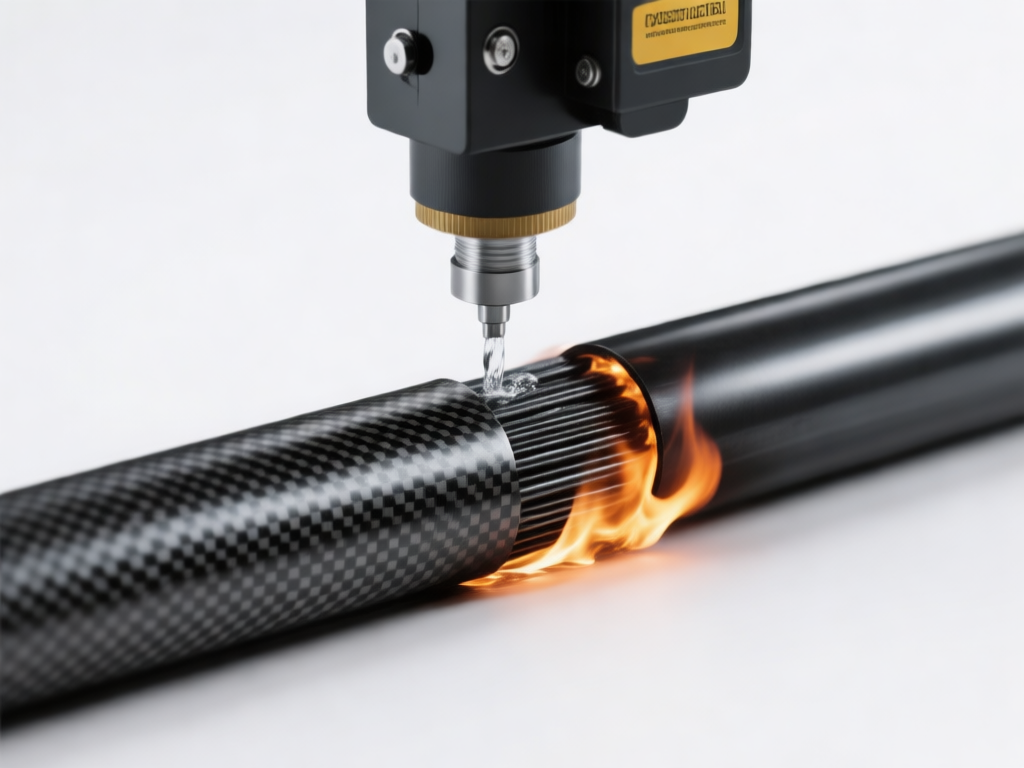
# Waterjet Cutting Carbon Tubes: Eliminating High-Temperature Fiber Burnout Defects
## Introduction
Carbon fiber reinforced polymer (CFRP) tubes are increasingly used in aerospace, automotive, and sports equipment due to their exceptional strength-to-weight ratio. However, machining these tubes presents significant challenges. Traditional cutting methods such as laser, plasma, or abrasive sawing generate intense heat, leading to a critical defect known as fiber burnout. This article explores how waterjet cutting technology eliminates high-temperature fiber burnout defects, ensuring pristine cut edges and preserving the structural integrity of carbon tubes.
## Understanding Fiber Burnout in Carbon Tube Cutting
### What is Fiber Burnout?
Fiber burnout occurs when the resin matrix surrounding carbon fibers is exposed to excessive heat during cutting. The resin vaporizes or degrades, leaving behind charred fibers and a weakened heat-affected zone (HAZ). This defect compromises the tube’s mechanical properties and often necessitates costly rework or scrap.
### Causes of High-Temperature Defects
Thermal cutting processes rely on concentrated energy to melt or vaporize material. In CFRP, the carbon fibers conduct heat rapidly, but the polymer matrix has low thermal conductivity. This mismatch causes localized overheating, resulting in:
– Resin degradation and volatilization
– Delamination between fiber layers
– Microcracks and fiber pull-out
– Charred edges requiring secondary finishing
## How Waterjet Cutting Eliminates Fiber Burnout
### The Cold-Cutting Principle
Abrasive waterjet cutting uses a high-velocity stream of water mixed with abrasive particles to erode material mechanically. Unlike thermal processes, waterjet cutting introduces no heat into the workpiece. The water acts as a coolant, maintaining the material at or near room temperature throughout the cut. This cold-cutting action completely prevents fiber burnout.
### Key Advantages for Carbon Tubes
– **No Heat-Affected Zone (HAZ):** The absence of heat preserves the resin matrix and fiber integrity.
– **Clean Edges:** Waterjet cutting produces smooth, satin-like finishes, often eliminating the need for secondary operations.
– **No Delamination:** The mechanical cutting force is precisely controlled, minimizing interlaminar stresses.
– **Versatility:** Waterjets can cut complex shapes, tight radii, and varying thicknesses without compromising quality.
## Technical Parameters for Optimal Results
### Abrasive Selection and Size
Garnet abrasive is commonly used due to its hardness and angular shape. For carbon tubes, a finer mesh size (e.g., 120 mesh) is recommended to achieve smooth edges and reduce kerf width.
### Cutting Speed and Pressure
Optimizing cutting speed and water pressure is crucial. Excessive speed may cause incomplete cuts, while too slow may lead to taper. Typical parameters for CFRP tubes:
– Water pressure: 40,000–60,000 psi
– Abrasive flow rate: 0.5–1.0 lb/min
– Cutting speed: 10–30 in/min (depending on thickness)
### Fixturing and Support
Proper support prevents tube deformation during cutting. Rotational fixtures allow precise indexing for multi-sided cuts.
## Case Study: Aerospace Hydraulic Tubing
A leading aerospace manufacturer replaced laser cutting with abrasive waterjet for CFRP hydraulic tubes. Results showed:
– Elimination of fiber burnout and charring
– 30% reduction in post-processing time
– Improved fatigue life by 25%
– Zero delamination incidents
## Conclusion
Waterjet cutting offers a definitive solution to high-temperature fiber burnout defects in carbon tubes. By employing a cold-cutting mechanism, it preserves the material’s structural integrity and delivers superior edge quality. As industries continue to adopt carbon fiber tubes for critical applications, waterjet technology will remain the preferred method for defect-free machining.