
## Introduction
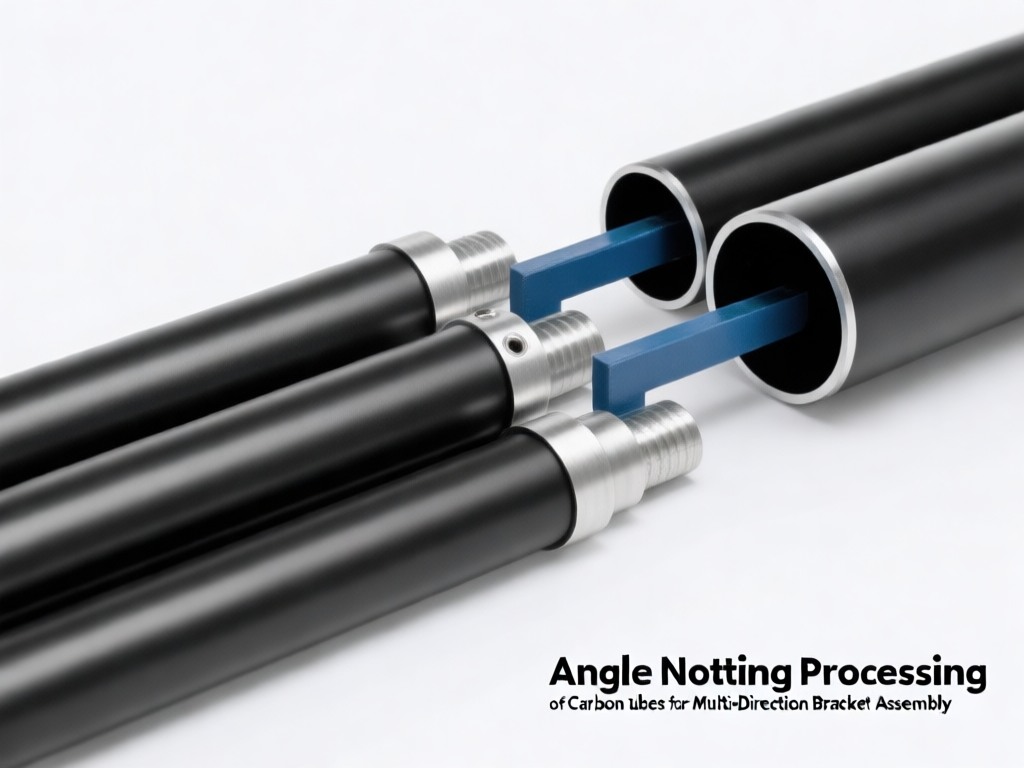
Carbon fiber tubes are increasingly used in multi-direction bracket assemblies for aerospace, automotive, and sports equipment due to their high strength-to-weight ratio. However, joining carbon tubes at various angles requires precise notching to ensure strong, durable connections. Multi-angle notching processing is a specialized technique that cuts tube ends at different angles to fit complex bracket geometries. This article explores the methods, challenges, and best practices for multi-angle notching of carbon tubes, enabling efficient multi-direction bracket assembly.
## Understanding Multi-Angle Notching
Multi-angle notching involves cutting the end of a carbon tube at one or more angles to create a saddle or fish-mouth shape that matches the profile of the mating component. Unlike simple straight cuts, multi-angle notches require simultaneous control of rotation and tilt, often on multiple axes. This is essential when tubes meet at compound angles in a bracket assembly, such as in truss structures or space frames.
### Why Carbon Tubes Require Special Handling
Carbon fiber reinforced polymer (CFRP) is anisotropic and brittle compared to metals. Improper cutting can cause delamination, fiber pull-out, and micro-cracks, compromising structural integrity. Therefore, multi-angle notching must minimize mechanical and thermal stress. Abrasive waterjet cutting and diamond-coated tooling are preferred over conventional sawing.
## Methods for Multi-Angle Notching
Several techniques are employed for notching carbon tubes at multiple angles:
### 1. CNC Machining with Multi-Axis Control
CNC machines with 4 or 5 axes can precisely position the tube and cutting tool to create complex notches. Using diamond-coated end mills or burrs, the process can achieve tight tolerances. However, proper dust extraction and coolant are necessary to prevent overheating and airborne carbon fibers.
### 2. Abrasive Waterjet Cutting
Abrasive waterjet is a cold-cutting process that eliminates heat-affected zones. It can cut through carbon tubes at various angles by tilting the cutting head or rotating the tube. This method is ideal for thick-walled tubes and complex geometries, but it requires careful setup to avoid taper and delamination.
### 3. Laser Notching
Laser cutting offers high precision and speed, but the heat generated can cause charring and thermal damage to the resin matrix. For multi-angle notching, fiber lasers with short pulse durations can minimize the heat-affected zone. However, laser notching is generally limited to thin-walled tubes.
### 4. Mechanical Notching with Custom Fixtures
For low-volume production, custom fixtures can hold the tube at the required angle while a router or saw performs the cut. This method is cost-effective but less precise and repeatable than CNC or waterjet.
## Challenges in Multi-Angle Notching
### Delamination and Fiber Damage
Carbon fibers are prone to delamination when cut at angles. The cutting forces can separate layers, especially at the exit side of the cut. Using backing plates and optimizing feed rates can mitigate this.
### Dimensional Accuracy
Multi-angle notches must match the mating bracket precisely. Any deviation can lead to stress concentrations and joint failure. Therefore, tolerances are often in the range of ±0.1 mm. In-process inspection with laser scanners or vision systems is recommended.
### Tool Wear
Carbon fiber is highly abrasive. Cutting tools wear rapidly, affecting cut quality. Diamond-coated tools last longer but are expensive. Regular tool changes and monitoring are essential.
### Dust and Safety
Carbon dust is conductive and a health hazard. Enclosed cutting systems with HEPA filtration and personal protective equipment are mandatory.
## Best Practices for Multi-Angle Notching
To achieve reliable multi-angle notches for bracket assembly, follow these guidelines:
– **Design for Manufacturability:** Use CAD/CAM software to simulate the notching process and verify angles. Avoid sharp internal corners that can cause stress risers.
– **Choose the Right Cutting Method:** For high precision and complex angles, abrasive waterjet or 5-axis CNC is preferred. For thin tubes, laser cutting may be suitable.
– **Optimize Cutting Parameters:** Adjust feed rate, spindle speed, and depth of cut to minimize delamination. For waterjet, optimize abrasive flow rate and traverse speed.
– **Use Proper Fixturing:** Support the tube rigidly to prevent vibration and deflection. Rotate the tube if necessary to access all angles.
– **Post-Processing:** Deburr and clean the notched area. Apply a protective coating or adhesive primer to enhance bonding.
## Applications in Multi-Direction Bracket Assembly
Multi-angle notched carbon tubes are used in:
– **Aerospace Trusses:** Lightweight satellite and aircraft structures with complex node connections.
– **Automotive Chassis:** High-performance vehicle frames with multi-point joints.
– **Sports Equipment:** Bicycle frames, prosthetics, and racing wheelchairs where tubes meet at various angles.
– **Industrial Robots:** Carbon fiber arms with multi-directional brackets for reduced inertia.
## Conclusion
Multi-angle notching of carbon tubes is a critical enabling technology for multi-direction bracket assembly. By selecting the appropriate cutting method, optimizing parameters, and adhering to best practices, manufacturers can achieve precise, strong joints without compromising the integrity of the carbon fiber. As demand for lightweight, high-performance structures grows, advancements in multi-axis cutting and automation will further enhance the efficiency and accuracy of this process.