
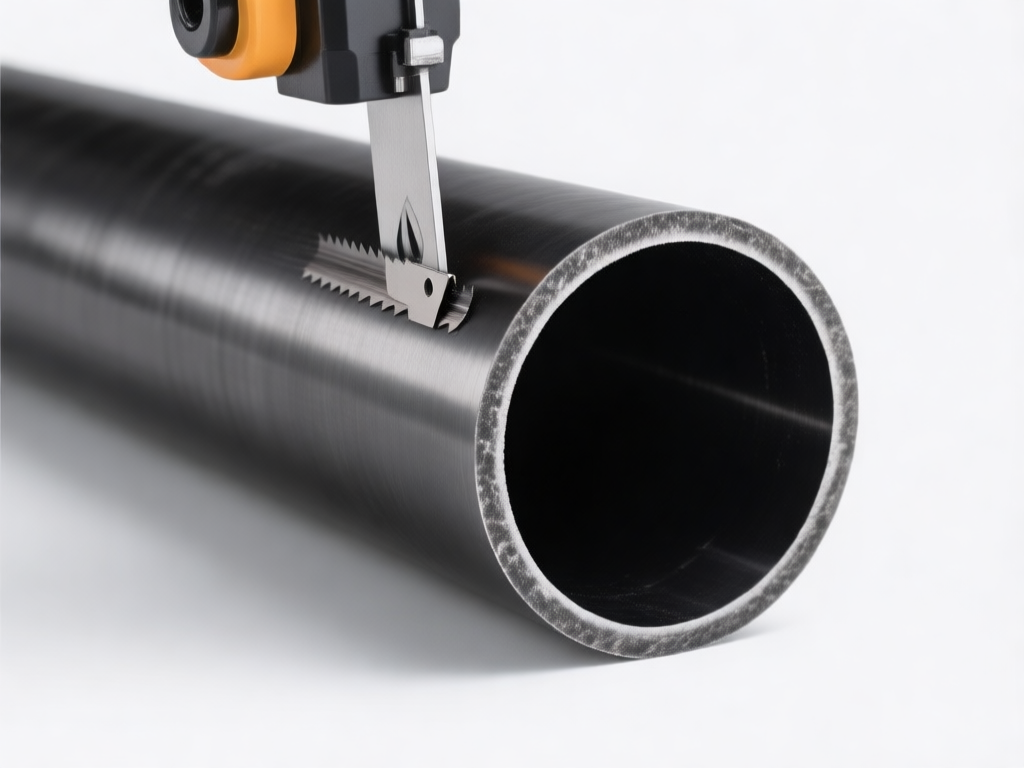
# Ultrasonic Cutting vs. Diamond Saw Cutting: Carbon Tube Edge Quality Contrast
## Introduction
In the aerospace, automotive, and sports equipment industries, carbon fiber reinforced polymer (CFRP) tubes are prized for their exceptional strength-to-weight ratio. However, their abrasive and anisotropic nature makes them notoriously difficult to cut without compromising edge quality. Two prominent cutting methods—ultrasonic cutting and diamond saw cutting—offer distinct advantages and drawbacks. This article provides a detailed contrast of edge quality outcomes, helping manufacturers make informed decisions for their carbon tube processing.
## Understanding the Cutting Methods
### Ultrasonic Cutting
Ultrasonic cutting utilizes a blade or horn vibrating at high frequencies (typically 20–40 kHz) to create localized melting or softening of the polymer matrix. The cutting action is often described as a combination of shearing and thermal softening, resulting in minimal mechanical force. This method is commonly used for trimming, slitting, and contour cutting of prepreg and cured composites.
### Diamond Saw Cutting
Diamond saw cutting employs a rotating blade with diamond-impregnated teeth or a diamond-coated wire. The abrasive diamond particles grind through the carbon fibers and resin matrix. This method is favored for its ability to cut thick sections and complex geometries, but it generates significant heat and mechanical stress.
## Edge Quality Metrics
To objectively compare edge quality, we evaluate several key metrics:
– **Delamination**: Separation between layers of the composite.
– **Fiber pull-out**: Protrusion of fibers from the cut edge.
– **Surface roughness (Ra)**: Average surface roughness of the cut edge.
– **Thermal damage**: Burn marks, charring, or matrix degradation.
– **Kerf width**: Width of the cut, affecting material waste.
– **Micro-cracking**: Subsurface cracks that can propagate under load.
## Edge Quality Contrast
### Delamination and Fiber Pull-out
Ultrasonic cutting typically produces minimal delamination because the high-frequency vibration reduces cutting forces. The softened matrix allows fibers to be cut cleanly with less pull-out. In contrast, diamond saw cutting often induces delamination due to the mechanical grinding action, especially when the blade becomes dull or feed rates are too high. Fiber pull-out is more pronounced with diamond saws, particularly on unidirectional carbon tubes.
### Surface Roughness
Ultrasonic cutting yields a smoother edge with lower Ra values, often in the range of 1–3 µm. The vibrating blade shears through the material, leaving a relatively uniform surface. Diamond saw cutting, while capable of producing acceptable finishes, typically results in rougher edges (Ra 3–6 µm) due to the abrasive action and potential for fiber tearing. However, with optimized parameters (fine grit, low feed), diamond saws can approach ultrasonic quality.
### Thermal Damage
Thermal damage is a critical concern. Ultrasonic cutting generates localized heat that softens the matrix but can also cause matrix smearing or slight charring if parameters are not controlled. Diamond saw cutting generates more frictional heat, leading to burn marks, resin degradation, and even fiber oxidation. Proper cooling is essential for diamond saws to mitigate thermal damage.
### Kerf Width and Material Waste
Ultrasonic cutting typically produces a narrower kerf (0.1–0.5 mm) compared to diamond saws (0.5–2 mm). This translates to less material waste, which is significant when cutting expensive carbon tubes. The narrower kerf also allows for tighter nesting and more precise cuts.
### Micro-cracking
Micro-cracking is often more prevalent with diamond saw cutting due to the impact and grinding forces. These subsurface cracks can act as stress concentrators, reducing fatigue life. Ultrasonic cutting, with its lower mechanical stress, tends to produce fewer micro-cracks, enhancing the structural integrity of the cut edge.
## Factors Influencing Edge Quality
### Material Properties
The type of carbon fiber (e.g., standard modulus, intermediate modulus) and resin system (epoxy, BMI, thermoplastic) affect cuttability. Thermoplastic matrices may respond better to ultrasonic cutting, while diamond saws are more versatile across materials.
### Process Parameters
For ultrasonic cutting, amplitude, frequency, and cutting speed are critical. For diamond saw cutting, blade grit size, feed rate, and coolant flow are key. Optimizing these parameters can significantly improve edge quality for both methods.
### Tool Wear
Diamond saw blades wear over time, leading to increased delamination and roughness. Ultrasonic blades also wear but often maintain consistent quality longer due to reduced forces.
## Case Studies and Industry Applications
In aerospace, where edge quality is paramount, ultrasonic cutting is often preferred for trimming CFRP tubes. For example, a study on aircraft hydraulic tubes showed ultrasonic cutting reduced delamination by 40% compared to diamond sawing. In automotive, diamond saw cutting is still used for high-volume production due to its speed and robustness, but post-processing is often required.
## Conclusion
When contrasting ultrasonic cutting and diamond saw cutting for carbon tube edge quality, ultrasonic cutting generally excels in minimizing delamination, fiber pull-out, and micro-cracking, while producing smoother edges and narrower kerfs. However, it may not be suitable for all thicknesses and requires precise parameter control. Diamond saw cutting, while more versatile and faster, often compromises edge quality through thermal damage and mechanical stress. The choice ultimately depends on the specific application requirements, production volume, and cost considerations. For critical applications demanding superior edge integrity, ultrasonic cutting is the superior choice.
## Key Takeaways
– Ultrasonic cutting delivers superior edge quality with less delamination and fiber pull-out.
– Diamond saw cutting is faster and more versatile but often requires post-processing.
– Thermal damage is more pronounced with diamond saw cutting.
– Ultrasonic cutting produces narrower kerfs, reducing material waste.
– Parameter optimization is crucial for both methods to achieve acceptable results.