
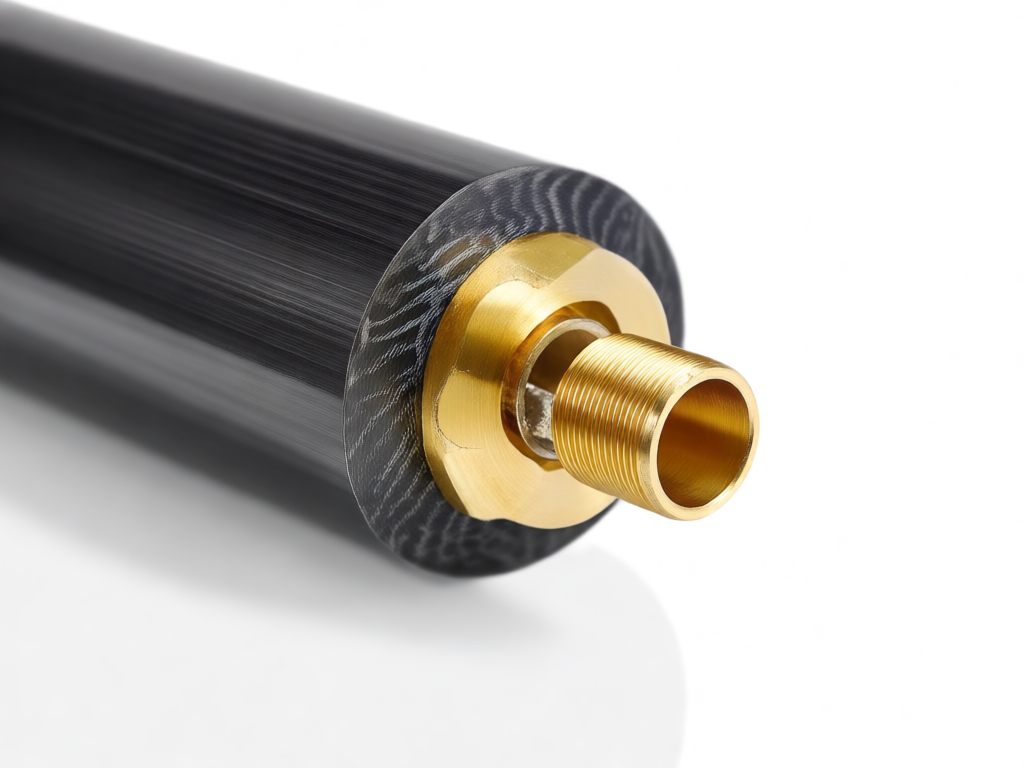
# Thread Tapping on Carbon Tubes and Brass Insert Embedding: A Complete Manufacturing Guide
## Introduction
Carbon fiber tubes are renowned for their exceptional strength-to-weight ratio, making them indispensable in aerospace, automotive, robotics, and high-performance sporting goods. However, their anisotropic, brittle nature poses unique challenges when creating threaded connections. Direct thread tapping into carbon tubes often leads to delamination, fiber breakage, and weak load-bearing capacity. The industry-proven solution is to embed brass inserts, which provide robust, reusable threads while preserving the structural integrity of the carbon tube. This article explores the thread tapping process on carbon tubes and details effective brass insert embedding solutions, offering manufacturers a roadmap for reliable, high-strength assemblies.
## Understanding the Challenges of Threading Carbon Fiber Tubes
Carbon fiber reinforced polymer (CFRP) is not homogeneous like metal. It consists of strong fibers embedded in a relatively weak resin matrix. When you attempt to cut threads directly into CFRP, several problems arise:
– **Delamination:** The cutting forces can separate fiber layers, creating internal voids and reducing mechanical performance.
– **Fiber pull-out:** Threads formed in the resin matrix alone lack reinforcement, leading to stripped threads under load.
– **Tool wear:** Carbon fibers are highly abrasive, causing rapid dulling of taps and drills.
– **Thermal damage:** Heat generated during machining can degrade the resin, further weakening the joint.
Because of these issues, direct tapping is rarely recommended for structural applications. Instead, a brass insert is embedded to serve as the threaded interface. Brass offers excellent machinability, corrosion resistance, and compatibility with carbon fiber (no galvanic corrosion risk when isolated properly).
## Thread Tapping Process on Carbon Tubes: Step-by-Step
Even when using inserts, some preparation of the carbon tube is necessary. The process typically involves drilling a pilot hole and possibly tapping a coarse thread to anchor the insert. Here is a detailed procedure:
### 1. Drilling the Pilot Hole
Select a drill bit specifically designed for CFRP, such as diamond-coated or carbide-tipped bits with a sharp point angle. The hole diameter should match the minor diameter of the brass insert’s external threads. Use high spindle speed and low feed rate to minimize delamination. Backing the tube with a sacrificial material (e.g., wooden block) can support the fibers and prevent exit-side damage.
### 2. Tapping the Carbon Tube (Optional)
In some cases, a coarse thread is tapped into the carbon tube to provide initial mechanical interlock for the insert. Use a tap with a slow spiral flute to evacuate chips efficiently. Apply minimal cutting fluid—often dry machining is preferred to avoid resin contamination. Tapping should be done by hand or with a tapping head set to low torque to avoid over-cutting. Remember: this tapped thread is not the final load-bearing thread; it merely holds the insert in place during bonding.
### 3. Cleaning and Surface Preparation
After drilling and tapping, clean the hole thoroughly with compressed air or a lint-free swab to remove carbon dust. Any debris will weaken the adhesive bond. For optimal adhesion, lightly abrade the internal threads with a nylon brush, then wipe with a suitable solvent such as acetone or isopropyl alcohol. Allow to dry completely.
## Brass Insert Embedding Solutions
Brass inserts come in various designs, each suited to specific applications. The embedding method depends on the insert type and the required pull-out strength.
### Types of Brass Inserts
– **Heat-set inserts:** Designed for thermoplastics, not suitable for carbon fiber.
– **Ultrasonic inserts:** Also for thermoplastics; not applicable here.
– **Threaded inserts for composites:** These feature external threads (often coarse) and may have knurled or slotted bodies for adhesive interlock. They are installed with epoxy.
– **Expansion inserts:** These deform when tightened, gripping the hole walls. They are less common for carbon tubes due to potential stress concentrations.
– **Potting inserts:** A brass insert with a hollow cavity that allows adhesive to flow through, creating a mechanical lock.
For carbon tubes, **threaded inserts installed with epoxy** are the most reliable. They distribute loads over a larger area and avoid stress concentrations.
### Embedding Process
1. **Adhesive selection:** Use a high-strength epoxy with a lap shear strength exceeding 20 MPa. Two-part epoxies with a long pot life are ideal for precise alignment. Ensure the epoxy is compatible with both carbon fiber and brass.
2. **Insert preparation:** Clean the brass insert with solvent to remove oils. Lightly abrade the external threads with sandpaper to improve adhesion.
3. **Adhesive application:** Apply a thin, uniform layer of epoxy to both the internal threads of the carbon tube and the external threads of the insert. Avoid excess adhesive that could squeeze into the insert’s internal threads.
4. **Insertion:** Thread the insert into the carbon tube by hand or with a driver. Stop when the insert is flush or slightly recessed. Do not over-torque, as this can crack the carbon tube.
5. **Curing:** Allow the epoxy to cure according to the manufacturer’s instructions, typically 24 hours at room temperature or accelerated with heat. Do not apply load during curing.
6. **Finishing:** After curing, wipe away any excess epoxy with a solvent-dampened cloth. If necessary, chase the internal threads with a tap to remove any adhesive that may have seeped in.
### Alternative: Co-molding and Potting
For high-volume production, brass inserts can be co-molded directly into the carbon tube during layup. This involves placing the insert on a mandrel and laying carbon prepreg around it. The insert becomes an integral part of the composite after curing. This method offers superior strength but requires precise tooling and is less flexible for modifications.
Another option is potting: the insert is placed in an oversized hole, and the gap is filled with a structural adhesive. This is simpler but may not achieve the same load capacity as a threaded insert.
## Best Practices for Reliable Threaded Connections
– **Design for load:** Calculate the required pull-out and torque strength. Use a safety factor of at least 2.
– **Match materials:** Choose brass inserts with threads that match the mating fastener. Avoid stainless steel fasteners in direct contact with carbon fiber to prevent galvanic corrosion; use isolating washers or coatings.
– **Control tolerances:** The hole diameter and insert dimensions must be precise to ensure a proper bond line thickness (typically 0.1–0.3 mm).
– **Test and validate:** Perform pull-out tests on sample assemblies to verify joint strength. Destructive testing can reveal failure modes and guide improvements.
– **Consider environmental factors:** Temperature, humidity, and chemical exposure can affect epoxy performance. Select adhesives accordingly.
## Conclusion
Thread tapping on carbon tubes is not a straightforward operation; it requires a nuanced approach that respects the material’s limitations. By embedding brass inserts with structural epoxy, manufacturers can create strong, durable threaded connections that leverage the benefits of carbon fiber without compromising its integrity. Whether you choose a threaded insert, co-molding, or potting, the key lies in meticulous surface preparation, appropriate adhesive selection, and controlled installation. As carbon fiber continues to penetrate new industries, mastering these techniques will be essential for engineers and fabricators aiming to deliver high-performance, reliable products.