
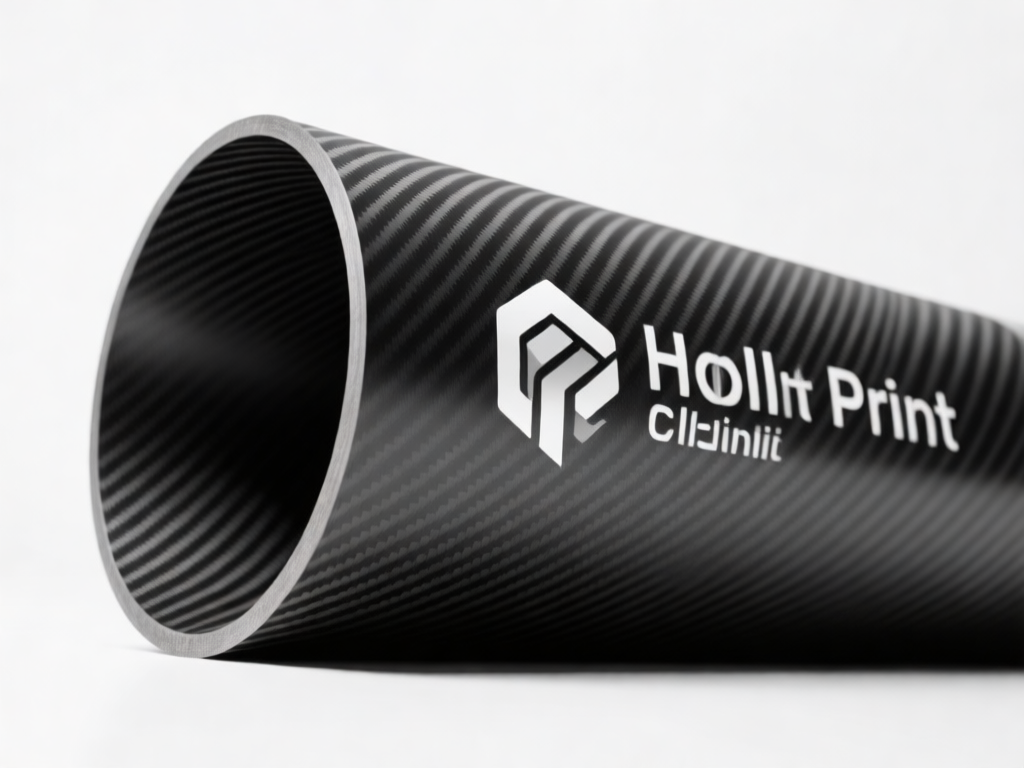
## Introduction
Hollow carbon tubes are widely used in aerospace, automotive, and sports equipment due to their exceptional strength-to-weight ratio. However, applying durable logos or branding to their outer walls presents a unique challenge: the smooth, chemically inert surface of carbon fiber composites often leads to poor adhesion, resulting in delamination of the printed layer. This article explores the causes of delamination and provides proven techniques to achieve permanent, high-quality logo printing on hollow carbon tube outer walls.
## Understanding Delamination in Logo Printing on Carbon Tubes
Delamination occurs when the printed ink or coating separates from the carbon tube surface, often peeling or flaking off. The primary culprits include:
– **Low surface energy**: Carbon fiber reinforced polymer (CFRP) typically has a surface energy around 30-40 mN/m, which is below the threshold for good wetting by most inks.
– **Release agents**: During manufacturing, mold release agents can leave residues that act as a barrier.
– **Thermal expansion mismatch**: Carbon tubes expand minimally with heat, while some inks expand more, causing stress at the interface.
– **Flexural stress**: Hollow tubes may bend in application, and brittle printed layers can crack and lift.
## Pre-Treatment: The Key to Adhesion
Proper surface preparation is critical. The goal is to increase surface energy and create mechanical interlocking sites without damaging the carbon fibers.
### 1. Abrasion
Gently abrade the tube surface with fine grit (e.g., 400-600) sandpaper or a Scotch-Brite pad. This removes release agents and creates a roughened profile. Avoid over-abrasion that could expose fibers.
### 2. Plasma Treatment
Atmospheric plasma treatment is highly effective for carbon composites. It introduces polar functional groups (e.g., hydroxyl, carboxyl) onto the surface, raising surface energy to 60-70 mN/m. This significantly improves ink wetting and chemical bonding.
### 3. Chemical Primers
Applying a specialized primer designed for carbon fiber (e.g., silane-based or epoxy-based) can bridge the gap between the inert surface and the ink. Primers should be applied thinly and cured per manufacturer instructions.
## Printing Technologies for Carbon Tube Outer Walls
Several printing methods can be adapted for cylindrical carbon tubes. The choice depends on production volume, logo complexity, and durability requirements.
### Pad Printing
Pad printing excels on curved surfaces. A silicone pad picks up ink from an etched plate and transfers it to the tube. This method works well for small logos and multi-color designs. Use high-adhesion inks formulated for plastics or metals.
### Screen Printing
For larger logos or high-volume production, screen printing offers thick ink deposits that resist wear. Rotary screen printing can be integrated into a continuous tube coating line. Inks must be flexible to avoid cracking when the tube bends.
### Inkjet Printing
Industrial inkjet printers with UV-curable inks can print directly onto carbon tubes. UV curing instantly crosslinks the ink, forming a strong bond. This method is ideal for variable data or short runs.
### Laser Marking
Although not strictly “printing,” laser marking creates a permanent logo by altering the surface of the carbon tube. It avoids delamination entirely because there is no added layer. However, it may compromise the structural integrity if not carefully controlled.
## Ink Selection and Curing
Ink choice is paramount. Look for inks with:
– **High adhesion to carbon fiber**: Epoxy-based, polyurethane-based, or UV-curable inks.
– **Flexibility**: To withstand tube flexing without cracking.
– **Chemical resistance**: To resist oils, fuels, and cleaning agents.
Curing must be thorough. For UV inks, ensure the UV dose is sufficient to fully cure the ink, especially on heat-sensitive carbon tubes. For solvent-based inks, controlled heating can accelerate curing but must not exceed the tube’s glass transition temperature.
## Application Techniques to Prevent Delamination
Even with the right materials, application technique matters.
– **Clean environment**: Dust and moisture can interfere with adhesion.
– **Controlled ink thickness**: Too thick a layer can trap solvents and cause lifting.
– **Proper curing schedule**: Follow ink manufacturer’s recommendations for temperature and time.
– **Edge sealing**: For logos with sharp edges, a clear protective coat can seal the edges and prevent peel initiation.
## Testing for Adhesion and Durability
After printing, conduct rigorous tests to ensure the logo will not delaminate:
– **Cross-hatch adhesion test (ASTM D3359)**: Score the logo and apply tape; check for removal.
– **Flexural test**: Bend the tube to simulate real-world stress.
– **Environmental cycling**: Expose to temperature and humidity cycles.
– **Abrasion test**: Rub with a weighted cloth to simulate handling.
## Case Study: Logo Printing on Bicycle Frame Tubes
A bicycle manufacturer needed to print logos on hollow carbon frame tubes. Initial attempts with standard pad printing led to delamination after a few rides. By implementing plasma treatment, using a flexible epoxy ink, and curing at 80°C for 30 minutes, they achieved a logo that withstood 10,000 flex cycles without peeling. The key was the plasma treatment, which increased surface energy and allowed the ink to form a chemical bond.
## Conclusion
Printing logos on hollow carbon tube outer walls without delamination is achievable with the right combination of surface preparation, ink selection, printing technology, and curing. Plasma treatment and specialized primers are game-changers for adhesion. By following the guidelines in this article, manufacturers can ensure their branding remains intact throughout the product’s life, enhancing both aesthetics and perceived quality.