
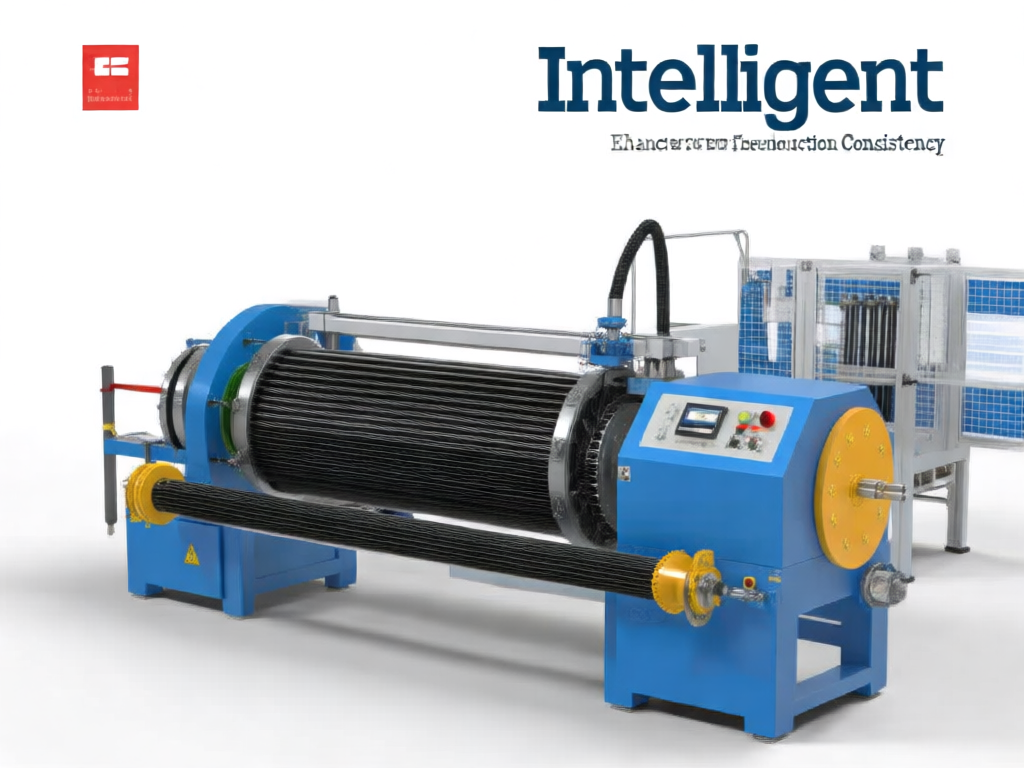
## Introduction
The production of carbon fiber tubes has evolved significantly over the past decade, driven by the demand for lightweight, high-strength components in aerospace, automotive, and sporting goods. However, achieving consistent quality in carbon tube manufacturing remains a challenge due to the inherent variability in fiber alignment, resin distribution, and winding tension. Traditional manual or semi-automated winding processes often lead to inconsistencies that compromise mechanical performance. The advent of intelligent automated winding equipment has revolutionized this landscape, offering precise control, real-time monitoring, and adaptive adjustments that ensure uniform product quality. This article delves into how intelligent automated winding systems improve carbon tube production consistency, addressing key technical aspects and operational benefits.
## The Role of Winding Equipment in Carbon Tube Manufacturing
Carbon tubes are typically produced by winding continuous carbon fiber filaments around a mandrel, impregnated with resin, and then cured. The winding process determines the fiber orientation, which directly influences the tube’s tensile strength, stiffness, and fatigue resistance. Inconsistent winding parameters—such as tension, speed, and angle—can lead to defects like fiber waviness, voids, or resin-rich areas, all of which degrade performance. Therefore, the precision of the winding equipment is paramount to achieving consistent, high-quality tubes.
### Traditional Winding Limitations
Conventional winding machines rely on manual adjustments and fixed parameters, making it difficult to respond to variations in fiber properties, resin viscosity, or ambient conditions. Operators may inadvertently introduce inconsistencies, and the lack of real-time feedback means defects often go undetected until after curing, resulting in scrap and rework. This not only increases costs but also limits the scalability of production.
## Intelligent Automation: Key Features and Technologies
Intelligent automated winding equipment integrates advanced sensors, control algorithms, and data analytics to overcome the limitations of traditional systems. These machines are designed to monitor and adjust winding parameters in real time, ensuring that each layer of fiber is placed with optimal precision.
### Real-Time Tension Control
One of the most critical factors in carbon tube consistency is fiber tension. Inconsistent tension can cause fiber slippage, buckling, or uneven resin wet-out. Intelligent systems employ load cells and closed-loop control to maintain constant tension throughout the winding process. The controller continuously compares actual tension to the setpoint and adjusts the payout speed or braking force accordingly. This ensures that the fiber is laid down with uniform tension, reducing the risk of defects.
### Precision Fiber Placement and Angle Control
Winding angle (the angle at which the fiber is laid relative to the mandrel axis) determines the tube’s mechanical properties. Intelligent equipment uses servo motors and encoders to precisely control the carriage movement and mandrel rotation, achieving exact winding angles. Moreover, advanced software can generate complex winding patterns, such as helical or hoop windings, with high repeatability. This level of precision is impossible to achieve manually, making intelligent automation essential for high-performance applications.
### Adaptive Process Control
Intelligent systems are equipped with machine learning algorithms that can predict and compensate for variations in raw materials. For instance, if the fiber tow has a slight variation in thickness or the resin viscosity changes due to temperature fluctuations, the system can adjust the winding speed or resin application rate to maintain consistent quality. This adaptive capability ensures that every tube produced meets the same specifications, regardless of batch-to-batch variations in materials.
### In-Process Quality Monitoring
Modern winding machines incorporate inline sensors, such as laser scanners and ultrasonic probes, to inspect the fiber placement and resin content during winding. These sensors detect anomalies like fiber misalignment, voids, or resin pooling in real time. If an issue is detected, the system can either alert the operator or automatically correct the parameters. This proactive approach minimizes defects and reduces the need for post-curing inspections.
## Benefits of Intelligent Automated Winding for Consistency
The implementation of intelligent automated winding equipment brings numerous benefits that directly contribute to production consistency.
### Reduced Human Error
Automation eliminates the variability introduced by manual operations. Operators no longer need to adjust parameters based on subjective judgment; instead, they rely on data-driven decisions. This reduces the risk of human error and ensures that the process is repeatable across shifts and operators.
### Enhanced Repeatability
Intelligent systems can store and reproduce exact winding recipes for different tube specifications. Once a process is optimized, the same parameters can be replicated with high fidelity, ensuring that each tube is identical to the previous one. This repeatability is crucial for industries where consistency is critical, such as aerospace components.
### Improved Material Utilization
By maintaining optimal tension and resin application, intelligent winding reduces material waste. Consistent fiber alignment and resin distribution mean that fewer tubes are rejected, leading to higher yields and lower material costs. Additionally, the ability to adapt to material variations prevents over- or under-impregnation, further enhancing efficiency.
### Data-Driven Process Optimization
Intelligent equipment generates vast amounts of data during production. This data can be analyzed to identify trends, optimize parameters, and predict maintenance needs. Over time, manufacturers can refine their processes to achieve even higher levels of consistency and quality. For example, by analyzing historical data, they can determine the optimal winding speed for specific fiber-resin combinations, reducing cycle times without compromising quality.
## Case Study: Aerospace Industry Implementation
A leading aerospace manufacturer recently upgraded its carbon tube production line with intelligent automated winding equipment. The system was equipped with real-time tension control, adaptive algorithms, and inline inspection. Within six months, the manufacturer reported a 30% reduction in scrap rates and a 20% improvement in dimensional consistency. The ability to maintain tight tolerances on fiber angle and tension allowed the company to meet stringent aerospace standards, leading to increased customer confidence and new contracts.
## Challenges and Considerations
While intelligent automated winding offers significant advantages, its implementation requires careful planning. Initial capital investment is higher than traditional equipment, and staff must be trained to operate and maintain the sophisticated systems. Additionally, integrating the equipment with existing manufacturing execution systems (MES) may require IT infrastructure upgrades. However, the long-term benefits in terms of quality, efficiency, and cost savings typically outweigh these initial hurdles.
## Future Trends
The future of intelligent winding equipment lies in further integration with Industry 4.0 technologies. Digital twins, for instance, can simulate the winding process in a virtual environment, allowing for offline optimization and predictive maintenance. Additionally, the use of artificial intelligence for real-time defect detection and process adjustment will become more prevalent. As carbon fiber composites continue to gain traction in high-volume industries like automotive, the demand for consistent, high-quality tubes will drive further innovation in automated winding technology.
## Conclusion
Intelligent automated winding equipment is a game-changer for carbon tube manufacturers seeking to enhance production consistency. By providing real-time control, adaptive adjustments, and in-process quality monitoring, these systems minimize variability and ensure that every tube meets exact specifications. The benefits—reduced waste, improved repeatability, and data-driven optimization—translate into tangible cost savings and competitive advantages. As technology advances, the adoption of intelligent winding will become a standard practice in the industry, paving the way for higher performance and more reliable carbon fiber products.