
## Introduction
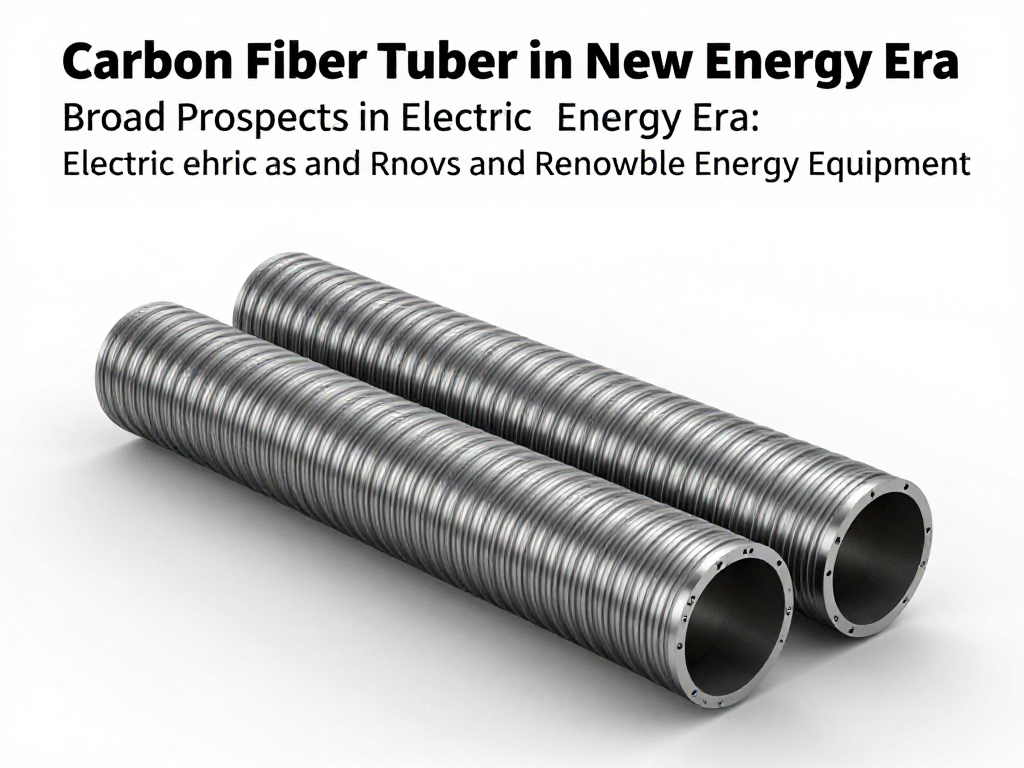
The global transition toward sustainable energy is reshaping the manufacturing landscape, demanding materials that combine exceptional strength, lightweight properties, and long-term durability. Among advanced composites, carbon fiber tubes have emerged as a cornerstone component for the new energy era. From electric vehicle (EV) drivetrains to wind turbine blades and solar tracking systems, these cylindrical structures offer a unique balance of mechanical performance and weight reduction. This article explores the expanding role of carbon fiber tubes in electric vehicles and renewable energy equipment, highlighting their technical advantages, current applications, and future market potential.
## Why Carbon Fiber Tubes? Key Properties for New Energy Applications
Carbon fiber tubes are manufactured by pultrusion, filament winding, or roll wrapping, resulting in hollow cylindrical profiles with unidirectional or multi-directional fiber orientation. Their standout properties include:
– **High specific strength and stiffness:** Carbon fiber composites offer strength-to-weight ratios significantly superior to steel or aluminum, enabling lighter structural components without compromising load-bearing capacity.
– **Corrosion and fatigue resistance:** Unlike metals, carbon fiber tubes do not corrode in harsh environments, making them ideal for outdoor renewable energy installations and EV underbody components exposed to moisture and road salts.
– **Thermal stability:** Low coefficient of thermal expansion ensures dimensional stability across wide temperature ranges, critical for precision equipment in solar and wind power systems.
– **Design flexibility:** Tubes can be tailored in diameter, wall thickness, and fiber orientation to meet specific mechanical requirements, allowing engineers to optimize performance for each application.
## Carbon Fiber Tubes in Electric Vehicles
### Lightweighting for Extended Range
One of the primary challenges in EV design is maximizing driving range while managing battery weight. Carbon fiber tubes contribute to lightweighting in several key areas:
– **Battery enclosures and crash structures:** Tubes are used as reinforcement in battery pack frames and side-impact beams, providing high energy absorption without adding excessive mass.
– **Drive shafts and torque tubes:** Replacing steel drive shafts with carbon fiber tubes reduces rotational inertia, improving drivetrain efficiency and enabling higher motor speeds. This is particularly beneficial for performance EVs and commercial vehicles.
– **Chassis and suspension components:** Carbon fiber tubes in control arms, anti-roll bars, and subframes reduce unsprung weight, enhancing ride comfort and handling dynamics.
### Thermal Management and Electrical Insulation
Carbon fiber tubes are electrically conductive, but when coated or combined with insulating layers, they can be used in battery cooling systems and high-voltage cable conduits. Their thermal conductivity can be engineered to aid heat dissipation in battery modules, while their low weight simplifies routing in tight under-vehicle spaces.
### Case Study: Carbon Fiber Drive Shafts in Commercial EVs
A notable example is the adoption of carbon fiber drive shafts in electric buses and trucks. These vehicles require long, slender shafts that are prone to vibration at high speeds. Carbon fiber’s high specific stiffness raises the critical speed threshold, allowing longer shafts without the need for center bearings. This reduces weight, improves driveline efficiency, and lowers maintenance costs—a compelling value proposition for fleet operators.
## Carbon Fiber Tubes in Renewable Energy Equipment
### Wind Turbine Components
Wind turbines operate in harsh, dynamic environments where material fatigue and corrosion are major concerns. Carbon fiber tubes are increasingly used in:
– **Spar caps and blade stiffeners:** While large blades primarily use carbon fiber laminates, tubular profiles serve as internal reinforcement in blade roots and tip sections, improving stiffness and reducing edge-wise vibrations.
– **Nacelle and hub structures:** Tubes provide lightweight, high-strength support for pitch and yaw mechanisms, reducing the load on tower bearings and drive trains.
– **Tower internals:** Carbon fiber tubes are used for ladder rails, cable conduits, and maintenance platforms, offering corrosion resistance and reduced weight for easier installation.
### Solar Tracking Systems
Solar trackers require precise, durable linear actuators and support arms that can withstand wind loads and thermal expansion. Carbon fiber tubes are ideal for:
– **Push-pull rods and torque tubes:** Their high stiffness-to-weight ratio allows longer spans between support posts, reducing the number of foundations and lowering installation costs.
– **Sensor masts and mounting frames:** Tubes provide stable, non-magnetic support for tracking sensors and photovoltaic panels, ensuring accurate alignment over decades of service.
### Hydroelectric and Marine Energy
In tidal and wave energy converters, carbon fiber tubes are used for structural arms, mooring connectors, and buoy components. Their resistance to saltwater corrosion and biofouling reduces maintenance intervals, a critical factor in offshore installations.
## Manufacturing and Cost Considerations
Despite their advantages, carbon fiber tubes face cost and production challenges. The price of carbon fiber raw material remains higher than glass fiber or metals, but ongoing advancements in recycling and low-cost precursor fibers are narrowing the gap. Automated fiber placement and continuous pultrusion processes are improving production efficiency and consistency, making carbon fiber tubes more accessible for high-volume applications.
For new energy equipment, the total cost of ownership often favors carbon fiber due to reduced maintenance, longer service life, and energy savings from lightweighting. As production scales up, unit costs are expected to decline further, accelerating adoption.
## Future Outlook and Market Trends
The new energy sector is projected to grow exponentially over the next decade. According to industry analyses, the global carbon fiber composite market in automotive and renewable energy is expected to witness a compound annual growth rate (CAGR) of 8–12% through 2030. Key trends include:
– **Integration with battery technology:** As solid-state batteries and structural batteries emerge, carbon fiber tubes may serve as both structural and energy-storage components, further reducing vehicle weight.
– **Recycled carbon fiber:** Advances in pyrolysis and solvolysis are enabling the recovery of high-quality fibers from end-of-life components, addressing sustainability concerns and reducing material costs.
– **Hybrid designs:** Combining carbon fiber tubes with aluminum or thermoplastic matrices offers tailored performance at lower cost, expanding their use in mid-range EVs and cost-sensitive renewable projects.
## Conclusion
Carbon fiber tubes are poised to play a pivotal role in the new energy era, offering unmatched performance in electric vehicles and renewable energy equipment. Their ability to reduce weight, resist corrosion, and withstand fatigue makes them indispensable for improving efficiency and durability in these rapidly evolving industries. While cost and manufacturing hurdles remain, continuous innovation and economies of scale are driving broader adoption. For engineers and manufacturers committed to sustainability, carbon fiber tubes represent a strategic investment in a cleaner, more efficient future.