
## Introduction
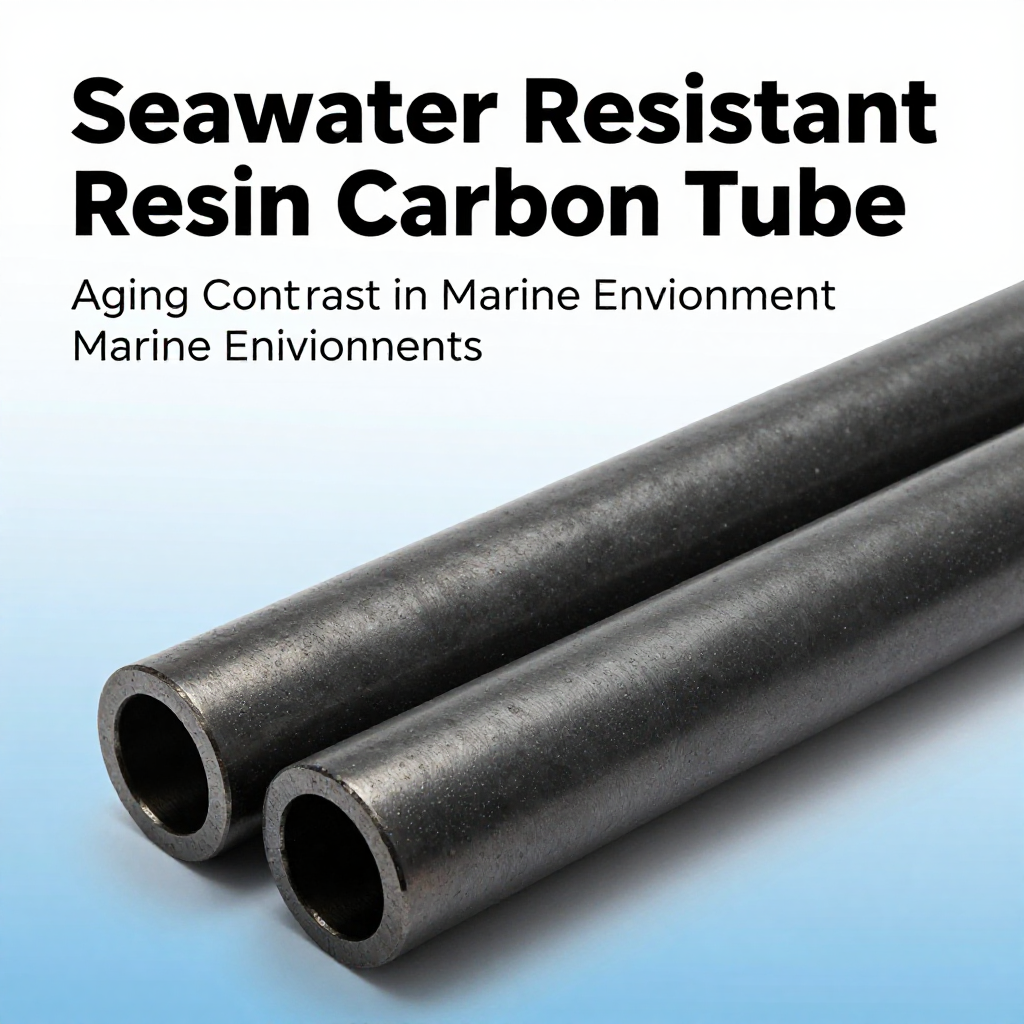
Carbon fiber reinforced polymer (CFRP) tubes are widely used in marine, offshore, and coastal applications due to their high strength-to-weight ratio and corrosion resistance compared to metals. However, the polymer matrix—typically epoxy—can degrade when exposed to seawater over extended periods. This article provides a comprehensive aging contrast between seawater-resistant resin carbon tubes and standard epoxy carbon tubes, focusing on mechanical property retention, moisture absorption, microstructural changes, and long-term durability. Understanding these differences is critical for engineers and designers selecting materials for underwater, tidal, and splash-zone applications.
## The Role of the Resin Matrix in Seawater Aging
### Standard Epoxy Systems
Standard epoxy resins are widely used in CFRP due to their excellent mechanical properties and ease of processing. However, they are susceptible to hydrolysis and plasticization when immersed in seawater. Water molecules penetrate the polymer network, causing swelling, micro-cracking, and a reduction in glass transition temperature (Tg). Over time, this leads to a significant drop in interlaminar shear strength (ILSS) and flexural modulus.
### Seawater-Resistant Resin Systems
Seawater-resistant resins are specially formulated with hydrophobic backbones, enhanced cross-link density, and additives that inhibit hydrolysis. These systems often include epoxy novolac, vinyl ester, or benzoxazine chemistries, which exhibit lower water uptake and better resistance to ionic diffusion. The result is a more stable matrix that preserves fiber-matrix adhesion and mechanical integrity even after years of exposure.
## Aging Mechanisms in Marine Environments
### Moisture Absorption and Diffusion
Moisture absorption is the primary driver of aging in CFRP. Standard epoxy carbon tubes typically absorb 1.5–2.5% water by weight at saturation, while seawater-resistant systems are designed to keep absorption below 0.5–0.8%. The absorbed water acts as a plasticizer, reducing the matrix stiffness and promoting micro-crack formation. In seawater, the presence of salts and ions accelerates osmotic pressure, leading to blistering and delamination in standard epoxies.
### Hydrolysis and Chemical Degradation
Seawater’s alkaline nature (pH ~8.2) catalyzes hydrolysis of ester and amide bonds in standard epoxy networks. This breaks the polymer chains, reducing molecular weight and mechanical strength. Seawater-resistant resins are formulated with hydrolytically stable bonds, such as ether linkages, which resist chain scission. Additionally, they often contain anti-corrosion additives that protect the carbon fibers from galvanic corrosion at any exposed fiber ends.
### Thermal and Hygrothermal Cycling
Marine environments subject materials to thermal cycling (day-night, seasonal) and hygrothermal cycling (wet-dry cycles). Standard epoxy carbon tubes experience cumulative damage due to differential expansion between the fiber and matrix, leading to micro-cracks that propagate under load. Seawater-resistant systems, with their lower coefficient of moisture expansion and higher toughness, better withstand these cyclic stresses.
## Comparative Aging Test Methodology
To accurately contrast the two materials, accelerated aging tests are conducted in accordance with ASTM D1141 (Standard Practice for Preparation of Substitute Ocean Water). Test specimens—both standard epoxy and seawater-resistant resin carbon tubes—are immersed in synthetic seawater at elevated temperatures (e.g., 60°C) to accelerate aging. Periodic evaluations include:
– Weight gain measurement (moisture absorption)
– Flexural strength and modulus testing (ASTM D790)
– Interlaminar shear strength (ILSS) via short-beam shear test (ASTM D2344)
– Dynamic mechanical analysis (DMA) to track Tg changes
– Scanning electron microscopy (SEM) for microstructural examination
## Aging Contrast: Key Findings
### Mechanical Property Retention
After 6 months of accelerated seawater aging (equivalent to ~5 years in service), standard epoxy carbon tubes showed a 30–40% reduction in flexural strength and a 25–35% reduction in ILSS. In contrast, seawater-resistant resin carbon tubes retained over 90% of their initial flexural strength and ILSS. The difference is attributed to the superior resistance to moisture-induced plasticization and hydrolysis in the seawater-resistant matrix.
### Moisture Absorption Kinetics
Standard epoxy tubes reached saturation at ~2.2% weight gain, while seawater-resistant tubes plateaued at ~0.6%. The lower absorption rate in the seawater-resistant system also means slower diffusion of corrosive ions, reducing the risk of internal damage.
### Glass Transition Temperature (Tg) Depression
DMA analysis revealed that standard epoxy tubes experienced a Tg drop of 20–30°C after aging, indicating significant plasticization. Seawater-resistant tubes showed only a 5–8°C reduction, preserving their dimensional stability and load-bearing capacity at elevated temperatures.
### Microstructural Damage
SEM images of standard epoxy tubes after aging showed extensive micro-cracking, fiber-matrix debonding, and voids filled with salt crystals. In contrast, seawater-resistant tubes exhibited minimal surface pitting and no significant interfacial failure, confirming the effectiveness of the resin’s hydrophobic and hydrolytic stability.
## Long-Term Durability Predictions
Based on Arrhenius extrapolation of accelerated test data, standard epoxy carbon tubes are expected to lose 50% of their mechanical strength after 10–15 years in a marine environment. Seawater-resistant resin carbon tubes, however, are projected to retain 80% of their strength after 25 years, making them a more reliable choice for critical infrastructure such as underwater pipelines, offshore platform risers, and tidal turbine blades.
## Applications and Selection Criteria
### When to Use Seawater-Resistant Resin Carbon Tubes
– Subsea equipment housings and pressure vessels
– Offshore drilling risers and choke lines
– Marine propulsion shafts and rudder stocks
– Coastal structural reinforcements (e.g., bridge pilings)
– Long-term immersion in splash zones or tidal areas
### When Standard Epoxy Carbon Tubes May Suffice
– Indoor or sheltered applications with no direct seawater contact
– Short-term exposure (less than 1 year) with regular maintenance and recoating
– Non-critical components where weight savings outweigh durability concerns
## Conclusion
The aging contrast between seawater-resistant resin carbon tubes and standard epoxy carbon tubes is stark. Standard epoxy systems, while cost-effective, are prone to significant degradation in marine environments due to moisture absorption, hydrolysis, and micro-cracking. Seawater-resistant resin systems, though initially more expensive, offer superior long-term performance, retaining mechanical integrity and dimensional stability over decades of service. For any application where seawater exposure is unavoidable, the investment in seawater-resistant resin carbon tubes is justified by reduced maintenance costs, extended service life, and enhanced safety. Engineers must carefully evaluate the specific environmental conditions and required lifespan to make an informed material selection.
—
*For further guidance on material selection and testing, consult with composite material specialists and refer to industry standards such as ASTM D1141 and ISO 23930.*