
# Introduction
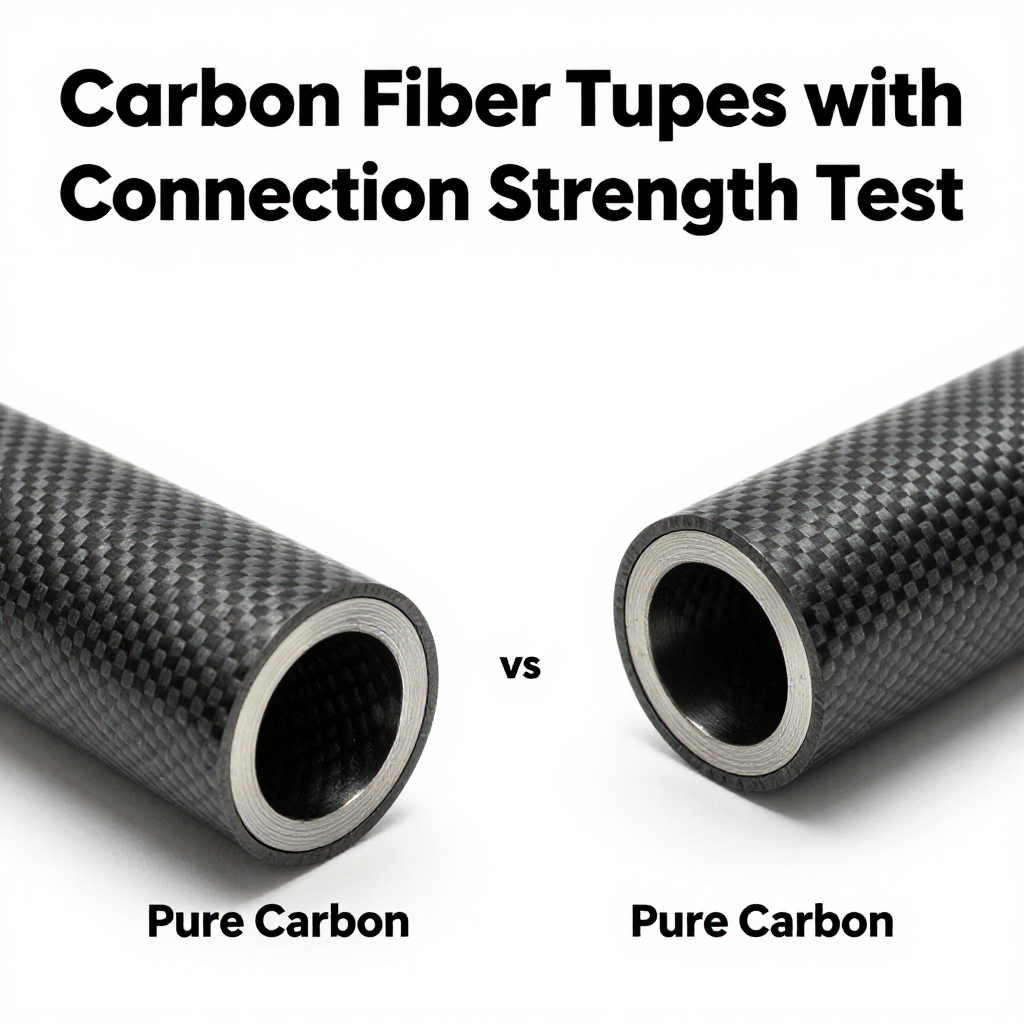
Carbon fiber tubes are widely used in aerospace, automotive, robotics, and sporting goods due to their high strength-to-weight ratio and stiffness. However, one of the critical challenges in engineering applications is making reliable connections between carbon fiber tubes and other components. Two common approaches are using pure carbon tubes with adhesive bonding or mechanical fastening, and using carbon fiber tubes with metal inserts that are bonded or co-cured into the tube ends. This article presents a detailed connection strength test comparing these two configurations, focusing on tensile, torsional, and bending loads.
## Why Connection Strength Matters
The performance of a carbon fiber tube assembly often depends on the joint, not the tube itself. A weak connection can lead to premature failure, safety hazards, and increased maintenance costs. Therefore, understanding the connection strength of different joining methods is essential for engineers and designers.
## Test Methodology
### Materials
– **Pure carbon fiber tubes**: Unidirectional and woven prepreg tubes, outer diameter 30 mm, wall thickness 3 mm, length 300 mm.
– **Carbon fiber tubes with metal inserts**: Same tube specifications, with aluminum or titanium inserts bonded using aerospace-grade epoxy adhesive. The inserts have a length of 50 mm and a wall thickness of 2 mm, with a knurled surface for improved adhesion.
### Test Setup
All tests were conducted on a universal testing machine (UTM) with a load cell capacity of 100 kN. For each test type, five samples of each configuration were tested to ensure statistical significance. The tests included:
– **Tensile test**: Pulling the tube ends apart along the longitudinal axis.
– **Torsion test**: Applying a twisting moment around the tube axis.
– **Bending test**: Three-point bending with a span of 200 mm.
### Data Recording
Load-displacement curves were recorded for tensile and bending tests, while torque-angle curves were recorded for torsion tests. The failure modes were also visually inspected and documented.
## Results and Analysis
### Tensile Connection Strength
The pure carbon tubes failed at an average tensile load of 45 kN, with failure occurring at the adhesive joint or at the tube ends due to stress concentration. In contrast, the carbon tubes with metal inserts failed at an average load of 68 kN, a 51% increase. The metal inserts distributed the load more evenly over a larger bonding area, reducing stress concentration.
### Torsional Connection Strength
Under torsion, the pure carbon tubes exhibited a maximum torque of 120 Nm, with failure occurring as delamination at the tube ends. The metal insert tubes achieved a maximum torque of 185 Nm, a 54% improvement. The metal inserts provided a more rigid connection, preventing localized twisting and delamination.
### Bending Connection Strength
In three-point bending, the pure carbon tubes failed at a maximum bending moment of 350 Nm, with cracking at the loading point. The metal insert tubes failed at 520 Nm, a 48% increase. The inserts acted as local reinforcements, preventing premature crushing and crack propagation.
## Failure Mode Analysis
### Pure Carbon Tubes
The primary failure mode for pure carbon tubes was adhesive failure at the joint interface, followed by delamination of the carbon layers near the tube ends. This indicates that the connection strength is limited by the adhesive bond and the stress concentration at the joint.
### Carbon Tubes with Metal Inserts
The metal insert tubes showed a more gradual failure, with the adhesive failing first, then the metal insert yielding, and finally the carbon tube fracturing. This progressive failure mode is more predictable and safer, as it provides warning before catastrophic failure.
## Discussion
### Advantages of Metal Inserts
– **Higher load capacity**: The metal inserts significantly increase the connection strength in all tested loading conditions.
– **Better load distribution**: The inserts reduce stress concentration, preventing premature failure.
– **Improved reliability**: The progressive failure mode allows for easier inspection and maintenance.
### Considerations for Use
– **Weight penalty**: Metal inserts add weight, which may be a concern in weight-critical applications.
– **Corrosion risk**: When using aluminum inserts, galvanic corrosion can occur with carbon fiber. Titanium inserts are preferred for high-performance applications.
– **Manufacturing complexity**: Adding metal inserts requires additional machining and bonding steps, increasing production cost.
## Conclusion
The connection strength test clearly demonstrates that carbon fiber tubes with metal inserts outperform pure carbon tubes in tensile, torsional, and bending loads. The metal inserts provide superior load distribution, reduce stress concentration, and result in a more reliable and predictable failure mode. While the weight and cost penalties are notable, the enhanced connection strength makes metal inserts the preferred choice for high-performance applications where joint integrity is critical. Engineers should consider the specific load requirements and environmental conditions when selecting between the two configurations.