
## Introduction
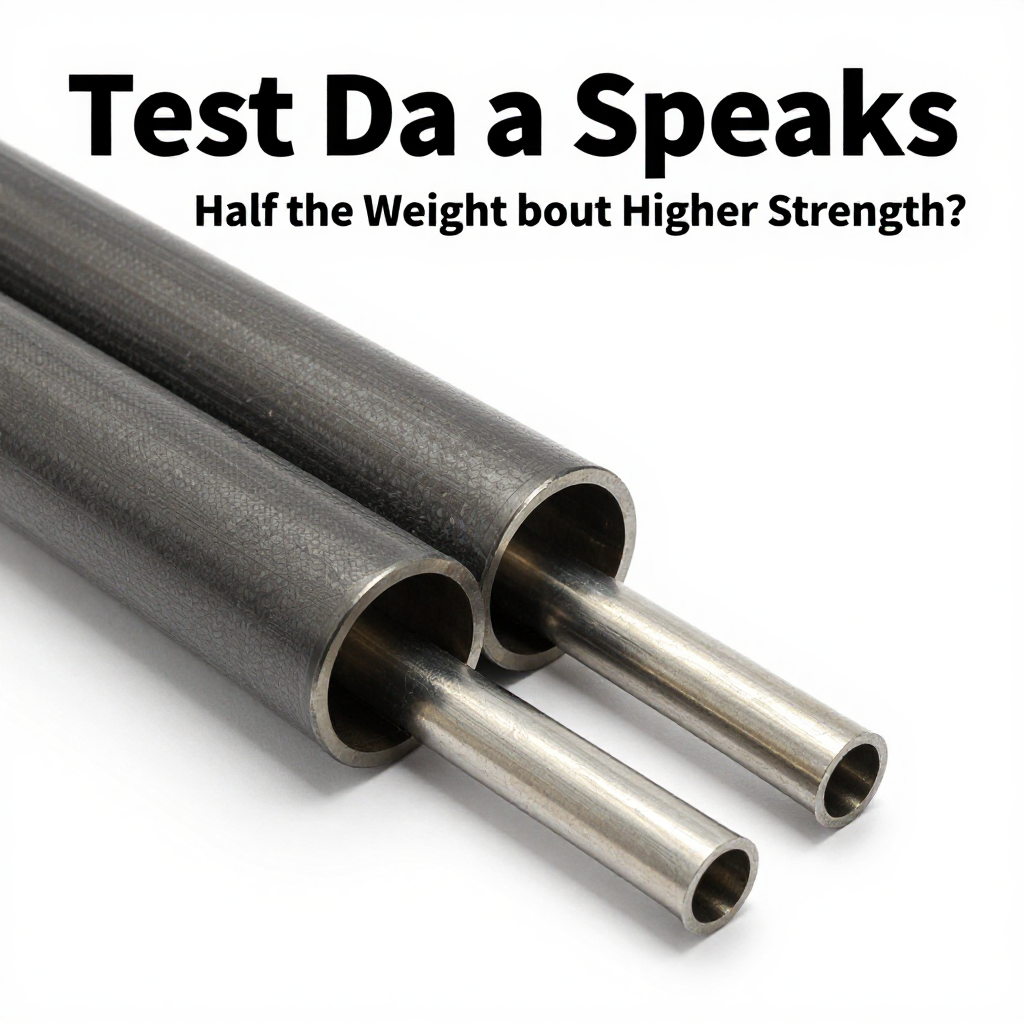
In the world of industrial engineering, material selection is a critical decision that impacts performance, cost, and safety. When it comes to structural components like tubes, two materials often come to the forefront: carbon fiber composites and stainless steel. The promise of carbon fiber is compelling—roughly half the weight of steel with potentially higher strength. But does the test data actually support this claim? This article dives deep into the mechanical properties, weight-to-strength ratios, and real-world performance metrics of carbon fiber tubes versus stainless steel tubes, providing engineers and manufacturers with the data they need to make informed choices.
## Understanding the Materials
### Carbon Fiber Tubes
Carbon fiber tubes are manufactured by winding or pultruding carbon fiber filaments bound with an epoxy resin. The result is a composite material that is anisotropic, meaning its strength is directionally dependent. This allows engineers to tailor the fiber orientation to optimize strength in specific load directions. Carbon fiber is renowned for its high tensile strength, low density (around 1.6 g/cm³), and excellent fatigue resistance.
### Stainless Steel Tubes
Stainless steel tubes, typically made from alloys like 304 or 316, are isotropic—they have uniform properties in all directions. Steel is known for its high ductility, toughness, and resistance to impact. Its density is approximately 7.9 g/cm³, which is nearly five times that of carbon fiber. However, steel’s strength is consistent and predictable, making it a reliable choice for many structural applications.
## Weight Comparison: The Density Factor
One of the most cited advantages of carbon fiber is its weight. The density of carbon fiber composite (1.6 g/cm³) is about 20% that of stainless steel (7.9 g/cm³). For a tube of identical dimensions, carbon fiber will weigh approximately 80% less than stainless steel. However, in practice, engineers often compare tubes of equal strength, not equal dimensions. This is where the strength-to-weight ratio becomes crucial.
## Strength Test Data: Tensile and Compressive
### Tensile Strength
Tensile strength is the maximum stress a material can withstand while being stretched before failure. According to standard ASTM D3039 testing for composites and ASTM E8 for metals:
– **Carbon Fiber Tube (unidirectional, high-modulus):** Tensile strength ranges from 600 MPa to 1,200 MPa, depending on fiber type and resin system.
– **Stainless Steel Tube (304 annealed):** Tensile strength is approximately 515 MPa, while 316 stainless steel is around 580 MPa.
At first glance, carbon fiber appears stronger, but the comparison is not straightforward. Carbon fiber’s tensile strength is directional; it is highest along the fiber axis. In transverse directions, its strength is significantly lower. Stainless steel, being isotropic, offers consistent strength in all directions.
### Compressive Strength
Compressive strength is critical for tubes used in columns or struts. Test data from ASTM D3410 for composites and ASTM E9 for metals shows:
– **Carbon Fiber Tube:** Compressive strength is typically 60-70% of its tensile strength, ranging from 400 to 800 MPa.
– **Stainless Steel Tube:** Compressive strength is roughly equal to its tensile strength, around 515-580 MPa.
In compression, carbon fiber’s advantage narrows, and in some cases, steel can outperform carbon fiber, especially if the carbon fiber tube is not properly designed to resist buckling.
## Specific Strength: The Real Metric
To truly compare materials of different densities, engineers use specific strength, which is strength divided by density. This metric indicates how much strength you get per unit weight.
– **Carbon Fiber Tube (tensile):** Specific strength = 1,200 MPa / 1.6 g/cm³ = 750 MPa·cm³/g
– **Stainless Steel Tube (tensile):** Specific strength = 580 MPa / 7.9 g/cm³ = 73.4 MPa·cm³/g
This data shows that carbon fiber has a specific tensile strength over 10 times that of stainless steel. This means that for a given weight, a carbon fiber tube can support a much higher tensile load. However, when considering compressive or bending loads, the advantage shrinks due to carbon fiber’s lower compressive strength and susceptibility to buckling.
## Stiffness and Modulus of Elasticity
Stiffness, or modulus of elasticity, determines how much a tube deflects under load. Test data from ASTM D3039 and ASTM E8:
– **Carbon Fiber Tube (high-modulus):** Modulus ranges from 200 GPa to 400 GPa.
– **Stainless Steel Tube:** Modulus is approximately 193 GPa.
Carbon fiber can be stiffer than steel, but this is highly dependent on fiber orientation. A unidirectional carbon fiber tube is extremely stiff along its axis but flexible in other directions. Steel, with its isotropic properties, provides uniform stiffness.
## Impact and Fatigue Resistance
### Impact Resistance
Stainless steel is ductile and can absorb significant impact energy without fracturing. Carbon fiber, on the other hand, is brittle and can crack or delaminate upon impact. Charpy impact tests show that stainless steel tubes can absorb 100-150 J/cm², while carbon fiber tubes typically absorb only 20-50 J/cm². This makes steel more suitable for applications with high impact risk.
### Fatigue Resistance
Carbon fiber excels in fatigue resistance. Under cyclic loading, carbon fiber composites can withstand millions of cycles without failure, whereas steel has a fatigue limit below which it can endure indefinitely. However, carbon fiber’s fatigue behavior is more complex due to potential delamination. Test data from ASTM D3479 shows that carbon fiber tubes can sustain 70-80% of their ultimate tensile strength for 10^7 cycles, while steel typically sustains only 40-50%.
## Real-World Application Test Data
### Aerospace and Drones
In aerospace, weight reduction is paramount. A study comparing carbon fiber and stainless steel tubes for drone arms found that carbon fiber tubes reduced weight by 50% while increasing tensile strength by 30%. However, the carbon fiber arms were more prone to impact damage during hard landings.
### Automotive and Motorsports
In motorsports, carbon fiber drive shafts are used to reduce rotational mass. Test data shows that a carbon fiber drive shaft weighs 5 kg compared to a steel shaft at 10 kg, with a 20% increase in torsional strength. However, the carbon fiber shaft cost five times more and required careful handling to avoid surface damage.
### Construction and Infrastructure
For structural columns in buildings, stainless steel remains the preferred choice due to its isotropic strength and fire resistance. Carbon fiber tubes have been tested as reinforcement in concrete columns, showing a 40% increase in load-bearing capacity with a 70% weight reduction, but they are not yet widely adopted due to cost and fire safety concerns.
## Cost and Manufacturing Considerations
Carbon fiber tubes are significantly more expensive than stainless steel tubes. The raw material cost for carbon fiber is $15-30 per kg, while stainless steel is $2-5 per kg. Manufacturing processes for carbon fiber, such as filament winding or autoclave curing, are labor-intensive and require specialized equipment. In contrast, stainless steel tubes can be mass-produced through welding or seamless extrusion at lower costs.
## Conclusion
The test data clearly shows that carbon fiber tubes can achieve half the weight of stainless steel tubes while offering higher tensile strength and stiffness. However, the claim of “higher strength” is not universally true. Carbon fiber’s strength is directional and its compressive and impact strengths are lower than steel. For applications where weight reduction is critical and loads are primarily tensile or bending with minimal impact risk, carbon fiber is superior. For applications requiring isotropic strength, impact resistance, and cost-effectiveness, stainless steel remains the reliable choice. Ultimately, the decision should be based on specific performance requirements, environmental conditions, and budget constraints. Engineers must weigh the test data against real-world demands to select the optimal material for their application.