
## Introduction
Carbon fiber tubes are widely used in aerospace, automotive, robotics, sporting goods, and industrial machinery due to their exceptional strength-to-weight ratio and stiffness. However, the market is flooded with products labeled as “carbon fiber” that are actually inferior imitations or low-grade composites. These counterfeit or substandard tubes can fail catastrophically under load, leading to safety hazards and financial losses. This buying guide provides a systematic approach to identifying high-quality carbon fiber tubes and avoiding common pitfalls.
## Understanding Carbon Fiber Grades and Manufacturing Processes
### Raw Material Quality: PAN vs. Pitch-Based Fiber
High-quality carbon fiber tubes are typically made from polyacrylonitrile (PAN) precursor, which yields superior tensile strength and modulus. Pitch-based fibers are cheaper but have lower mechanical properties. Always ask the supplier for the fiber type and its tensile modulus (e.g., T300, T700, T800, M40). Premium tubes use aerospace-grade fibers like T700 or higher.
### Manufacturing Methods: Filament Winding vs. Pultrusion vs. Roll Wrapping
– **Filament winding** produces tubes with high hoop strength and is ideal for pressure vessels and drive shafts.
– **Pultrusion** offers continuous, low-cost tubes with consistent cross-sections but lower interlaminar shear strength.
– **Roll wrapping** (or sheet wrapping) is common for structural tubes, providing good axial strength.
High-quality tubes are often autoclave-cured to eliminate voids and ensure proper resin-to-fiber ratio. Ask about the curing process—oven curing without pressure can lead to porosity.
## Visual Inspection: What to Look For
### Surface Finish and Texture
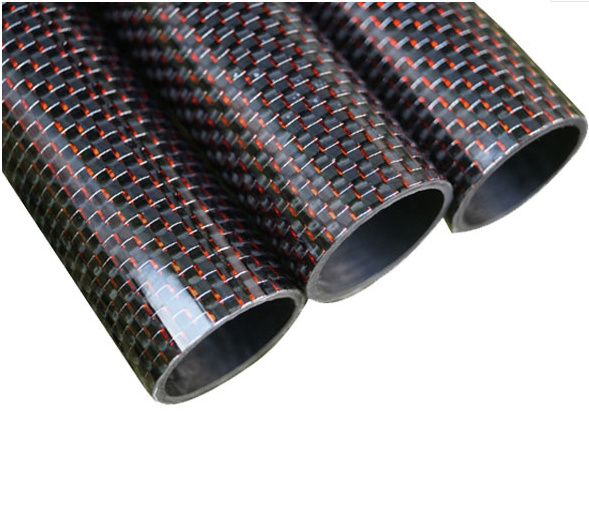
A genuine carbon fiber tube has a smooth, glossy surface with a visible, uniform weave pattern (e.g., 2×2 twill or plain weave). The weave should be tight and consistent, with no gaps, frayed edges, or resin-rich areas. Inferior tubes may have a dull, blotchy surface, uneven weave, or visible fiber misalignment. Run your fingers along the surface—high-quality tubes feel perfectly smooth, while counterfeits may have slight ridges or bumps.
### Color and Gloss
Authentic carbon fiber has a deep, metallic black sheen with subtle variations. If the tube appears too uniformly black or has a plastic-like shine, it may be a carbon-wrapped fiberglass or a painted aluminum tube. Some counterfeits use carbon-look vinyl or hydro-dipping, which lacks the three-dimensional depth of real carbon fiber. Tilt the tube under light—real carbon fiber shows a subtle shimmer from the fiber orientation.
### Weight and Density
Carbon fiber is lightweight but not featherweight. A high-quality tube has a density of about 1.6 g/cm³. If a tube feels unusually light, it may be hollow with thin walls or made of low-density resin. Conversely, if it feels heavy, it could be fiberglass or metal with a carbon wrap. Compare the weight to the specified dimensions—any significant deviation is a red flag.
## Mechanical Testing: Simple Field Checks
### Flexural and Compression Tests
You can perform a simple three-point bend test on a small sample (if the supplier allows). A high-quality carbon fiber tube will flex slightly and then return to its original shape without cracking. Inferior tubes may deform permanently, show surface cracks, or delaminate. For compression, apply axial pressure—quality tubes resist buckling until high loads, while poor tubes may crush or split easily.
### Tap Test for Delamination
Gently tap the tube with a coin or a small metal object. A high-quality tube produces a sharp, ringing sound, indicating good consolidation. A dull, thudding sound suggests voids, delamination, or excessive resin. This test is especially useful for detecting internal defects that are not visible externally.
## Chemical and Thermal Resistance Checks
### Resin System Quality
High-quality carbon fiber tubes use epoxy resins with high glass transition temperature (Tg) above 120°C. Inferior tubes may use polyester or vinyl ester resins that soften at lower temperatures. You can test this by exposing a small sample to heat (e.g., with a heat gun) and observing for smoke, discoloration, or deformation. Quality epoxy will resist heat without immediate degradation.
### Solvent Resistance
Apply a small amount of acetone or MEK to an inconspicuous area. A high-quality epoxy-based tube will not dissolve or soften. If the surface becomes sticky or the resin dissolves, it is likely a low-grade resin or even a painted imitation. This test is destructive, so perform it only on a sample or with the supplier’s permission.
## Documentation and Certification
### Material Data Sheets and Traceability
Reputable manufacturers provide detailed material data sheets (MDS) specifying fiber type, resin system, tensile strength, modulus, and curing process. Ask for certificates of conformance (CoC) and, if possible, third-party test reports. High-quality tubes often come with traceable batch numbers. If a supplier cannot provide these documents, it is a strong indication of inferior quality.
### Compliance with Industry Standards
Check if the tubes meet relevant standards such as ASTM D3039 (tensile properties), ASTM D3410 (compressive properties), or ISO 527. For aerospace or automotive applications, look for certifications like AS9100 or IATF 16949. These certifications ensure consistent quality control during manufacturing.
## Common Counterfeit Types and How to Spot Them
### Carbon-Wrapped Fiberglass Tubes
These are fiberglass tubes with a thin carbon fiber outer layer. They are heavier and have lower stiffness. To spot them, look at the cut ends—if you see a white or greenish core, it is fiberglass. Also, the weave pattern may be only on the surface, not through the entire wall thickness.
### Painted or Hydro-Dipped Tubes
Some tubes are made of aluminum or plastic and painted to look like carbon fiber. The weave pattern is printed, so it lacks the natural irregularity of real carbon. A magnet test can help—aluminum is non-magnetic, but steel is. Also, scratch the surface gently; real carbon fiber will show black fibers, while paint will peel or reveal a different color underneath.
### Low-Grade Carbon Fiber (Recycled or Short-Fiber)
Some manufacturers use recycled carbon fiber or chopped fibers mixed with resin. These tubes have lower mechanical properties and a less uniform appearance. They may have a speckled or matte finish. High-quality tubes use continuous, unidirectional or woven fibers for maximum strength.
## Cost and Supplier Evaluation
### Price Red Flags
If the price is significantly lower than the market average, be suspicious. High-quality carbon fiber tubes are expensive due to raw material and processing costs. For example, a T700-grade tube costs at least $50 per meter for common sizes. Extremely cheap tubes are likely made with inferior materials or processes.
### Supplier Reputation and Reviews
Purchase from established suppliers with a track record in the industry. Check online reviews, ask for references, and visit their manufacturing facility if possible. A reliable supplier will be transparent about their materials and processes and will offer samples for testing before bulk orders.
## Conclusion
Distinguishing high-quality carbon fiber tubes from inferior counterfeits requires a combination of visual inspection, mechanical testing, and documentation review. Always prioritize safety and performance over cost. By understanding the manufacturing processes, checking surface quality, performing simple field tests, and demanding proper certifications, you can make informed purchasing decisions. Remember that a high-quality carbon fiber tube is an investment in reliability and longevity—never compromise on quality for a lower price.