
## Introduction
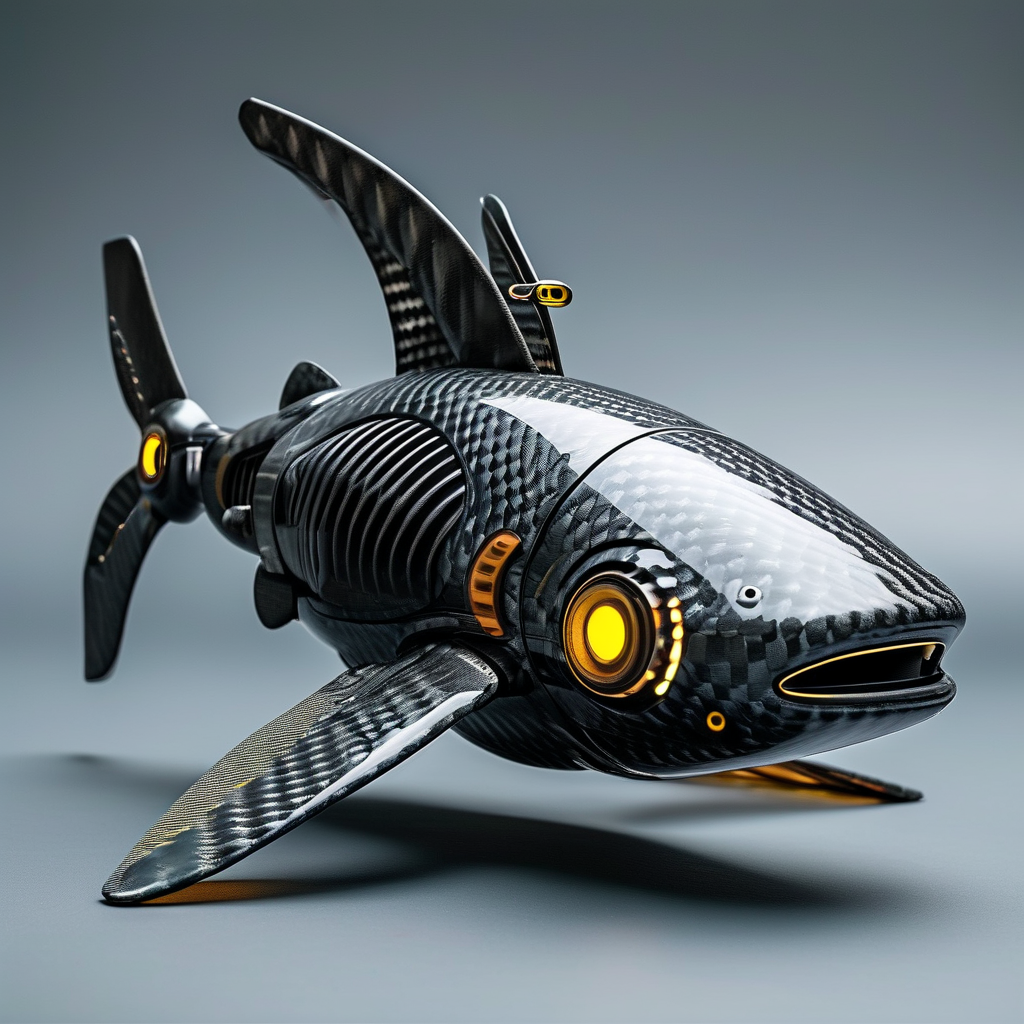
The evolution of underwater robotics has taken a remarkable turn with the development of biomimetic robot fish. Unlike traditional propeller-driven underwater vehicles, robot fish emulate the natural undulatory locomotion of real fish, offering superior maneuverability, energy efficiency, and reduced acoustic signature. Central to the performance of these bionic systems is the mechanical backbone that transmits propulsion forces: the carbon fiber support tube. This article explores the critical role of carbon fiber support tube accessories in robot fish bionic propulsion, detailing their design, manufacturing, and integration challenges.
## The Role of Support Tubes in Bionic Propulsion
In a robot fish, the propulsion system typically consists of a flexible tail fin, an actuation mechanism (such as a servo motor or smart actuator), and a structural frame that connects the internal components to the external body. The support tube serves as the primary structural element that houses the actuation system and transmits the undulatory motion to the tail. It must withstand cyclic bending, torsion, and axial loads while maintaining precise alignment of the internal components.
### Why Carbon Fiber?
Carbon fiber composites offer an exceptional strength-to-weight ratio, high stiffness, and excellent fatigue resistance. These properties are essential for a component that undergoes millions of bending cycles during operation. Additionally, carbon fiber’s low density reduces the overall mass of the robot fish, improving buoyancy control and energy efficiency. The material’s damping characteristics also help attenuate vibrations, leading to smoother propulsion and reduced noise—a critical advantage for stealth applications.
## Design Considerations for Carbon Fiber Support Tubes
### Mechanical Load Analysis
The support tube must be engineered to handle the dynamic forces generated during swimming. Finite element analysis (FEA) is commonly used to simulate the stress distribution under various swimming gaits. Key parameters include:
– **Bending stiffness**: Determines the tail’s flexibility and the amplitude of the undulatory wave.
– **Torsional rigidity**: Prevents unwanted twisting that could misalign the actuation system.
– **Axial strength**: Withstands the thrust forces transmitted from the tail.
### Dimensional Tolerances
Precision manufacturing is crucial. The tube’s inner diameter must accommodate the actuator and wiring, while the outer diameter must match the robot’s body profile. Tolerances are typically held within ±0.1 mm to ensure proper sealing and alignment.
### Integration with Other Accessories
Support tubes are rarely used in isolation. They are paired with a range of accessories that enhance functionality:
– **End caps and flanges**: Provide attachment points for the tail fin and the main body.
– **Bearing housings**: Support rotating shafts in the actuation system.
– **Cable guides**: Route electrical wires through the tube without interference.
– **Sealing rings**: Prevent water ingress at the tube’s ends.
## Manufacturing Processes for Carbon Fiber Tubes
### Filament Winding
Filament winding is a common method for producing high-performance carbon fiber tubes. Continuous carbon fiber tows are wound around a rotating mandrel at precise angles to achieve the desired mechanical properties. The angle of the winding can be tailored to optimize bending or torsional stiffness.
### Pultrusion
Pultrusion involves pulling carbon fiber rovings through a resin bath and then through a heated die. This process yields tubes with constant cross-sections and excellent longitudinal strength. It is cost-effective for large production runs but offers less flexibility in fiber orientation.
### Roll Wrapping
For smaller-diameter tubes, roll wrapping (or sheet wrapping) is used. Pre-preg carbon fiber sheets are wrapped around a mandrel and cured in an autoclave. This method allows for precise control over wall thickness and fiber orientation, making it ideal for custom robot fish prototypes.
## Accessories and Their Functional Importance
### Tail Fin Connectors
The connection between the support tube and the tail fin is a critical interface. A rigid connector can dampen the natural motion, while a flexible one may cause energy loss. Typically, a metallic or composite flange is bonded to the tube’s end, providing a secure mounting point for the fin.
### Internal Actuator Mounts
Inside the tube, the actuator (often a brushless DC motor or a shape-memory alloy actuator) must be firmly mounted to prevent movement during operation. Custom-machined brackets or 3D-printed inserts are used to secure the actuator and align its output shaft with the tube’s axis.
### Waterproofing Components
Since robot fish operate underwater, the support tube must be part of a watertight enclosure. O-rings, gaskets, and specialized sealing compounds are used at the tube’s ends. The tube itself may be coated with a hydrophobic layer to prevent water absorption.
## Case Study: A Biomimetic Tuna Robot
A practical example is a tuna-inspired robot developed for oceanographic monitoring. Its carbon fiber support tube was manufactured using filament winding with a ±45° fiber orientation to balance bending and torsional stiffness. The tube housed a servo motor and a spring-loaded mechanism that generated the characteristic tail beat. The accessories included a titanium end cap for the tail fin and a polyurethane sealing boot. The robot achieved a swimming speed of 1.2 m/s with an energy efficiency 30% higher than a comparable propeller-driven vehicle.
## Challenges and Solutions
### Corrosion and Galvanic Coupling
Carbon fiber is electrically conductive and can cause galvanic corrosion when in contact with metals in seawater. To mitigate this, insulating layers or sacrificial anodes are used. Alternatively, all metallic accessories are made from corrosion-resistant alloys such as titanium or stainless steel.
### Fatigue Life
The cyclic loading of the support tube can lead to delamination or fiber breakage over time. Advanced manufacturing techniques, such as automated fiber placement, can align fibers along the principal stress directions, extending the fatigue life. Regular inspection using ultrasonic testing is recommended for critical missions.
### Cost vs. Performance
Carbon fiber components are expensive. For research prototypes, the cost is justified by the performance gains. For mass-produced consumer robot fish, alternative materials like fiberglass or aluminum may be considered, but they often compromise on weight and stiffness.
## Future Trends
### Smart Materials and Embedded Sensors
The next generation of support tubes may incorporate embedded fiber-optic sensors to monitor strain and temperature in real time. This would enable predictive maintenance and adaptive control of the robot’s swimming behavior.
### Additive Manufacturing
3D printing with carbon fiber-reinforced thermoplastics is gaining traction. It allows for complex geometries, such as integrated cable channels and mounting bosses, which are difficult to achieve with traditional methods. However, the mechanical properties of printed parts are still inferior to those of continuous fiber composites.
### Modular Designs
Modular support tube systems, where the tube can be easily disconnected from the body, would simplify maintenance and allow for quick swapping of different tail fin designs. Quick-release couplings and standardized interfaces are being developed to facilitate this.
## Conclusion
The carbon fiber support tube is a vital component in robot fish bionic propulsion systems. Its unique combination of strength, stiffness, and lightness enables the high-performance undulatory locomotion that sets these robots apart from conventional underwater vehicles. The design and manufacturing of these tubes, along with their associated accessories, require careful consideration of mechanical loads, environmental conditions, and integration requirements. As materials science and manufacturing technologies advance, we can expect even more sophisticated support tube systems that will push the boundaries of underwater robotics, enabling longer missions, deeper dives, and more agile maneuvers.
For engineers and researchers in the field, understanding the nuances of carbon fiber support tube design is not just a technical detail—it is a cornerstone of successful biomimetic robot development. By mastering this component, we unlock the full potential of bionic propulsion and pave the way for a new era of autonomous underwater exploration.