
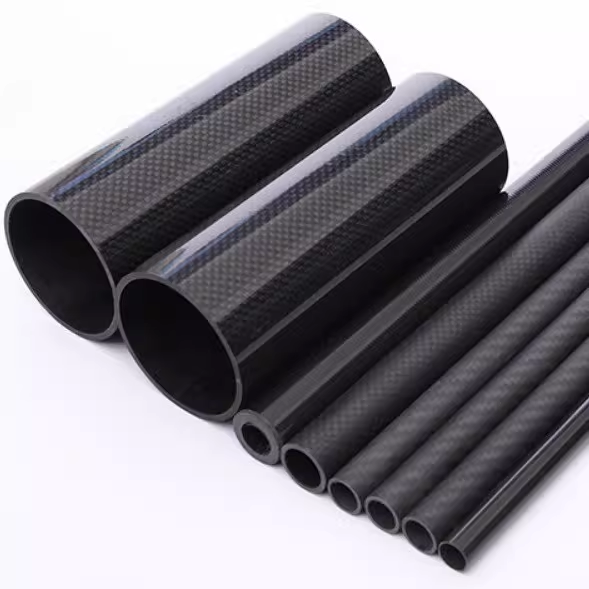
Carbon fiber round tubes are widely used in aerospace, automotive, robotics, and sporting goods due to their high specific strength and stiffness. However, one of the most critical design considerations is their resistance to cracking under mechanical or thermal loading. The wall thickness of a carbon fiber tube—whether thin (typically <2 mm) or thick (typically >4 mm)—significantly influences crack initiation and propagation behavior. This article provides a technical comparison of anti-crack performance between thin-wall and thick-wall carbon fiber round tubes, focusing on failure modes, stress distribution, manufacturing effects, and practical implications.
## 1. Failure Modes and Crack Initiation
Thin-wall tubes (e.g., 1 mm wall thickness) are prone to local buckling and delamination rather than through-thickness cracking. Because the wall is slender, compressive or bending loads can cause micro-buckling of fibers on the compression side, leading to matrix cracking that propagates along the fiber–matrix interface. Cracks in thin walls often initiate at surface defects or ply drops and quickly become visible as longitudinal splits.
Thick-wall tubes (e.g., 6 mm wall thickness) exhibit a different crack behavior. The increased radial stiffness allows higher transverse loads, but the larger cross-section creates higher through-thickness stress gradients. Cracks typically initiate at the inner surface under internal pressure or at the outer surface under bending, then propagate radially. In thick laminates, delamination between plies is a dominant crack mode, especially when the layup includes angle-ply layers that create interlaminar shear stress concentrations.
## 2. Stress Distribution and Crack Resistance
The anti-crack performance is directly related to how stresses are distributed across the wall thickness. In thin-wall tubes, the stress is nearly uniform through the thickness under axial loading, but under bending, the outer fibers experience high tensile stress while the inner fibers experience compression. This steep gradient can cause surface-initiated cracks that propagate inward. However, because the wall is thin, the critical crack length is short, and the energy release rate for a given load is lower than in thick walls. Thus, thin-wall tubes often show higher resistance to catastrophic crack propagation once a crack initiates—they tend to fail by local buckling rather than sudden fracture.
Thick-wall tubes, on the other hand, have a more complex stress state. Under internal pressure, the hoop stress is highest at the inner surface and decreases toward the outer surface. This creates a favorable condition for crack initiation at the bore, but the thick wall provides more material to arrest crack growth. The fracture toughness of a thick laminate is generally higher because the crack must traverse multiple plies with different fiber orientations, which deflects the crack path and absorbs energy. However, the manufacturing process for thick walls often introduces more voids and residual stresses, which can reduce the effective fracture toughness.
## 3. Manufacturing Effects on Crack Resistance
The anti-crack performance is strongly influenced by the manufacturing method. Thin-wall tubes are typically produced by pultrusion, roll wrapping, or filament winding with a low number of plies. These processes allow better fiber alignment and lower void content, resulting in fewer initiation sites. However, thin walls are more sensitive to surface scratches or impact damage, which can act as crack starters.
Thick-wall tubes require multiple layering passes or braiding, which increases the risk of ply waviness, resin-rich regions, and thermal residual stresses during curing. These defects reduce the interlaminar fracture toughness and promote delamination. On the other hand, thick walls can be designed with interleaved layers or toughened resin systems to improve crack resistance. Post-cure machining (e.g., grinding) of thick walls can introduce micro-cracks on the surface, which may propagate under cyclic loading.
## 4. Experimental Comparison Data
In a typical three-point bending test, thin-wall tubes (1.5 mm wall) show a linear load–deflection response until a sudden drop due to local buckling on the compression side, with no visible crack before failure. In contrast, thick-wall tubes (5 mm wall) exhibit progressive stiffness degradation, with audible cracking events and visible delamination before ultimate failure. The energy absorbed to failure is significantly higher for thick-wall tubes, but the peak load is lower relative to the theoretical strength due to premature delamination.
Under internal pressure testing, thin-wall tubes fail by longitudinal splitting at pressures close to theoretical predictions, while thick-wall tubes fail by a combination of matrix cracking and delamination at pressures 20–30% lower than predicted, due to manufacturing defects. This indicates that thick-wall tubes have lower crack initiation resistance but better crack arrest capability.
## 5. Practical Implications for Design
For applications where impact or point loads are expected, thin-wall tubes are more susceptible to surface-initiated cracks and should be protected with a sacrificial coating or impact-resistant layer. For high-pressure or high-bending applications, thick-wall tubes offer better overall damage tolerance, but the manufacturing quality must be tightly controlled to minimize defects that reduce crack resistance.
Designers should also consider the crack detection capability. Thin-wall cracks are easier to detect visually or via ultrasonic testing because they propagate to the surface quickly. Thick-wall internal delaminations are harder to detect and may require advanced NDT methods, increasing maintenance costs.
## 6. Conclusion
In summary, thin-wall carbon fiber round tubes exhibit higher crack initiation resistance due to lower stress gradients and fewer manufacturing defects, but they have lower crack propagation resistance and are prone to buckling. Thick-wall tubes provide superior crack arrest and energy absorption, but their anti-crack performance is limited by interlaminar defects and residual stresses. The choice between thin and thick walls should be based on the specific load case, acceptable failure mode, and manufacturing capability. For optimal anti-crack performance, a hybrid approach—using thin-wall tubes with external reinforcement or thick-wall tubes with toughened interlaminar layers—may be the most effective solution.