
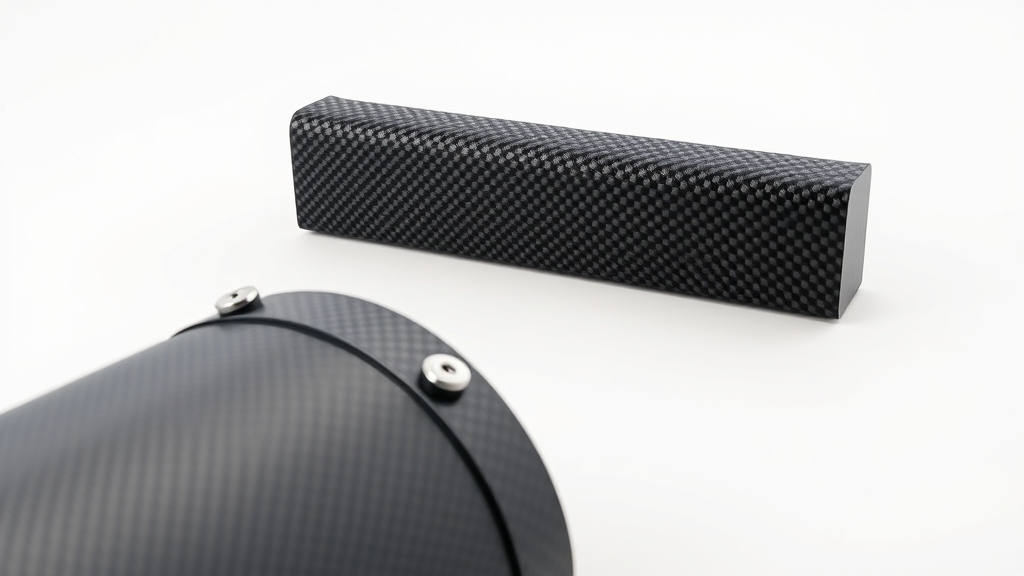
In the relentless pursuit of performance, industries from aerospace to sporting goods have converged on a singular truth: weight is the enemy of efficiency. Every gram shed translates directly into faster acceleration, lower energy consumption, and superior handling. At the heart of this transformation lies an unassuming yet revolutionary component—the carbon fiber tube. Its emergence has not merely replaced traditional materials; it has redefined the boundaries of what lightweighting can achieve. This post explores the mechanics of how carbon fiber tubes deliver unprecedented weight reduction and the cascading efficiency enhancements that follow.
The Material Science Behind Carbon Fiber
To understand the advantage, one must first appreciate the material itself. Carbon fiber is a polymer composed of thin, strong crystalline filaments of carbon, typically 5–10 micrometers in diameter. These filaments are bundled into tows, which are then woven into fabrics or aligned unidirectionally. When combined with a resin matrix—usually epoxy—the resulting composite exhibits a strength-to-weight ratio that shames steel and aluminum.
For tubular structures, the magic lies in the anisotropy of carbon fiber. Unlike isotropic metals, which have uniform properties in all directions, carbon fiber composites can be engineered to place stiffness and strength precisely where loads demand it. Fibers oriented along the tube’s axis resist bending and tensile forces, while hoop-oriented fibers handle crushing and torsional stresses. This directional tailoring means that a carbon fiber tube uses only the material absolutely necessary, eliminating the parasitic mass inherent in metal designs. The result is a component that can be 50–70% lighter than its steel equivalent and 30–50% lighter than aluminum, with no compromise in structural integrity.
Weight Reduction: The Primary Mechanism
The most immediate benefit of carbon fiber tubes is mass elimination. In dynamic systems, weight reduction triggers a virtuous cycle. Consider an automotive driveshaft: a steel shaft might weigh 10 kg, while a carbon fiber equivalent weighs under 4 kg. That 6 kg saving reduces rotational inertia, meaning the engine expends less energy to spin it. This directly improves fuel efficiency and throttle response. Moreover, the lighter component allows for downsizing of supporting structures—bearings, mounts, and housings—creating secondary weight savings that multiply the initial benefit.
The mechanism extends to static applications as well. In aerospace, replacing aluminum hydraulic tubes with carbon fiber versions slashes weight from an airframe. Every kilogram removed from an aircraft reduces fuel burn over its service life by thousands of liters. Space launch vehicles see even more dramatic returns, where every gram saved in a satellite’s structural bus translates to more payload capacity or extended mission life. Carbon fiber tubes achieve this through a combination of low material density (around 1.6 g/cm³ versus 2.7 for aluminum) and the ability to tailor wall thickness precisely to load requirements, often resulting in thin yet robust cylinders.
Efficiency Enhancement Across Industries
Weight reduction is a means, not an end. The true value emerges in the efficiency gains it unlocks. In cycling, carbon fiber frame tubes have become ubiquitous not just because they lighten the bike, but because they transform the riding experience. A lighter frame accelerates faster and climbs with less effort, directly improving the rider’s energy-to-distance ratio. The material’s vibration-damping properties further enhance efficiency by reducing muscle fatigue over long distances.
Industrial automation provides a striking example. Robotic arms equipped with carbon fiber tubes move faster and with greater precision because the lower inertia allows smaller motors and quicker direction changes. This accelerates cycle times on assembly lines, directly boosting throughput. In fluid transport, carbon fiber tubes offer smooth internal surfaces that minimize frictional losses, improving pump efficiency in hydraulic systems. For high-performance vehicles, the reduction in unsprung weight—from carbon fiber suspension control arms—improves tire contact with the road, translating to better grip and shorter braking distances. These are efficiency gains that go far beyond simple fuel or energy savings; they represent performance multipliers.
Manufacturing Precision and Design Freedom
The weight-reduction potential of carbon fiber tubes is amplified by advanced manufacturing techniques. Processes like filament winding, pultrusion, and roll-wrapping allow precise control over fiber placement and resin content, minimizing voids and ensuring consistent wall thickness. Automated fiber placement can lay down material with millimeter accuracy, creating tubes with complex ply schedules that vary along the length. This enables localized reinforcement at joints or high-stress areas without adding mass elsewhere, a concept impossible with monolithic metals.
Design freedom further extends to cross-sectional shapes. While metal tubes are largely limited to round, square, or rectangular profiles due to extrusion constraints, carbon fiber tubes can be formed into aerodynamic airfoil shapes or complex multi-chamber configurations. An aerodynamic tube on a bicycle or drone reduces drag, saving energy without adding weight. Similarly, integrating features like internal ribs or mounting points during layup eliminates the need for heavy joining hardware. This consolidation of parts reduces assembly weight and complexity, compounding efficiency improvements.
Real-World Applications in Action
The impact of carbon fiber tubes is best illustrated through concrete examples. In the medical field, carbon fiber patient positioning boards for X-ray tables are not only light enough for a single technician to manipulate but also radiolucent, allowing clear imaging without interference. This dual benefit—weight and transparency—improves workflow efficiency and diagnostic quality. In marine engineering, sailboats use carbon fiber spars that are stiff enough to handle high wind loads yet so light they lower the vessel’s center of gravity, enhancing stability and speed.
Urban transportation is another frontier. Electric scooters and bicycles increasingly feature carbon fiber frame tubes and handlebars. The weight reduction extends battery range, a critical consumer concern, while the material’s fatigue resistance ensures longevity despite constant vibration. Even in architecture, carbon fiber tubes serve as lightweight tension structures in tensile fabric roofs, reducing the foundational load and enabling larger clear spans with less material consumption. Each application leverages the same core principle: removing mass from the equation creates efficiencies that ripple through the entire system.
Overcoming Challenges and Future Outlook
Despite their advantages, carbon fiber tubes face hurdles. The primary barrier has been cost, as raw carbon fiber and labor-intensive manufacturing drove prices higher than metal alternatives. However, economies of scale, recycled carbon fiber, and automated production are steadily narrowing that gap. Concerns about end-of-life disposal are being addressed through emerging recycling technologies that reclaim fibers for secondary applications, helping to offset the energy-intensive production process.
Looking ahead, the lightweight revolution will accelerate. Integration of carbon fiber tubes with smart sensors embedded during fabrication will enable real-time structural health monitoring, reducing maintenance downtime and extending service life. Hybrid materials combining carbon fiber with bio