
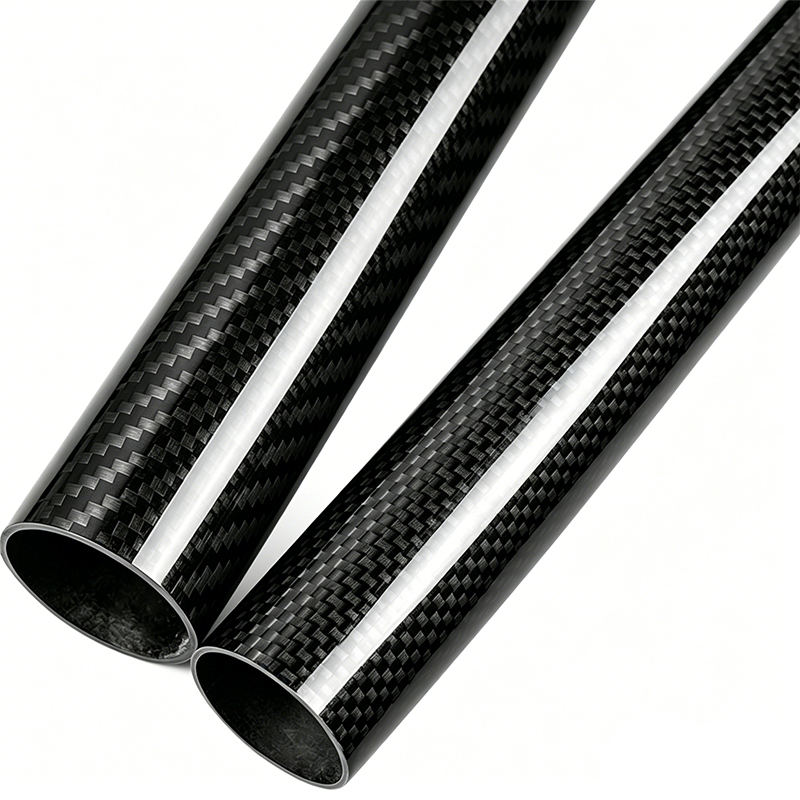
The Pursuit of Dimensional Stability
Precision instruments and measuring equipment operate on a fundamental principle: the accuracy of the measurement is directly dependent on the structural stability of the device itself. Any deformation, however minute, introduced by thermal expansion, mechanical load, or vibration, translates directly into measurement error. For decades, materials like steel, aluminum, and invar have been the standards. However, the limitations of these metals—weight, thermal sensitivity, or both—have pushed engineers to seek alternatives. Carbon fiber reinforced polymer (CFRP) tubes, specifically those engineered for high rigidity, have emerged as a superior solution, offering a combination of properties that redefine the boundaries of precision.
The Mechanics of Low Deformation
The term "high rigidity" refers to a material's resistance to elastic deformation under load, quantified by its Young's modulus. A standard structural carbon fiber tube boasts a modulus in the range of 150-250 GPa. However, high-rigidity variants, often utilizing intermediate or high-modulus pitch-based fibers, can achieve moduli exceeding 400 GPa. This is two to three times that of standard structural steel (approx. 200 GPa). When applied to a tubular structure, this translates to an exceptionally high flexural and torsional stiffness-to-weight ratio. A high-rigidity carbon fiber tube can maintain its geometric profile under significant bending or twisting forces where a comparable metal tube would deflect measurably. This stiffness is the first line of defense against load-induced error.
Thermal Stability: The Silent Disruptor
For measuring equipment, thermal expansion is often a more insidious source of error than mechanical load. A coordinate measuring machine (CMM) or optical bench operating in a temperature-controlled environment still experiences small thermal gradients. Here, carbon fiber offers a decisive advantage. The coefficient of thermal expansion (CTE) of a carbon fiber composite is not a single value but is tunable. By carefully controlling fiber orientation and the layup process, manufacturers can achieve a near-zero CTE along the tube's longitudinal axis. While standard metals expand linearly with heat, a high-rigidity carbon fiber tube can be engineered to have a CTE of +/- 0.5 ppm/°C, or even a negative CTE in specific directions. This means that as temperature fluctuates within a controlled lab, the critical length of a high-rigidity carbon fiber tube remains virtually constant, eliminating thermal drift as a source of measurement uncertainty.
Vibration Damping and Dynamic Performance
Precision is not only about static position; it also concerns dynamic behavior. When a measurement is taken, the structure must settle quickly without oscillating. Metals, with their high density and elastic properties, tend to ring or vibrate at their natural frequencies for extended periods. Carbon fiber composites exhibit exceptional vibration damping characteristics. The anisotropic nature of the material, combined with the viscoelastic properties of the polymer matrix, dissipates vibrational energy efficiently. A high-rigidity carbon fiber tube will absorb impacts and return to equilibrium faster than a comparable steel or aluminum tube. This "quietness" is invaluable for applications such as high-speed optical scanning, where micro-vibrations can blur images or distort interferometric readings.
Application in Precision Instrumentation
The unique properties of high-rigidity carbon fiber tubes enable a new class of equipment. In the construction of optical benches and metrology frames, these tubes provide a stable, lightweight skeleton that supports heavy optics without sagging. In high-performance coordinate measuring machines, they are used for the moving Z-axis quills and arms, reducing inertial mass while increasing measuring speed and accuracy. This weight reduction is also critical for portable measurement arms, where operator fatigue is a real concern. Furthermore, their use extends to aerospace tooling fixtures and specialized scientific instruments like particle accelerators, where both structural stiffness and dimensional stability under vacuum or temperature cycling are paramount. The ability to manufacture these tubes in long, continuous lengths also simplifies the construction of large-scale measurement systems where single-piece construction is preferable to segmented assemblies.
A Superior Alternative
While no material is without its challenges, such as relatively high cost and susceptibility to UV degradation if unpainted, the performance advantages of high-rigidity carbon fiber tubes are clear. They offer a unique triad of properties—extreme stiffness, near-zero thermal expansion, and excellent vibration damping—that are not concurrently achievable in any metallic counterpart. For engineers designing the next generation of precision measurement systems, the choice is no longer a compromise. It is the deliberate selection of a material that promises a structure so stable that it effectively disappears from the measurement equation, leaving only the pure signal of the phenomenon being measured. This is the definitive answer to the problem of low-deformation characteristics in high-precision tools.